The Reputation: September is the Market’s Worst Month
The data is not kind to September. It has the weakest average return of any month for U.S. stocks going back to 1950. Narrow the window and the picture holds: Since 1964, the index has averaged a roughly 0.7% decline in September and ended the month higher only 46% of the time, making it the only month where losses have historically been more common than gains. Volatility also tends to rise, with September’s worst-ever performance approaching a 12% decline and price swings typically running above average.
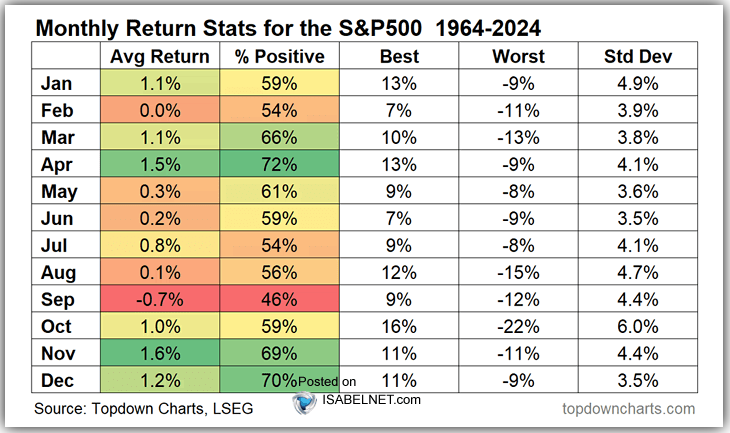
Source: Topdown Charts, LSEG
In plain English: on average, September has quietly taken money off the table more often than any other month. And 2026 started on script, the S&P fell about 0.7% on the first trading day of September, its worst day in roughly two weeks, as fresh U.S. strikes on Iran lifted oil.
The Catch: The Best Septembers Ever Were All Midterm Years
Here is the twist. 2026 is a midterm election year (U.S. midterms fall in November), and history says that matters.
All four of the strongest Septembers on record, 2010, 1954, 1998 and 1950 happened in midterm years (Carson Investment Research, FactSet). The table below shows the ten best Septembers ever; midterm years dominate the top.
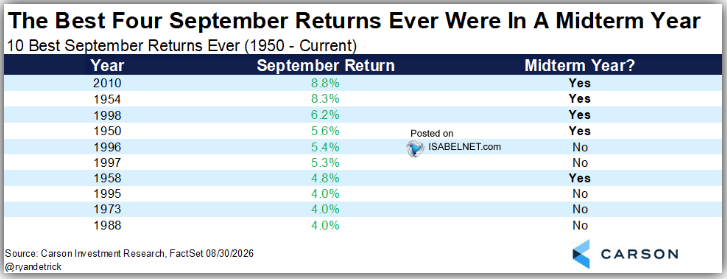
Source: Carson Research, Factset
Two more data points lean the same way. Under President Trump, the S&P has closed higher in September in four of the last five years, averaging about +0.7% (Carson). And August, usually a sluggish month in midterm years was already up around 3% this year, a hint that 2026 is not following the tired seasonal script.

Source: Carson Research
The Risk The Bulls May Be Ignoring: Euphoria
There is a catch to the catch. The “Euphoriameter”, a single gauge that blends how expensive stocks are (forward price-to-earnings), how calm the market is (the VIX “fear index”) and how bullish investors feel, is sitting deep in euphoria territory (Topdown Charts).
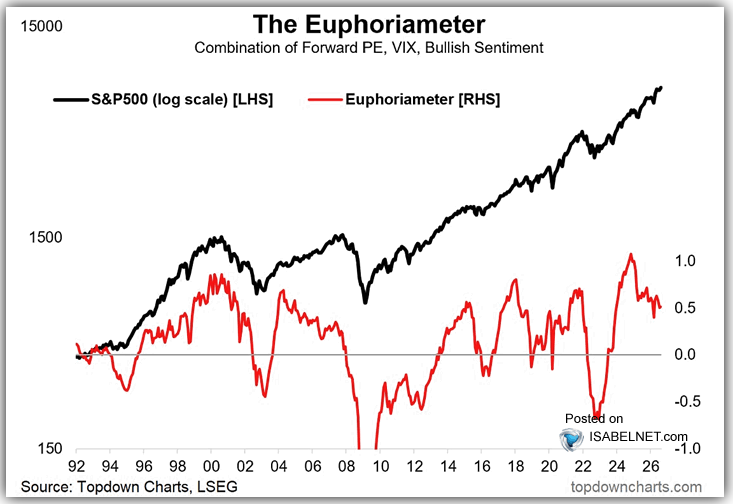
Source: TopDown Charts
When almost everyone is already bullish and paying up for stocks, there are fewer new buyers left, and today’s optimists can flip into tomorrow’s sellers on the first bad headline.
And 2026 has no shortage of bad-headline risk: a hawkish Fed under Kevin Warsh, with September rate-hike odds now around 57–58% ahead of the September 15–16 decision, plus the Iran conflict pushing oil higher.
The index sits near 7,631, roughly 2–3% below its August record around 7,817, up about 19% over the past year on strong earnings
Bull / Base / Bear into the September 15–16 FOMC
| Case | Trigger | Likely Path |
|---|---|---|
| Bull | Fed holds or cools the hike talk; midterm-year seasonality kicks in; earnings hold | Melt-up back toward the ~7,817 record and beyond; a green September like 2010 or 1998 |
| Base | Headline-driven chop into the FOMC; sentiment cools without breaking | Grind around 7,500–7,700; a small monthly move either way as the market waits |
| Bear | Warsh hikes or stays hawkish; oil spikes on Iran; euphoria unwinds | The “next bad headline” hits an over-owned market — a typical few-percent September dip, tail risk toward the –5% to –12% zone |
For Traders
The euphoria reading is the tell. The unprofitable cohort tends to be fully long into stretched sentiment right before a known event, buying record-high optimism and holding maximum size into September 15–16. MarketFramework “Positioning Edge” data usually shows this crowding at exactly the wrong moment.
In a month that is a coin-flip by the numbers, up just 46% of the time, position sizing and a defined stop beat a one-way conviction bet.


