
Most of the attention this week has been on what rising yields are doing to the stock market. But the more interesting story for futures traders sits in the bonds themselves. The 30-year Treasury bond future (ZB) and the 10-year note future (ZN), which fall in price when yields rise are under heavy pressure as September begins.
The 30-year yield sat at 5.27% on Tuesday and has now closed above 5% on 55 days this year, the most since 2006. In plain terms, this is the worst stretch for long-dated bonds in almost two decades.
Two Different Selloffs at Once
It's tempting to file this under a simple “yields are going up” story, but there are really two selloffs happening side by side, driven by different things.
At the short end, the 2-year yield (around 4.36%) is rising because traders now expect the Fed to raise rates rather than cut them, the odds of a September hike have climbed to about 65% after Chair Kevin Warsh's hawkish Jackson Hole speech. This part of the move is about interest-rate policy.
At the long end, the 30-year is climbing for a different reason: sticky inflation from higher oil, plus the sheer size of government borrowing and the wave of new bonds being sold this month.
Investors are demanding extra compensation to hold long-dated debt. That is a fiscal and inflation story, not just a Fed story and it's the thread that runs back to the bond market's summer selloff.
A Global Squeeze, Not Just a US One
The pressure isn't only American. Japan's 10-year yield pushed above 3% for the first time since 1996, Germany's climbed to a 2011 high, and UK gilts hit levels last seen in 2008.
When the world's biggest bond markets all sell off together, it usually means investors are worried about inflation and government debt everywhere at once, not simply shifting money from one country to another.
For U.S. bond futures, that removes one of the usual safety nets: there's no obvious “safe” government bond to rotate into.
Key Numbers
| Yield/Level | Reading |
|---|---|
| 2-Year Yield | 4.36%, driven by Fed-hike bets |
| 10-year yield (ZN) | 4.79%, highest since January 2025 |
| 30-year yield (ZB) | 5.27%, worst run since 2006 |
| Curve (10s/30s) | 48 bp and steepening |
| Sept hike odds | 65% |
| FOMC decision | September 15-16 |
| September supply | Heavy corporate + Treasury issuance |
Is the Curve the Trade?
For bond-futures traders, the cleaner opportunity right now may be the shape of the curve rather than a straight bet on direction. Because the long end (ZB) is selling off faster than the shorter end (ZN), the gap between the two is widening, what traders call a “bear steepener.”
This is where the NOB spread comes in, short for “Notes over Bonds.” It pairs the 10-year note future against the 30-year bond future, so you're positioned on whether the curve steepens or flattens rather than on whether yields simply rise or fall.
When the two ends are moving for different reasons, that kind of relative trade can carry less headline risk than a naked long or short in a single contract.
Potential Scenarios for ZB
US 30Y Treasury Yields, Four-Hour Chart, September 1, 2026
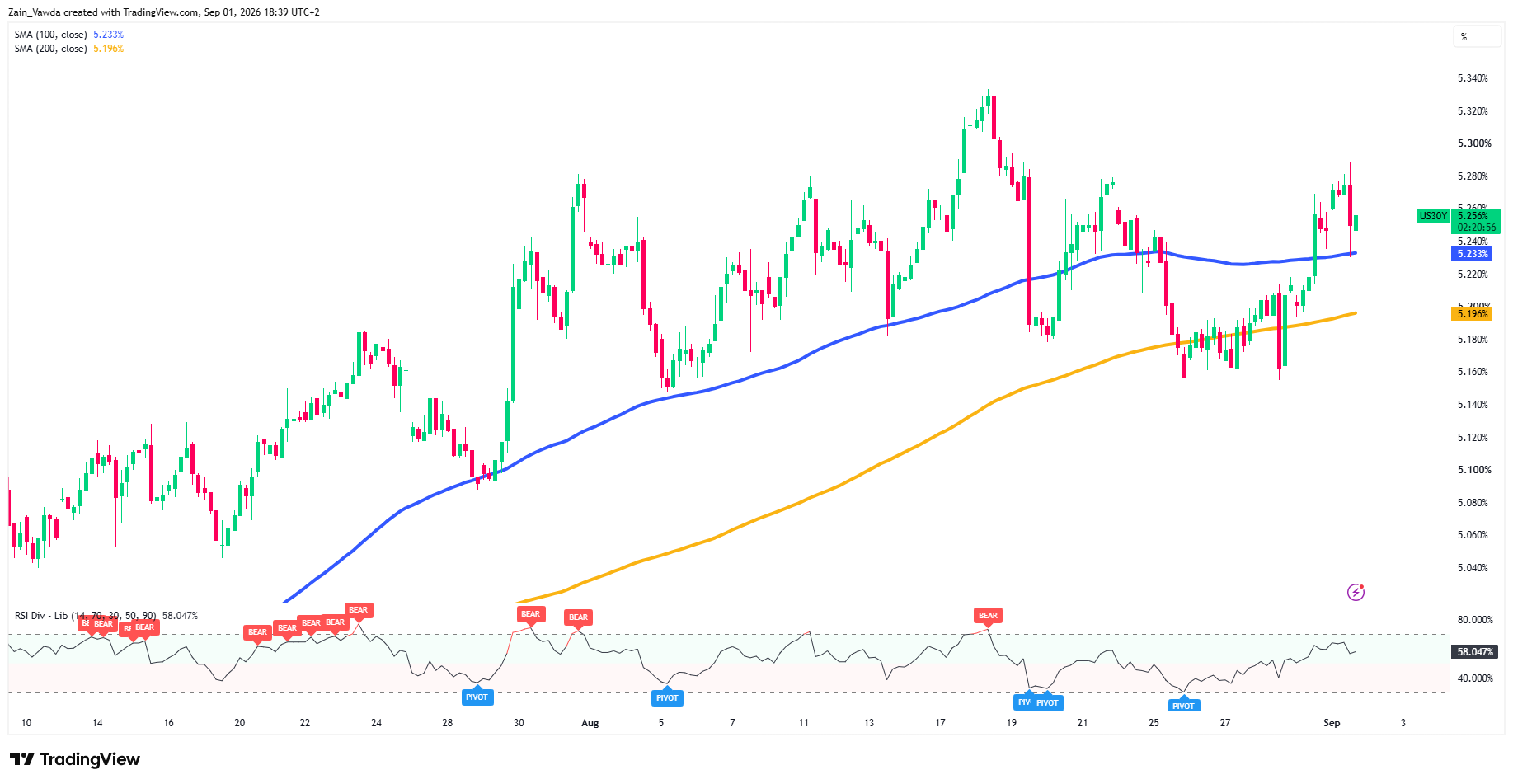
Source: TradingView
The near-term direction hinges on this week's jobs data (ADP Wednesday, payrolls Friday) and the Fed on September 15–16. Here's how the 30-year contract could trade:
Bearish (for bond prices): Strong jobs data or another leg higher in oil keeps both inflation and hike bets alive, pushing the 30-year yield further above 5% and ZB to fresh lows. That's the path of least resistance while momentum stays this negative.
Base case: Yields consolidate near multi-decade highs as traders wait for payrolls and the Fed. ZB chops in a range and the steepening trade, rather than outright direction, does the work.
Bullish (for bond prices): A soft payrolls number cools hike expectations, letting the front end rally and handing ZB a relief bounce, though the long end's fiscal and supply worries would likely cap how far that bounce can run.


