The Dow Jones Industrial Average’s (DJIA) march to record highs while the S&P 500 and Nasdaq lag raises an important question for investors: Is market leadership broadening beyond AI-driven technology stocks, or is the divergence an early sign that enthusiasm for the sector powering the bull market is beginning to fade? The answer could shape the next phase of Wall Street's rally.
Tuesday, the divergence was starker as the Nasdaq 100 Index (NDX) fell more than 1.50%, weighed down by multiple catalysts that include Samsung’s second-quarter preliminary results, and the competition posed by China’s DeepSeek to U.S. tech giants. Meanwhile, the Dow was down by a far less 0.32%.
Techs are Already Inside the Dow
The Dow is a price-weighted measure of 30 U.S. companies covering all industries, except for transportation and utilities. Before going further, the "Dow vs. Tech" framing needs a caveat: The Dow isn't tech-free. Of the mega-cap tech names driving so much of the bull market's returns, Microsoft, Apple, Amazon, Alphabet and Nvidia can be found in the blue-chip average. Outside of the Magnificent Seven names, IBM, Salesforce and Cisco Systems round up the tech names featured in the index. Together, they make up only about 23.61% of the Dow’s weighting.
So this isn't old-economy industrials outrunning Silicon Valley. It's something narrower.
Part of the apparent divergence is mechanical, not sentimental. The fact that the Dow is weighted by price rather than market cap limits the Magnificent Seven's contributions on the way up, but then it also helps limit any damage on their way down. When high-flying, high-cap chip stocks swing hard, the Nasdaq-100, where size (market-cap) determines influence, feels it directly. The Dow, structurally, is cushioned from the same swing even when it holds some of the same names.
Volatility Takes the Edge Off Tech's Rally
That artificial intelligence (AI)-linked tech names, mainly semiconductor stocks, fueled much of the market upside is an undeniable fact. But the upside hasn’t been linear. Steep climb has been interspersed by occasional pullbacks, applying brakes on the rally’s momentum. Four distinct episodes stand out over the past five weeks, namely:
- Chip-led rout in early June
- a slump that spread to Samsung and SK Hynix in Asia in early July
- A second straight down day for semiconductors even as the Dow notched a record on a weak jobs report
- Tuesday's overnight reversal as memory stocks fell alongside Samsung's earnings-day stock decline
Each wobble has been sharp and each has been contained too, which argues against a broad "AI trade is over" rhetoric and toward something more specific to chip-cycle jitters and positioning.
Breadth is Improving and Not Collapsing
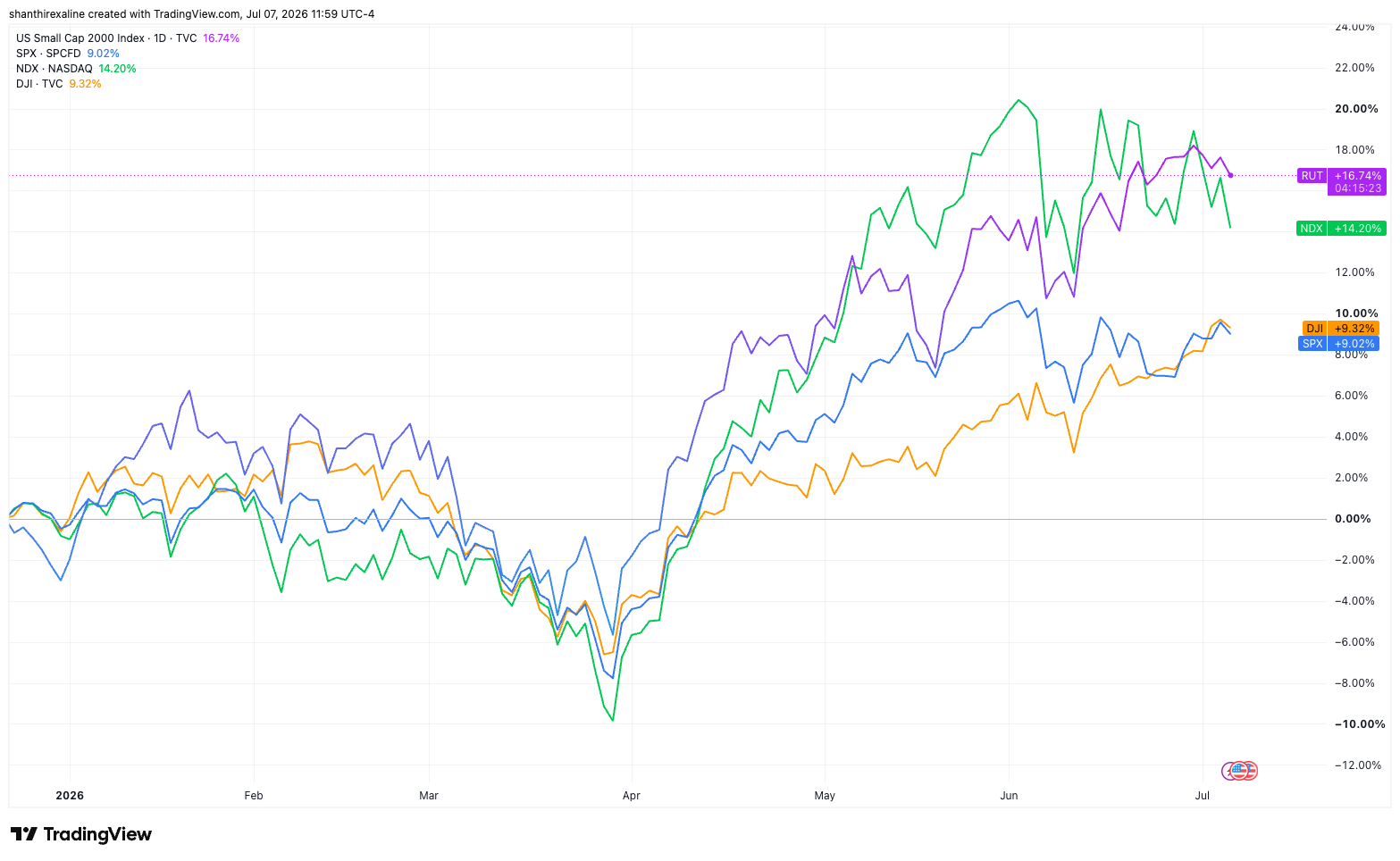
If the loss of confidence is across the board, small caps, which are the most economically sensitive, and least AI-exposed, may have tanked. Instead, small-caps just had their best first-half since 1991, suggesting the breadth is widening and providing solid evidence for the premise that money isn’t leaving equities but leaving the most crowded trades. This, therefore, suggests a healthy rotation.
Small-Caps Outperform
Source: TradingView
The valuation gap underscores the rotation story. The Dow's biggest sector weighting, financials at 27.2% of the index, trades at a forward P/E of just 11.83, a discount to the S&P 500's roughly 18-20x multiple. On the other hand, the AI-infrastructure names driving the Nasdaq-100 carry far richer valuations. Record highs, in other words, are coming from the cheap end of the market, not the expensive one.
Check out MarketFramework's Trade Validator tool for insights into how futures traders are positioned on key index futures.
What Resolves the Question?
The next few weeks will likely settle which read is correct. Critical second-quarter earnings reports arrive in July from several Dow components, including Goldman Sachs, JPMorgan, Microsoft, and Caterpillar, and a collective beat would validate the bull case, while a miss at current valuations would trigger multiple compression.
Samsung's detailed memory-chip results later this month should offer fresh insight into the AI trade. Until then, the Dow-Nasdaq divergence remains a debate rather than a conclusion, and company earnings will matter more than index moves.


