
U.S. stocks are holding close to record highs, but the rally is facing an increasingly important test from two corners of the market that have yet to fully confirm the bullish message coming from the S&P 500: the Treasury market and semiconductor stocks.
The S&P 500 has remained resilient even as long-term Treasury yields have climbed. The 10-year yield topped 4.7% intraday on Tuesday,, while oil prices have also moved higher amid continued uncertainty around the Middle East. Investors are now turning to Wednesday's July consumer price inflation (CPI) report for clues about whether inflation will force the Federal Reserve to keep rates higher for longer.
For Matt Maley, chief market strategist at Miller Tabak + Co., that combination deserves more attention than the record level of the S&P 500 itself.
Maley: Inflation May Be Taking Priority Over Jobs
Maley argues that the market may be underestimating the inflation risk facing the Fed
In his view, the recent Fed rhetoric has increasingly emphasized the fact that inflation has remained above target for too long. If inflation fails to move convincingly toward 2%, he believes policymakers could be more willing to tolerate weakness in the labor market rather than ease policy aggressively.
That creates a difficult backdrop for equities.
The concern is not simply whether the Fed actually raises rates. Rather, it is whether investors have become too comfortable assuming that monetary policy will eventually become more supportive.
The bond market appears to be raising a similar question. With the 10-year yield near 4.7%, investors are demanding a relatively high return from longer-dated Treasuries even as stocks trade close to record levels.
Maley's warning is therefore less about predicting an immediate market collapse and more about questioning whether equities are adequately priced for the possibility that inflation remains stubborn.
The Bond Market Is Refusing to Give Stocks a Free Pass
The divergence between stocks and bonds becomes particularly important ahead of CPI.
Over the past month, the 30-year Treasury yield has risen about 13 basis points, while U.S. equities have gained roughly 3%, according to BTIG's Jonathan Krinsky. His argument is that this leaves equities more exposed to a hotter-than-expected inflation reading because stocks have not fully reflected the risks already being priced into bonds.
A hotter CPI could therefore create an asymmetric reaction: Treasury yields may have already absorbed some inflation risk, while stocks could have further to fall if investors suddenly reassess the path for Fed policy.
That is precisely the kind of setup Maley is concerned about.
The opposite outcome is also possible. A benign CPI report could allow yields to retreat and give equities another leg higher. But the market's reaction in the bond market may ultimately be more important than the CPI headline itself.
Chip Stocks Are Sending Another Warning
The second concern is coming from semiconductors.
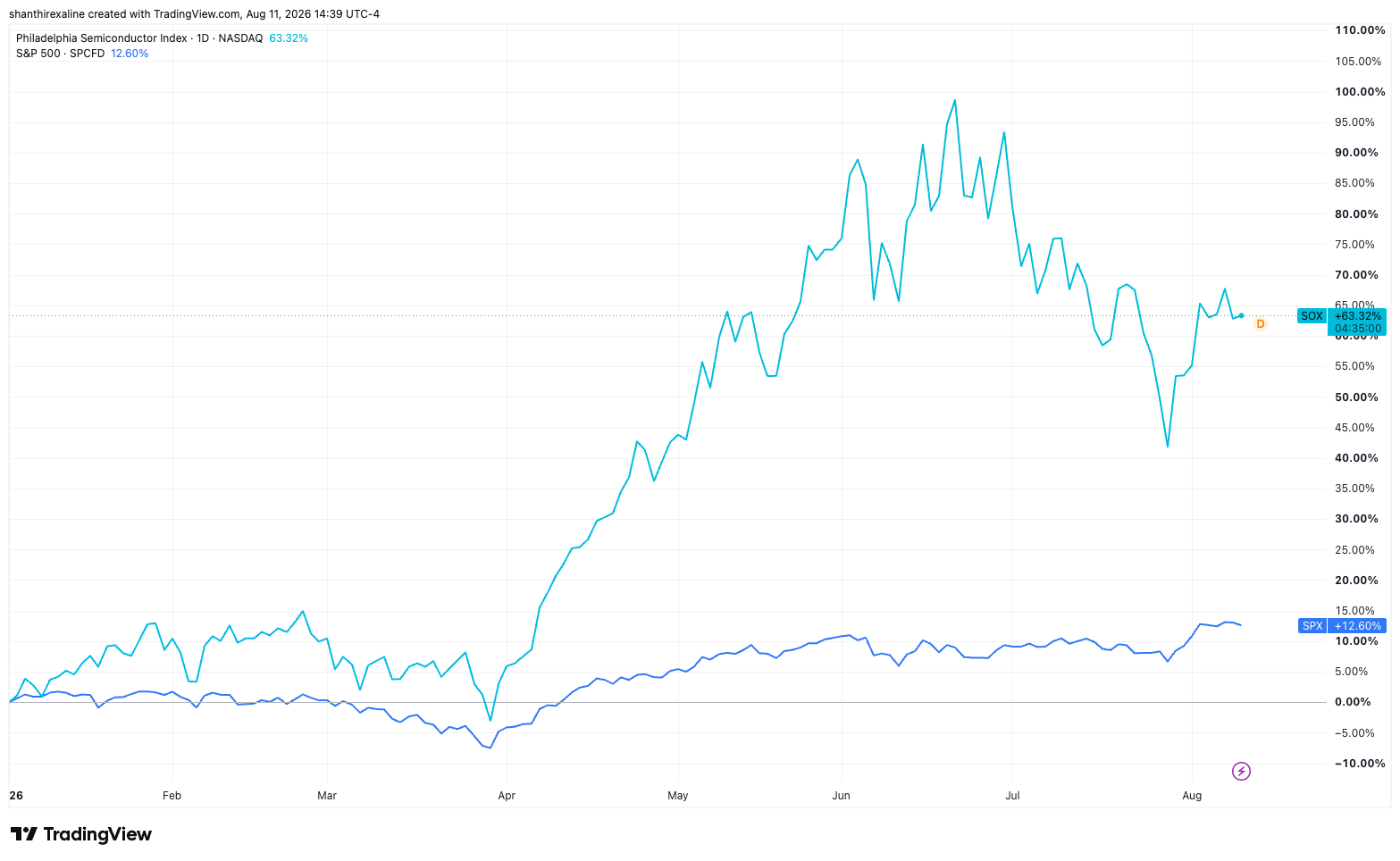
Maley points to the semiconductor sector as one of the biggest warning signs beneath the S&P 500's record-setting performance. While the broad index has recovered and pushed toward new highs, the SOX semiconductor index has failed to fully retrace its July decline.
Semis Trading Way off Late-June Highs
Source: TradingView
That divergence matters because chips have been among the most important leadership groups behind the technology and artificial intelligence (AI) driven rally. If the S&P reaches new highs without semiconductor stocks confirming the move, the rally may be less broadly supported than the headline index suggests.
Maley is particularly concerned by the market's reaction to recent chip earnings. Even when companies have delivered strong results and guidance, many semiconductor stocks have fallen afterward.
That “sell the news” behavior is important.
It suggests that the market may have moved beyond simply rewarding strong earnings. Expectations may now be so elevated that companies need to deliver results substantially above already-high expectations to generate further upside.
In other words, the problem may not be weak earnings. It may be that too much good news is already priced in.
Nvidia Is the Next Major Test
That makes Nvidia's upcoming earnings report particularly important.
Nvidia is scheduled to report on August 26, and the results will provide another major test of whether semiconductor leadership can return to the market. The company is not simply another technology stock; its earnings have become one of the clearest gauges of the strength of the AI investment cycle.
A strong earnings report could help repair the technical damage in the chip sector.
But Maley's argument raises a more difficult question: What happens if Nvidia delivers another blockbuster quarter and the stock still fails to rally?
That would suggest investors are increasingly focused on valuation, expectations and the sustainability of future growth rather than simply on whether AI demand remains strong.
For a market trading near record highs, that distinction could become crucial.
The Dollar Is Another Piece of the Puzzle
The muted reaction in the U.S. dollar to the jobs data also fits into this broader uncertainty.
Maley notes that the dollar has experienced several declines over the past year, but previous selloffs have ultimately proved to be false starts. That may explain why investors have been reluctant to make a larger bearish dollar bet without additional evidence.
CPI and PPI could provide that evidence.
If inflation remains sticky, the prospect of higher U.S. rates could support the dollar and Treasury yields. If inflation cools materially, both yields and the dollar could come under pressure as investors revive expectations for easier monetary policy.
The reaction across all three markets—dollar, bonds and equities—may therefore tell investors more than any single data point.
A Record High Doesn't Mean the Market Is Risk-Free
Maley is not calling for an end to the bull market. His argument is more measured: the upside may be considerably smaller than the consensus assumes, while downside risks are being underappreciated.
He highlights several reasons for caution: elevated valuations, high long-term interest rates, weak semiconductor leadership and an unsettled geopolitical environment.
The seasonal backdrop doesn't help either.
Maley expects volatility to increase from roughly mid-August through October, traditionally a more difficult period for equities. His biggest concern is not necessarily a crash but investor complacency.
That distinction is important.
A market can remain bullish while becoming increasingly vulnerable to a sharp correction.
The Market Is Waiting for Confirmation
For now, the S&P 500 continues to tell investors that the bull market is intact. But the bond market is demanding higher yields, semiconductor stocks are struggling to reclaim leadership, and inflation remains an unresolved threat.
Wednesday's CPI report is therefore more than another economic release. It is the next test of whether the stock market's optimism can withstand the message coming from bonds.
A softer inflation reading could reinforce the bullish narrative and allow stocks to push higher. But a hotter number could expose just how little room there is for disappointment when valuations are elevated and long-term yields are already high.
And then comes Nvidia.
If the semiconductor giant can deliver another exceptional quarter and reignite chip leadership, the S&P 500's record highs will look considerably healthier.
If it cannot, Maley's warning may become harder for investors to dismiss: the market may be making new highs, but some of its most important internal signals are not confirming the move.
The issue, then, is not whether stocks can go higher. They clearly can.
The more important question is whether the bond market and market leadership will eventually catch up—or whether equities will have to catch down.


