
Last Friday, the Bureau of Labor Statistics (BLS) dropped a number that should have hit the dollar hard. Non-farm payrolls fell by 23,000 in July, versus expectations for an 85,000 gain. May and June figures were also revised down by a combined 103,000 jobs, dragging the trailing 12-month average pace of hiring down toward roughly 34,000 a month, a level that reframes the entire labor-market narrative from "cooling" to "stalling."
By the standard playbook, that's the kind of surprise that sends a currency reeling. Instead, the U.S. Dollar Index (DXY) slipped only about 0.3%–0.6%, settling Friday’s session at 99.60, its softest level since June 16, but nowhere close to a rout. So what kept the floor from falling out?
The Unemployment Rate Told a Different Story
Even as the headline payrolls number cratered, the unemployment rate actually fell, from 4.2% to 4.1%. That's an unusual combination: job losses paired with a lower jobless rate. This happened largely because the labor force participation rate declined, meaning fewer people were actively looking for work rather than more people finding it. It's a genuinely weak signal underneath, but it muddies the "unambiguous recession" read that would normally hammer the dollar outright.
Rate-Hike Odds Fell, But Didn't Collapse
Markets had been pricing roughly 55%–57% odds of a September Fed hike heading into the report. After the data, those odds dropped to around 40%, a meaningful repricing, but still far from a full capitulation to rate cuts. The odds have since improved to 47.9%.
Notably, at the July Federal Open Market Committee (FOMC) meeting, three Fed officials had voted to raise rates, underscoring that a real hawkish bloc still exists inside the committee. That kind of institutional split gives the dollar a floor that a more unified, dovish Fed wouldn't provide.
July's Seasonal Reputation Works in the Dollar's Favor
Jobs data has a well-known tendency to run soft in July, partly due to seasonal adjustment quirks around summer hiring and school-year transitions. Traders factoring in that seasonal bias are less likely to treat one weak July print as proof of a structural break, even with the ugly prior-month revisions attached.
Safe-Haven Flows Are Doing Some Quiet Lifting
The jobs data landed against a backdrop of elevated geopolitical tension, including the ongoing attention on Iran-related diplomacy. Even a currency getting hit by weak domestic data can find support if global risk appetite sours elsewhere. The dollar's safe-haven status doesn't disappear just because the labor market wobbles.
The Yen Side of the Equation Was Already in Motion
A chunk of DXY's recent volatility has less to do with the U.S. economy and more to do with an unusual, coordinated intervention between Japanese and U.S. authorities in the currency markets. The dollar had already been giving back gains against the yen before the jobs report even printed, meaning some of the reaction traders are attributing to payrolls was really a continuation of a move already underway.
The Levels That Matter on the Chart
Heading into the jobs print, DXY was already sitting in a technically fragile spot — trading just above a pivotal support zone after breaking below its July uptrend in the wake of the last FOMC decision. The key levels to watch for are:
- Resistance: 100.15/35 (initial), with the more significant ceiling at 100.64/77 (key) and 101.59 above that
- Support: 99.41/49 (the zone that's now been tested), its 200-day simple moving average (SMA) around 99.18 ~99.17 and 98.68/69 as the next objective if that breaks
- Bearish invalidation: a daily close back above 100.64/77 would undercut the current corrective structure
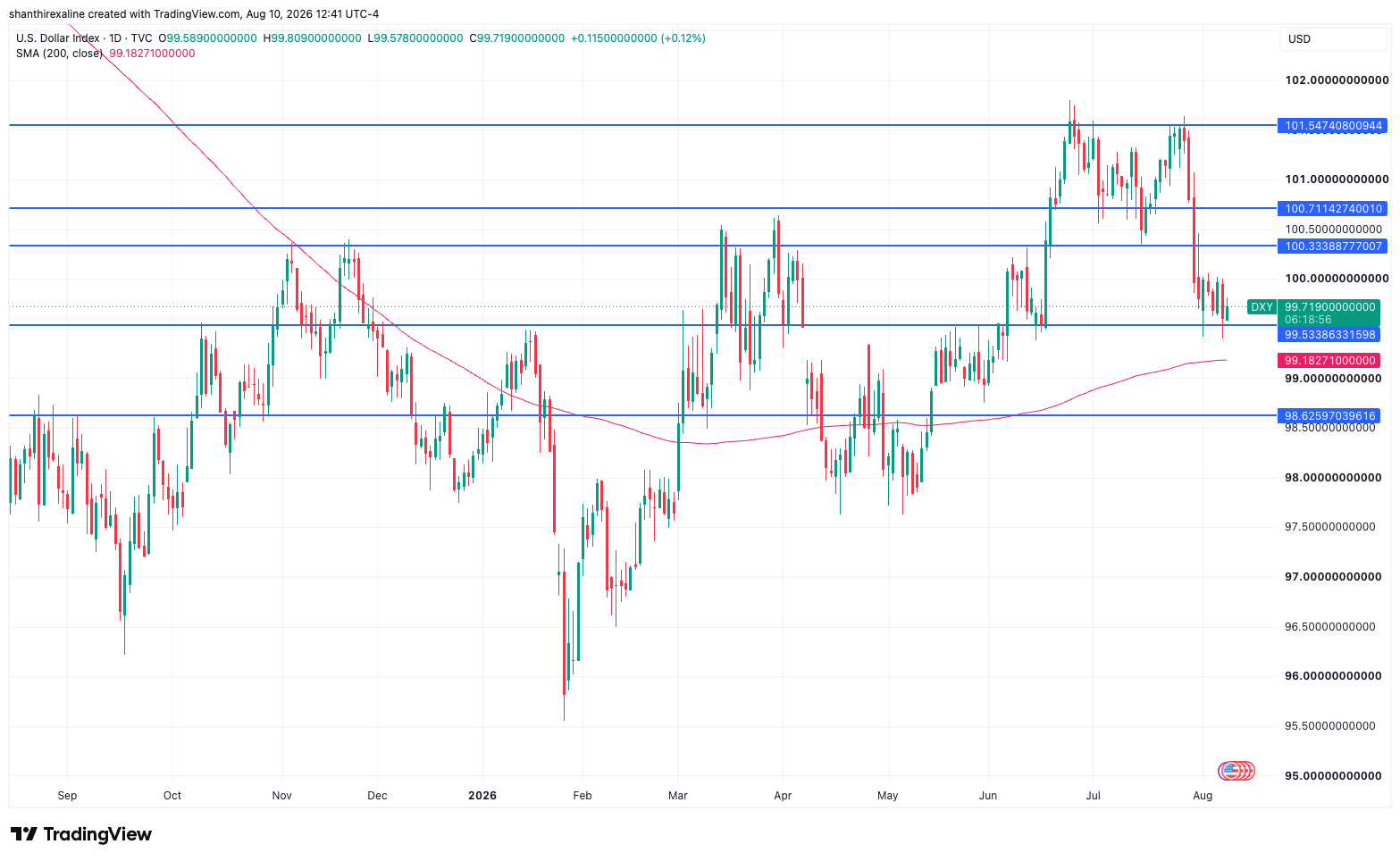
Source: TradingView
Positioning Is Crowded — and That's a Risk in Itself
Speculative futures positioning was stretched long going into the jobs report. CFTC Commitment of Traders data for the week ending August 4 showed leveraged funds turned less bearish on the U.S. dollar, cutting their short position by 6,707 contracts over the week to August 4, while reducing the long exposure by 1,257 contracts. This left them with a modest net-long position of 3,849 contracts, marking a shift in positioning as bearish exposure was unwound.
That matters for two reasons. First, it means a meaningful chunk of the "dollar resilience" story may simply be positioning inertia. Big speculators don't unwind three-and-a-half-year-high longs on one data point, however ugly. Second, it's a crowded-trade risk: the more one-sided that positioning gets, the more vulnerable DXY becomes to a sharp, positioning-driven air pocket if the next data point (inflation) doesn't cooperate. Watch the next COT release (due August 14) for early signs of long unwinding.
For anyone positioning around this, the near-term event risk is concentrated and sequential:
The Catalyst Calendar for the Next Two Weeks
| Date | Release | Why it Matters for DXY |
|---|---|---|
| Aug. 12 (8:30 a.m. ET) | July CPI | A hot print revives hawkish Fed bets and could fuel a snap-back toward 100.15+; a soft one accelerates the break toward 99.17/98.68 |
| Aug. 13 (8:30 a.m. ET) | July PPI | a pipeline-pressure check; a hot PPI print after a soft CPI would complicate the easing narrative |
| Aug. 14 | Weekly COT Report | First real read on whether specs are trimming the crowded long position post-CPI/PPI |
| Ongoing | Iran-related diplomatic headlines | Wildcard safe-haven driver that can move DXY independent of U.S. data |
Cross-Asset Tells Worth Watching
A few correlated markets are giving a real-time read on how much of the "dollar cushion" story the broader market actually believes:
- Gold and silver both rallied sharply on the jobs print, with gold trading north of $4,300/oz and silver spiking over 4% to a six-week high. That's a fairly clean signal that real-money flows are pricing in a softer Fed path even if the DXY hasn't fully caught up yet.
- The 10-year Treasury yield slipping alongside the dollar on Friday is the more conventional confirmation. Rates and DXY typically move together, and that relationship held here.
- USD/JPY is the pair to watch, with intervention-era volatility still fresh. Moves here may say more about G7 currency dynamics than about the U.S. labor market itself.
Bottom Line for Traders
The setup this week is binary and well-defined: DXY is pinned against key chart support (99.17–99.41) with a crowded long positioning base that hasn't meaningfully unwound yet, and two inflation prints in as many days will likely decide which way it breaks. A soft CPI/PPI combo stacked on top of the payrolls miss would give the "September cut" narrative real teeth and likely trigger the positioning unwind that pushes DXY toward 98.68 or lower.
A hot inflation surprise, on the other hand, hands the Fed's hawks their argument back and could fuel a sharp short-covering rally toward 100.15–100.64, precisely because so many traders are already positioned the same way on the long side.


