
The Setup
After the close on Tuesday, August 4, Space Exploration Technologies (NASDAQ: SPCX) reports quarterly results for the first time as a public company, with a live audio-only webcast scheduled for 4:30pm ET.
It is the debut earnings print for the company behind the largest IPO in history – a June 12 listing at $135 per share that implied a valuation near $1.77 trillion. But the number that matters most this week is not on the income statement. It is the share count. This same report starts the clock on an earnings-triggered lock-up structure that begins releasing insider stock from August 6, and the first tranche alone is enormous.
SPCX enters its maiden earnings print under pressure. After skyrocketing to an intraday peak of $225.64 days after listing, the stock has surrendered roughly half its value, falling ~43% from its $211.39 record close and hovering dangerously close to its $104.83–$107.01 low. Short interest has concurrently surged to nearly a third of the public float.
What's Actually in the Numbers
While consensus projects a GAAP net loss around 29 cents per share alongside a $1.2 billion operating drag from Starship and xAI data-center buildouts, long-term valuation will be dictated by execution across key segments:
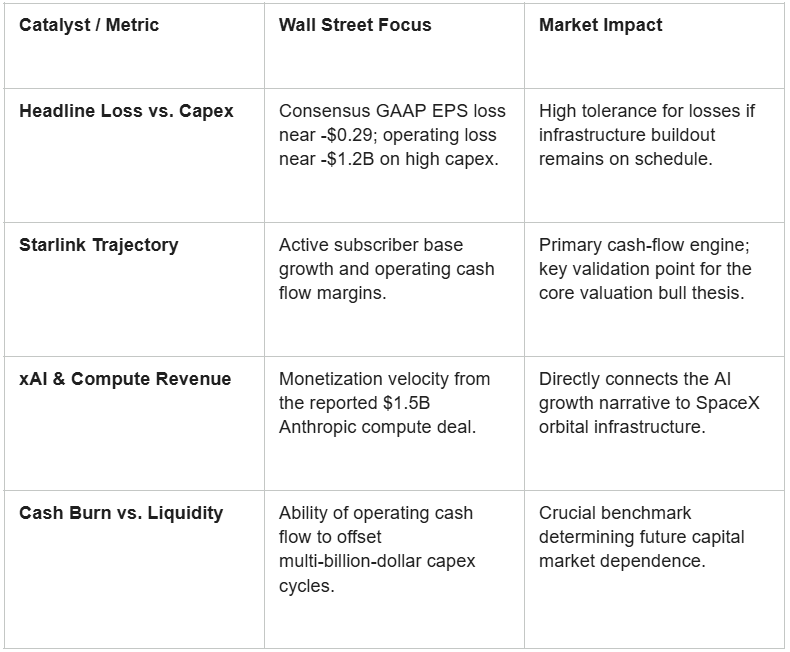
Table Created by Zain Vawda
The options market is pricing in a 14% to 15% post-earnings move in either direction—representing a potential $200B+ swing in market capitalization. With short interest elevated and shares pinned near post-IPO lows, an operational beat could ignite a rapid short squeeze, whereas a guidance miss creates downside momentum directly ahead of the lock-up release.
The Real Story: 911 Million Shares Come Off the Leash
SpaceX did something unusual with its lock-up. Rather than the standard fixed 180-day restriction, it tied the first insider selling window to the release of its first earnings report. That makes Tuesday's print the mechanical trigger for the single largest insider lock-up expiration Wall Street has ever had to absorb.
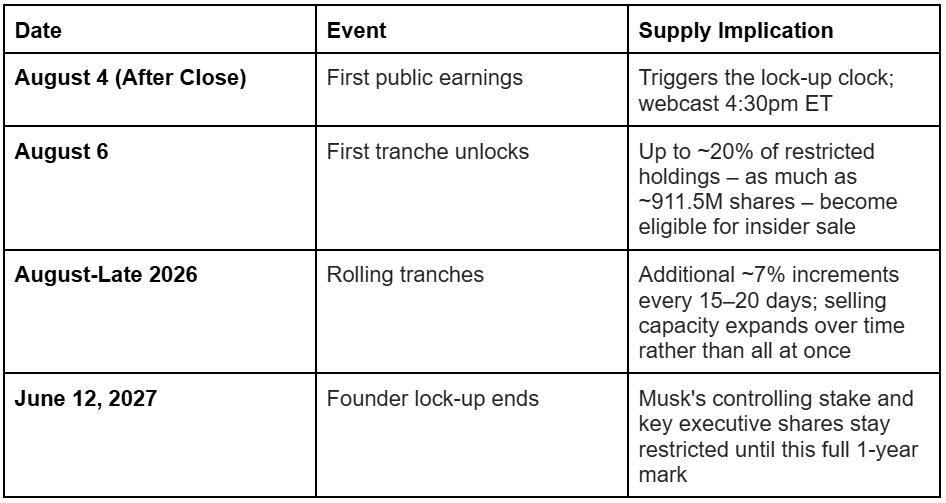
Table Created by Zain Vawda
The key figure: from August 6 – the second full trading day after the report – insiders may sell up to roughly 20% of their restricted holdings, as much as approximately 911.5 million shares. That capacity then expands in rolling tranches through late 2026, while the founder's controlling stake stays locked until June 2027. History shows both outcomes here: a lock-up expiry only moves a stock to the degree that eligible shares are actually sold into available liquidity.
The risk is not that 911 million shares hit the tape at once – they won't – but that the mere eligibility reshapes how buyers price a low-float name that is already thin and already heavily shorted.
Index Dynamics: Navigating the Nasdaq 100 Spillover
SPCX is not merely an isolated single-stock trade; it is an active component of the Nasdaq 100 (NDX). Following a fast-track inclusion rule rule-change executed shortly before the listing, SpaceX joined NDX on July 7—just 15 trading days post-IPO—without displacing an existing member.
Passive index products like QQQ were required to absorb an estimated $4 billion in stock via proportional rebalancing across the index.
Where it does matter is at the intersection of float and passive ownership. The Nasdaq 100 now permanently owns a slice of SPCX through every QQQ and NDX-tracking fund. When the lock-up releases fresh supply into a low-float name that index funds must hold, the stock's volatility can rise even as its index weight stays small – and that volatility becomes a second-order sentiment input for the AI/space complex that QQQ has come to symbolise.
A high-profile new constituent breaking down into its unlock is a poor look for the barometer of the AI bull market, even when the arithmetic drag is negligible.
History offers a caution here too: previous marquee Nasdaq-100 additions have tended to peak around their inclusion dates rather than rally afterward.
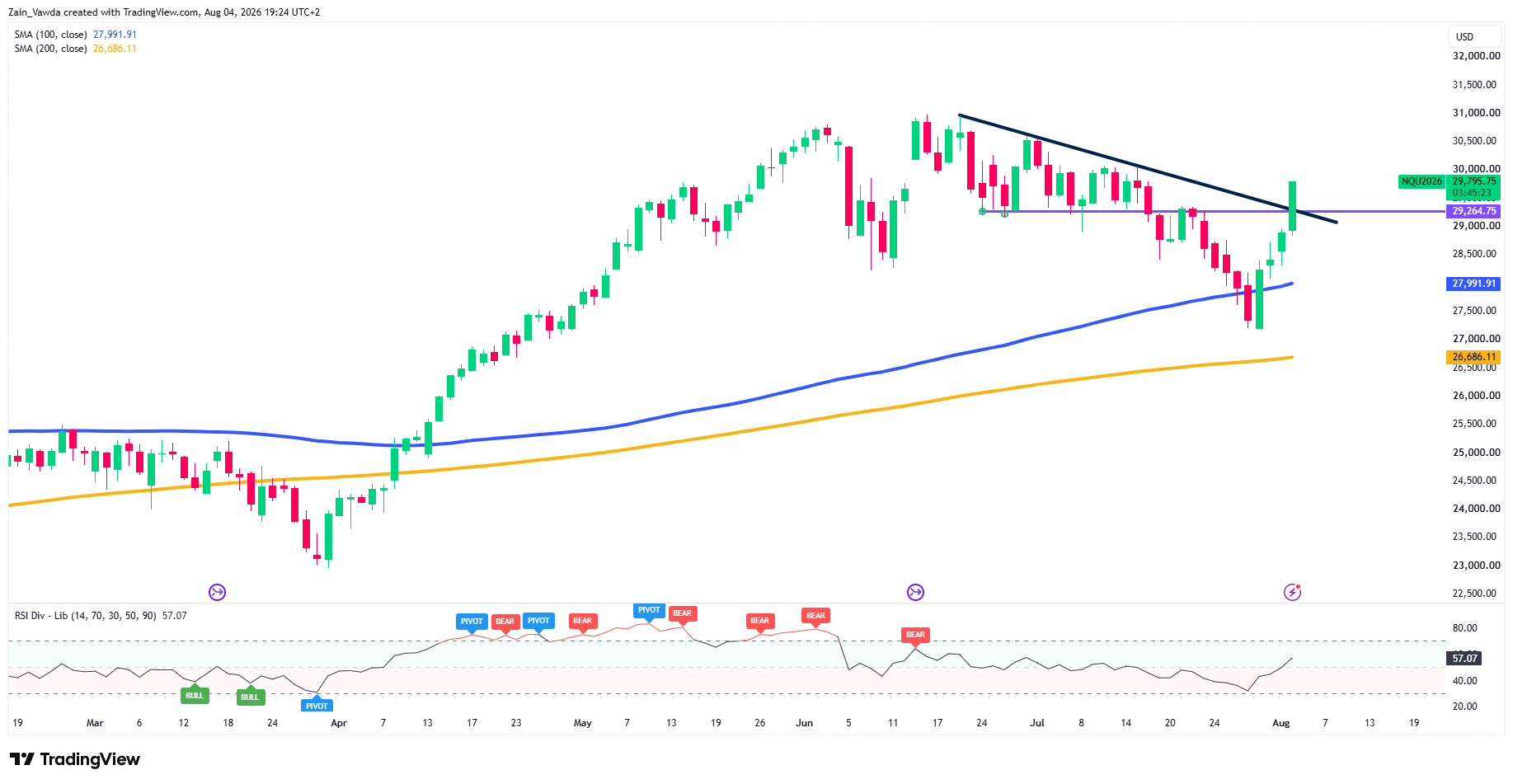
Heading into the earnings release, the Nasdaq is up just over 4% on the week. NQ futures is trading back within touching distance of the psychological 30,000 handle at 29,792.
Nasdaq 100 Daily Chart, August 4, 2026
Source: TradingView
For index and futures traders, SPCX should be monitored as a volatility and sentiment indicator rather than a heavy index-weight mover.
Post-Earnings Index Scenarios
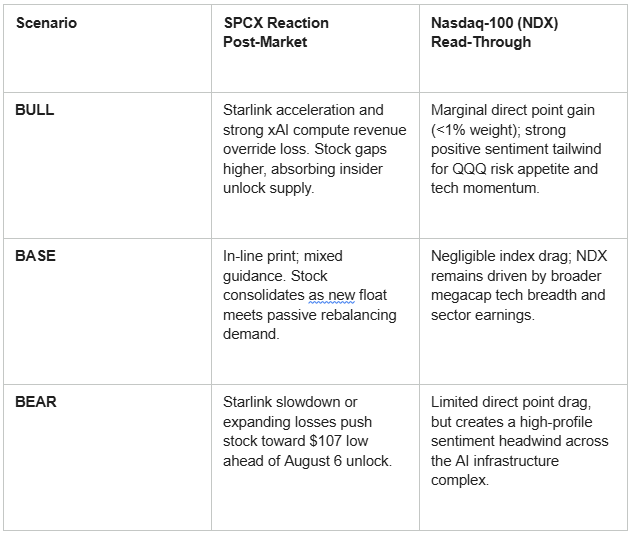
Table Created by Zain Vawda
The lock-up is a scheduled supply overhang the market can see coming; the earnings reaction is not. Trading the index off confirmation – letting the after-hours move and the breadth of the semis complex settle before committing NQ risk – beats front-running a first-ever print with no historical template. Respect the wildcard, size for the volatility, and keep the sub-1% reality in mind before assuming any single rocket can move the whole index.


