U.S. stocks stayed mostly unchanged by Tuesday midday. The S&P 500 edged up just 0.1%, supported mainly by strength in tech stocks, while both the Nasdaq and the Dow Jones remained flat.
Investors are staying cautious as they balance two main factors: small signs of progress in the Middle East against worries over upcoming economic reports that could influence the Federal Reserve's next decision on interest rates.
Geopolitics and Energy Markets
Geopolitical risk premiums continue to dictate sentiment, particularly within the energy complex. Oil prices held steady on Tuesday amid conflicting signals out of the Middle East. Iran has indicated it is closing in on a brokered deal with Oman to reopen the critical Strait of Hormuz.
However, Tehran remains steadfast in its refusal to engage in direct negotiations with Washington until specific conditions are met.
Iranian Foreign Minister Abbas Araghchi stated over the weekend that there is “no possibility of restarting negotiations” as long as the U.S. continues to violate the June memorandum of understanding and fails to provide compensation for those breaches, according to the Tasnim News Agency.
In a sharp pivot that further stymies diplomatic talks, President Donald Trump rejected Tehran’s demands for war reparations and insisted that the United States will instead demand counter-compensation from Iran in any future peace negotiations.
Speaking from the Oval Office and posting on social media, Trump declared that Iran must pay damages for American service members killed or injured by Iranian-backed actions over the past 50 years, as well as compensation for victims of regime crackdowns against domestic protesters and destabilization across the region.
The sweeping new demands follow an impasse in talks to reopen the strategically vital Strait of Hormuz, a waterway Trump claims the U.S. navy controls while signaling a shift toward relying on deepening economic sanctions and financial pressure on Tehran rather than immediate fresh military strikes.
As a result, crude markets remain well-supported. U.S. West Texas Intermediate (WTI) futures ticked marginally higher to trade at $82 a barrel, while the international benchmark Brent crude hovered around $88 a barrel. The stickiness in energy prices threatens to renew price pressure concerns just as the broader economy shows signs of cooling.
The Fed's Dilemma: Data Ahead
Looking ahead, the market's focus will sharply pivot to a crucial batch of inflation metrics, starting with the July Consumer Price Index (CPI) report due on Wednesday, followed by the Producer Price Index (PPI) on Thursday.
These readings carry outsized importance this month. Last Friday’s weak jobs report has already complicated the Federal Reserve’s outlook.
Policymakers now find themselves in a precarious position: elevated oil prices risk stoking inflationary embers, while a sharp slowdown in hiring raises red flags regarding consumer spending and overall economic health.
Dennis Follmer, Chief Investment Officer at Montis Financial, offered a pragmatic view on the upcoming data: "I expect the CPI report to continue its downward trend which will further support the case for the Federal Reserve to hold rates steady rather than hiking them, even with last Friday’s weak jobs report." Follmer noted that while services inflation remains a sticky issue, its lack of sensitivity to interest rates means it shouldn't fundamentally damage the case for keeping rates on hold.
Corporate Movers
- Nvidia (NVDA): The heavyweight champion of the AI rally continues to prop up the broader market. Shares rose approximately 1% in midday action following Monday's announcement that the chipmaker is partnering with six major asset managers to mobilize over $500 billion toward artificial intelligence infrastructure.
- Airbnb (ABNB): The vacation rental giant faced headwinds today following a downgrade at PhillipCapital. Despite a recent earnings beat that initially propelled shares higher, analyst Paul Chew noted that the stock's valuation has become stretched. PhillipCapital raised its price target slightly to $158—implying roughly a 14% downside from Monday’s close—citing that ABNB is now trading at a premium valuation of 30.9x PE, well above its 2-year historical average plus one standard deviation (29.6x). Despite the midday pullback, shares remain up over 36% year-to-date.
What do the Charts Say
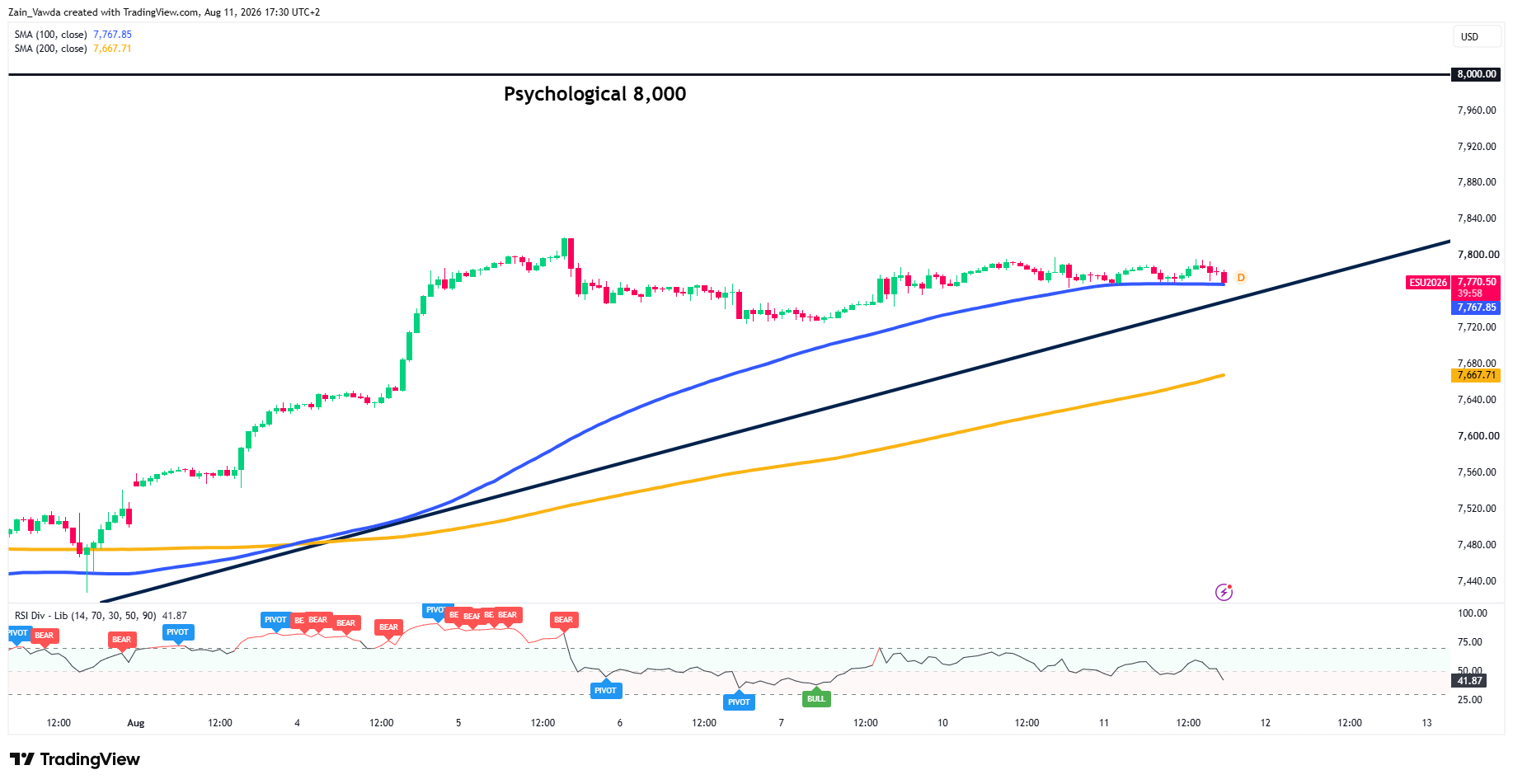
S&P 500 (ES) One-Hour Chart, August 11, 2026
Source: TradingView
The H1 chart for ES shows price consolidating after its strong early-August rally, currently testing a pivotal support zone around 7,770.50.
Price action is hovering directly atop a crucial confluence created by the 100-period MA (7,767.85) and an ascending trendline extending from recent lows.
The RSI sits at 41.87, signaling fading short-term bullish momentum. A decisive hourly close beneath the 100 SMA and trendline support opens the door for a deeper pullback toward the 200-period MA at 7,667.71.
However, if buyers successfully defend this support cluster, upside momentum should resume, targeting recent highs near 7,820 ahead of the psychological 8,000 resistance level.
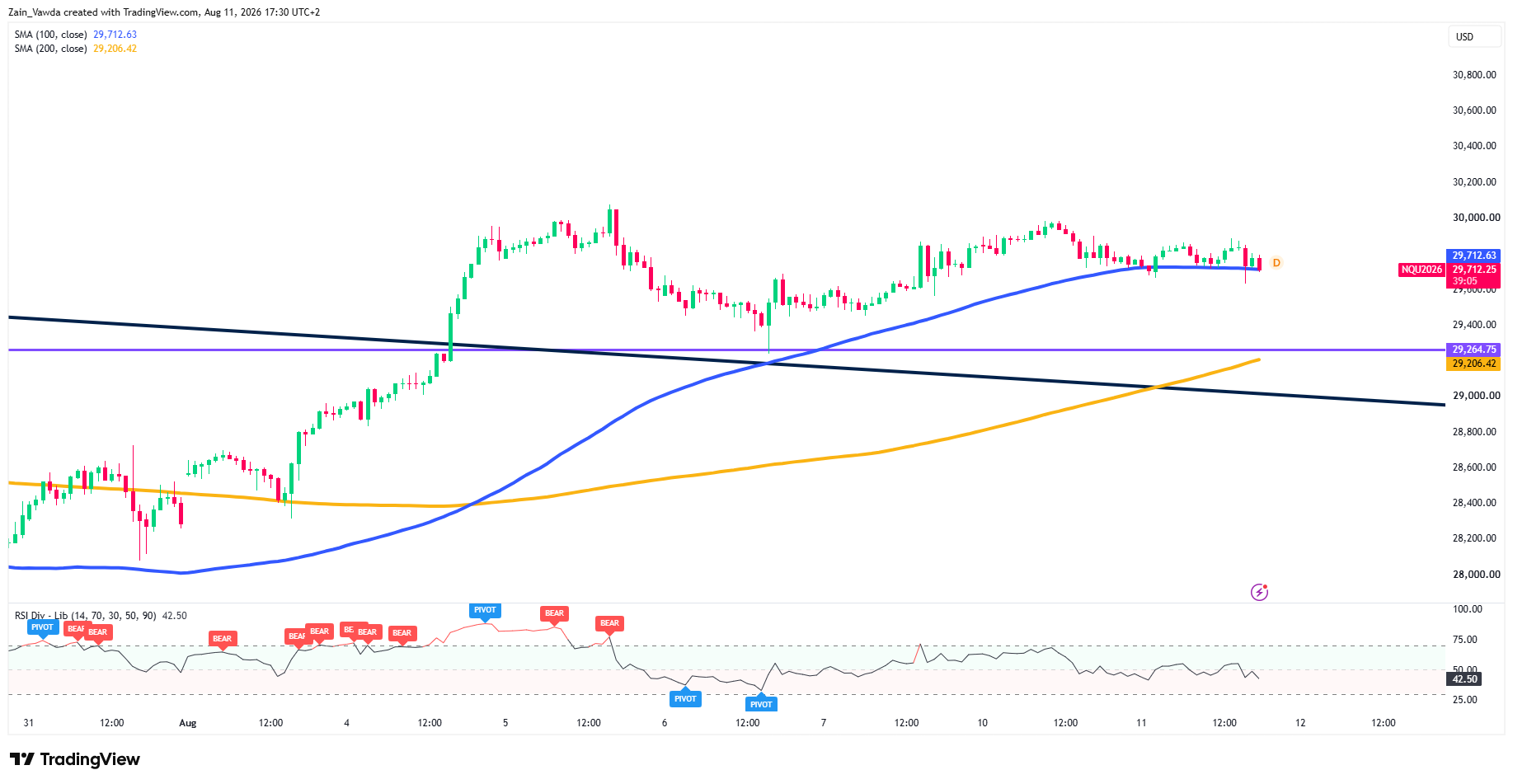
Nasdaq 100 (NQ) One-Hour Chart, August 11, 2026
Source: TradingView
The latest Positioning Edge tool data for NQ indicates an Extreme Bearish Divergence, signaling potential downside pressure for NQ traders. Profitable traders are currently 17% more short than unprofitable traders, with only 39% of profitable accounts holding long positions compared to 56% of unprofitable traders.
Even though the market dropped to 29,669, losing traders are still buying and hoping for a bounce. In contrast, winning traders are heavily betting that prices will fall even more.
This big difference appears to show that the "smart money" expects the market to keep going down, choosing to bet against it rather than try to buy at the bottom.


