On paper, Friday's 10 am release was another clean good-news macro print this week. The University of Michigan's preliminary July consumer sentiment index jumped to 54.4 against a 51.0 consensus — the highest reading since February and a second consecutive monthly gain of roughly 10% off May's record low.
All five index components improved, led by gains of around 20% in buying conditions for durables and year-ahead business conditions, with the improvement broad-based across age, income, wealth and political groups. Year-ahead inflation expectations eased to 4.2% from 4.6%, and the long-run measure, the one the Fed actually anchors policy to, held at 3.3%.
Gold rallied to session highs near $4,028/oz on the release.
Read the Footnote Not Just the Headline
The problem is one sentence buried in the release notes: most survey responses were collected before July 7, before the resumption of U.S. strikes against Iran and the subsequent rise in gasoline prices.
Surveys of Consumers director Joanne Hsu credited the jump to easing price pressures at the pump in recent weeks. That is precisely the variable that has since reversed. Brent is on track to gain more than 10% this week, the U.S. has now completed six consecutive nights of strikes, and pump prices follow crude with a lag measured in days, not months.
The survey measured the ceasefire economy. The market is trading the war economy.
Data Released
| Measure | July Prelim | June Final | May Final |
|---|---|---|---|
| Headline Sentiment | 54.4 (vs 51.0 exp) | 49.5 | 44.8 (record low) |
| 1-Year Inflation Expectations | 4.2% | 4.6% | 4.8% |
| Long-Run Inflation Expectations | 3.3% | 3.3% | 3.9% |
| Survey Window | Most Pre-July 7 | May 19 - June 8 | - |
Why the Gold Pop Is the Suspect Move
Gold's rally toward $4,028 on the print follows the mechanical logic of the past week: softer inflation expectations reduce the case for a Federal Reserve Chair Kevin Warsh hike, compress real-yield pressure, and relieve the metal.
But that chain only holds if the expectations data reflects current conditions — and this release, by its own admission, largely does not.
If the war-era gasoline tape does to August's preliminary reading what the ceasefire did to July's, the entire dovish impulse reverses: one-year expectations snap back toward 4.6% or higher, the hike trade reloads ahead of the September meeting, and gold's transmission problem — war is bullish oil, bullish oil is bullish hike odds, hike odds are bearish gold — reasserts itself from a higher starting point.
The same asterisk applies to the rates market's reaction and to any equity bid built on the consumer-resilience narrative.
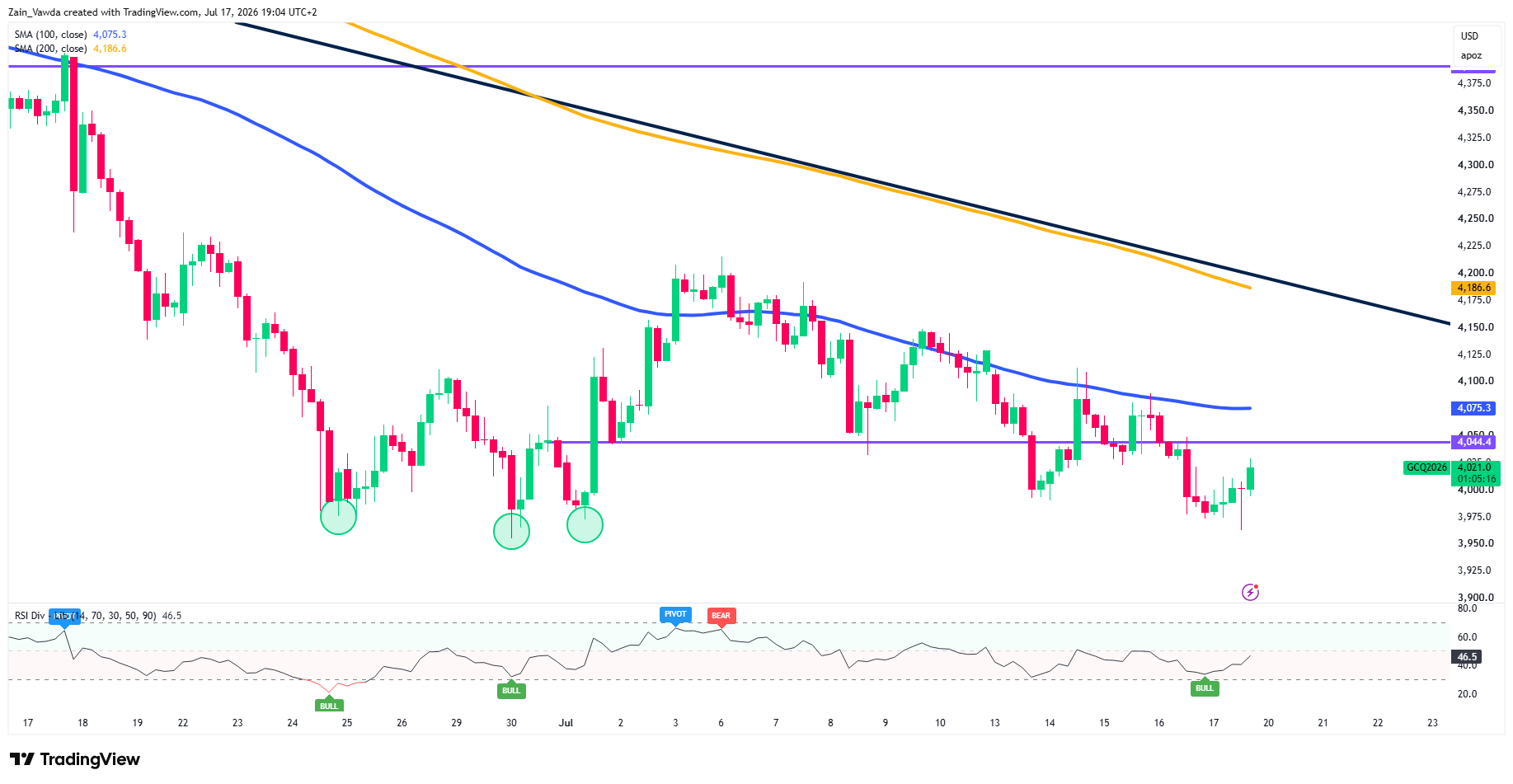
Gold Futures Four-Hour Chart, July 17, 2026
Source: TradingView
Gold futures trade near 4,021, attempting to base after a third defense of the 3,975 support zone.
The latest test printed a fresh bullish RSI divergence, echoing the signals that preceded the late-June and early-July bounces.
The recovery faces immediate resistance at 4,044, with the 100-MA at 4,075 capping every rally attempt since early July.
Above that, the 200-MA (4,186) and the descending trendline from the highs define the broader bearish structure.
Bias: neutral-to-bullish short term while 3,975 holds, targeting 4,044 then 4,075. A four-hour close below 3,975 opens 3,950 and the 3,900 handle.
RSI at 46.5 leaves room either way.
The geopolitical overhand remains strong though and continues to drive the precious metal. With that in mind, keep risk well managed as wild swings continue to be a feature for gold prices.
The Honest Counterargument
Two caveats keep this from being a one-way fade.
First, the long-run measure held at 3.3% — expectations remain anchored on the horizon the Fed weights most, and that series is deliberately less sensitive to pump-price swings.
Second, the improvement's breadth, especially among lower-income consumers most exposed to gasoline, suggests genuine underlying relief that a partial gas retracement would not fully erase.
The head-fake thesis is about the marginal repricing today, not a claim that the consumer recovery is fake.
Retail Trader Positioning
Retail trader data shows a consistent split on data days like this one. Profitable accounts trade the release's second-order question — was the print measured under current conditions?
To keep an eye on retail trader positioning using the positioning edge tool on MarketFramework.


