Wednesday's data pointed to an economy that continues to grow without a corresponding flare-up in price pressures. Under normal circumstances, that combination would have been supportive for silver, which benefits from both improving industrial demand and easing inflation concerns. Instead, the metal fell, suggesting traders remain more focused on rising oil prices and higher Treasury yields than on backward-looking economic data.
Before exploring the conundrum, here’s how Wednesday’s data looked like:
Producer prices fell 0.3% month over month (MoM) in June, confirming the deflationary signal from June’s consumer prices report. Economists had braced for unchanged prices following a 0.6% increase in May.
The annual rate slowed to 5.5% versus the consensus of 6.2% and May’s 6% rate.
Core consumer prices accelerated to a monthly pace of 0.2% from 0.1% but was tamer than the 0.3% consensus.
The year-over-year (YoY) increase in core consumer prices, however, accelerated to 4.7% from 4.6%, but much slower than the 5.2% rate expected by economists.
Energy prices were primarily responsible for the letup in pricing pressure that was seen in June.
Given the net downward revisions to the previous three months’ numbers, Fifth Third Commercial Bank Chief Economist Bill Adams expects the personal consumption expenditure (PCE) inflation will likely be revised too. The economist said the Federal Reserve will likely take the June inflation data as a justification for holding interest rates steady at the upcoming July rate-setting meeting. That said, the energy price rebound in the first half of July tempers optimism, he added.
Separately, the Empire State Manufacturing Survey showed New York's business conditions index jumping 10 points to 15.6 in July, with new orders surging 19 points and shipments hitting a four-year high. Price pressures in the survey eased too, with prices paid falling from 61 to 52.3, and prices received from 31.4 to 27.6.
Put those two reports together and you get the combination every policymaker wants: real activity reaccelerating while inflation pressure fades. It's the textbook case for the Fed to stay patient rather than reach for another hike.
Silver didn't get the memo.
The tell in the metals market
Silver futures for September delivery (SI) fell 1.80% to around $58 an ounce, giving back most of Tuesday's gains. Silver isn't a pure safe-haven asset the way gold is. Roughly half its demand comes from industrial uses, namely electronics, solar, EVs. This means silver should, in theory, respond positively to strong manufacturing data like Wednesday's Empire State print, and negatively to fading inflation risk, since less inflation typically means less urgency for hedging.
Instead, silver is doing something closer to the opposite. This means silver should, in theory, respond positively to strong manufacturing data like Wednesday's Empire State print and also benefit from easing inflation pressures, as lower inflation can reduce expectations for higher interest rates and lower the opportunity cost of holding non-yielding assets.
The Gold-Silver Ratio Tells the Same Story
Another sign of market skepticism comes from the gold-silver ratio—the number of ounces of silver needed to buy one ounce of gold. The ratio has risen from about 55 in May to around 70 today.
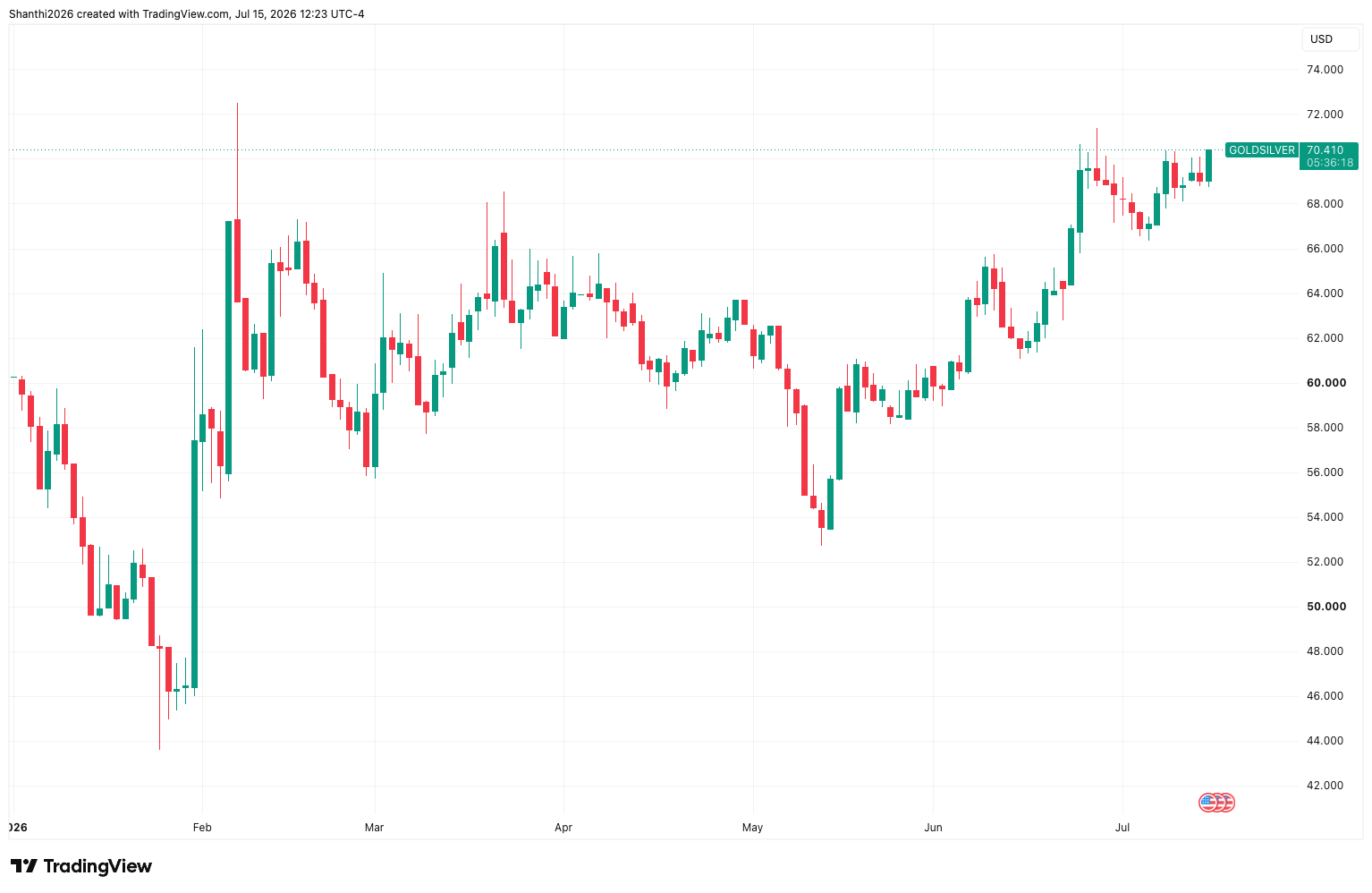
Source: TradingView
A rising ratio means gold is outperforming silver. That typically happens when investors prefer gold's safe-haven qualities over silver's more growth-sensitive and industrial characteristics.
If traders were fully confident that the economy was achieving strong growth with cooling inflation, silver would likely outperform and the ratio would fall. Instead, the higher ratio suggests investors remain cautious and are leaning toward defense rather than growth.
What's Actually Driving Silver
This week's move in precious metals has been driven less by economic data and more by developments in the Middle East. Renewed tensions involving Iran and ongoing concerns about the Strait of Hormuz have kept a geopolitical risk premium in both gold and silver.
As a result, silver's recent price action has been influenced more by headlines from the region than by Wednesday's PPI report or the Empire State Manufacturing Survey.
That helps explain the market disconnect. The economic data pointed to a favorable backdrop of cooling inflation and improving growth—normally a supportive combination for silver. Yet traders remain focused on risks that those reports did not capture, including potential disruptions to energy supplies and their impact on future inflation.
In other words, the market is not rejecting the good news. It is simply assigning greater weight to geopolitical risks and what they could mean for inflation, interest rates, and economic growth in the months ahead.
Why it matters going forward
The next key test for silver is not another inflation report but developments in the Strait of Hormuz.
If tensions ease and the geopolitical risk premium fades, silver could struggle to justify its current price levels based on Wednesday's economic data alone. In that scenario, expectations for industrial demand would need to provide the main support for the metal.
If tensions persist, however, silver may continue to reflect concerns about energy markets, inflation, and broader geopolitical risks rather than the benign picture painted by recent inflation data.
In that sense, silver's price action may offer an early indication of what traders believe matters most.
Silver Tests Support as Bearish Momentum Persists
Silver's technical picture remains fragile, with the metal trading below all major moving averages and is on the cusp of confirming a classic death cross (200-day moving average about to cross over above its 50-day counterpart) While the signal reinforces the prevailing downtrend, it comes after a substantial decline from this year's highs.The relative strength index highlights the oversold nature of the contract.
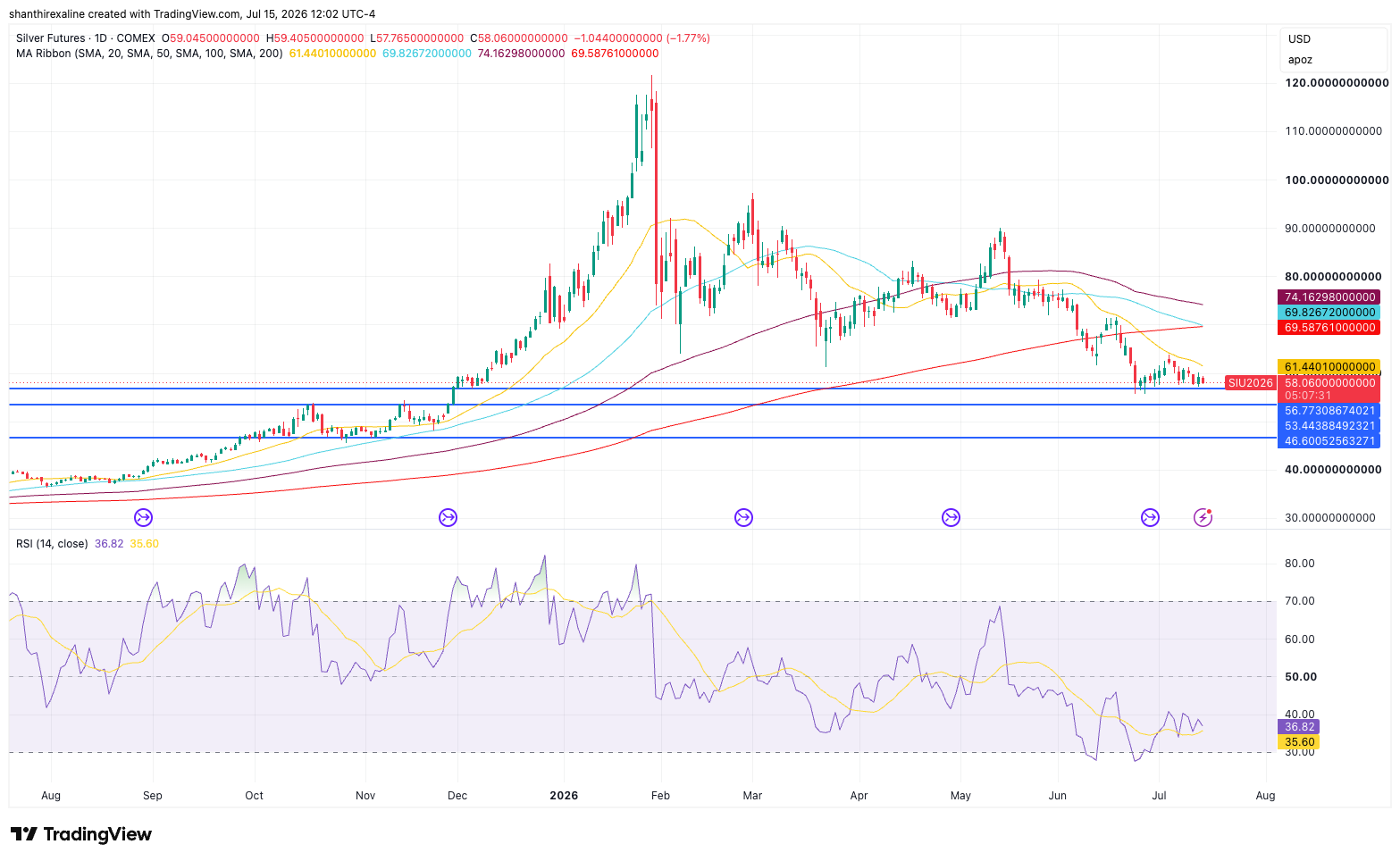
Source: TradingView
The key level to watch now is support around $56.8—a decisive break below it could open the door to further downside, while a move back above the 20-day average near $61.4 would be the first sign that bearish momentum is fading.


