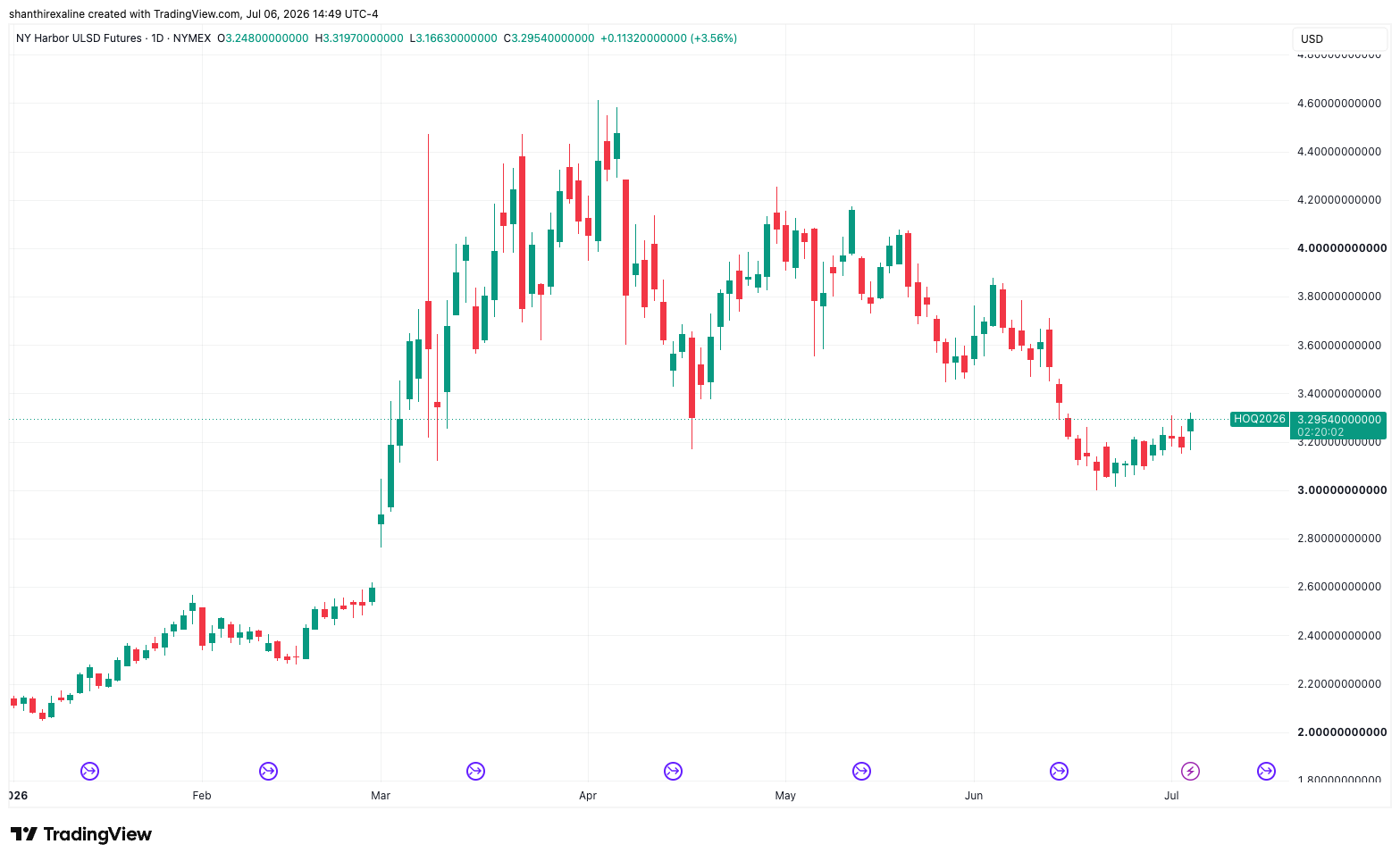
Heating oil futures climbed more than 3% on Monday, diverging sharply from crude oil futures as traders focused on tightening distillate fundamentals rather than ample crude supplies.
The NYMEX-traded heating oil futures contract for August delivery traded up 3.55% at $3.295 per gallon at last check.
Source: TradingView
But why in the first place is crude on a freefall
After nearly doubling in the aftermath of the U.S.-Iran conflict, the crude rally stalled in June, first in response to reports of a peace deal between the two warring sides, and subsequently reacting to the deal per se. The peace deal, though yet to crystallize a full framework agreement, ensured that oil shipments through the Strait of Hormuz, a major oil chokepoint, resumed slowly and steadily.
Supply prospects have also improved. Following a videoconference meeting, seven members of the OPEC+ alliance agreed to raise production by 188,000 barrels per day (bpd) beginning in August, adding to expectations of a better-supplied oil market.
The demand side of the equation has likewise turned less supportive. According to Energy Information Administration (EIA) projections, global oil demand is expected to decline by 1.1 million barrels per day (mb/d) year over year in 2026 to 104 mb/d. In the near term, elevated fuel prices have triggered some degree of demand destruction, while softer global economic growth and the gradual adoption of alternative energy sources continue to weigh on consumption.
Heating Oil on the Boil
Notwithstanding oil’s downward move that has removed essentially all of the war premium, distillates have seen some tightening in fundamentals. The key distinction is that refined-product markets are influenced less by crude availability and more by refinery output and inventory levels.
Even as crude supplies improve, refiners may not be producing enough distillates to rebuild inventories at the pace traders would like. As a result, concerns over product availability can persist even when the outlook for crude itself becomes more bearish.
Demand dynamics are also offering support. While higher fuel prices have weighed on overall petroleum consumption, diesel demand has proven more stable than other fuel categories. Because heating oil futures serve as a benchmark for the broader distillates market, they tend to be influenced more by diesel demand than by residential heating needs.
Crack Spread Is Sending a Message
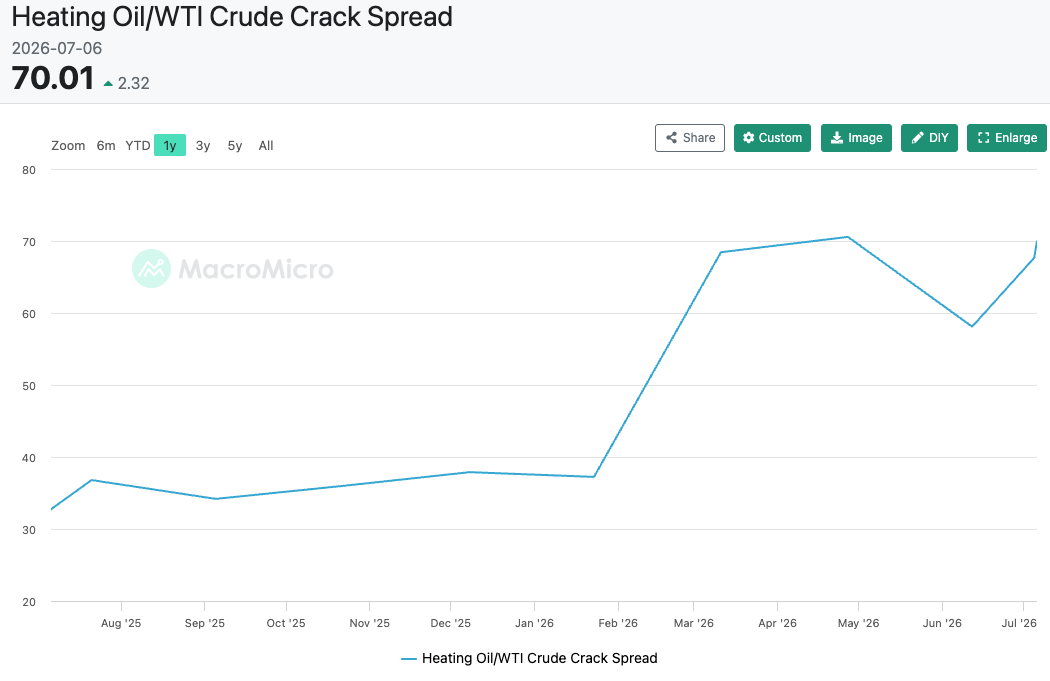
The move is also reflected in stronger crack spread, which is the margin refiners earn by converting crude oil into fuels. This suggests refined products are outperforming their underlying feedstock. The heating oil/WTI crude crack spread is at $70.01 currently.
Widening Crack Spread
Source: MacroMicro
At $70.01/barrel, the heating Oil/WTI crack spread has climbed further from the roughly $66 level seen just a few days ago, extending an already unusual move. This reading is well above the typical refining margin range and stands out even more given the time of year. Summer is normally the seasonal low point for distillate cracks, with heating oil demand usually confined to the October–February heating season.
Refiners are currently capturing an unusually fat margin on heating oil relative to WTI crude, and the trend so far has been widening rather than normalizing. For futures traders, that may indicate that the more attractive opportunities within the energy complex lie in distillates rather than crude oil.
What Traders Should Watch
The sustainability of heating oil's rally will likely depend on whether the tightening narrative in distillates continues to strengthen. Traders should pay close attention to weekly EIA inventory data, particularly distillate stockpiles, which will offer the clearest indication of whether supply is keeping pace with demand.
Refinery utilization rates will also be critical. Higher refinery runs could help replenish distillate inventories and ease some of the tightness supporting heating oil prices. Conversely, any unexpected refinery outages or maintenance activity could further constrain supplies and widen crack spreads. Demand indicators deserve equal attention.
Finally, traders should monitor developments in the Middle East. Although crude oil has shed much of its geopolitical risk premium, any renewed disruption to shipping routes or refining infrastructure could quickly alter supply expectations across the energy complex.
Positioning Could Amplify the Move
A further rise in crack spreads could attract fresh speculative buying into heating oil futures while encouraging relative-value trades that are long distillates and short crude oil. If traders become convinced that refined products will continue to outperform their feedstock, positioning flows could amplify price movements beyond what fundamentals alone would justify.
Check MarketFramework’s Trade Validator for positioning of futures traders.
Trade Shifts Beyond Oil
Monday's price action highlights a broader shift taking place within the energy complex. For much of the past several weeks, markets were focused on geopolitical risks and their implications for crude oil supplies. As those concerns fade, traders are increasingly differentiating between crude and the products derived from it.
The result is a market where crude oil is trading a story of improving supply and moderating demand, while heating oil is trading a story of tight distillate balances and expanding refining margins. If that divergence persists, the most compelling opportunities in energy futures may lie not in the outright direction of crude oil prices, but in relative-value trades that capitalize on the growing disconnect between crude and refined products.


