
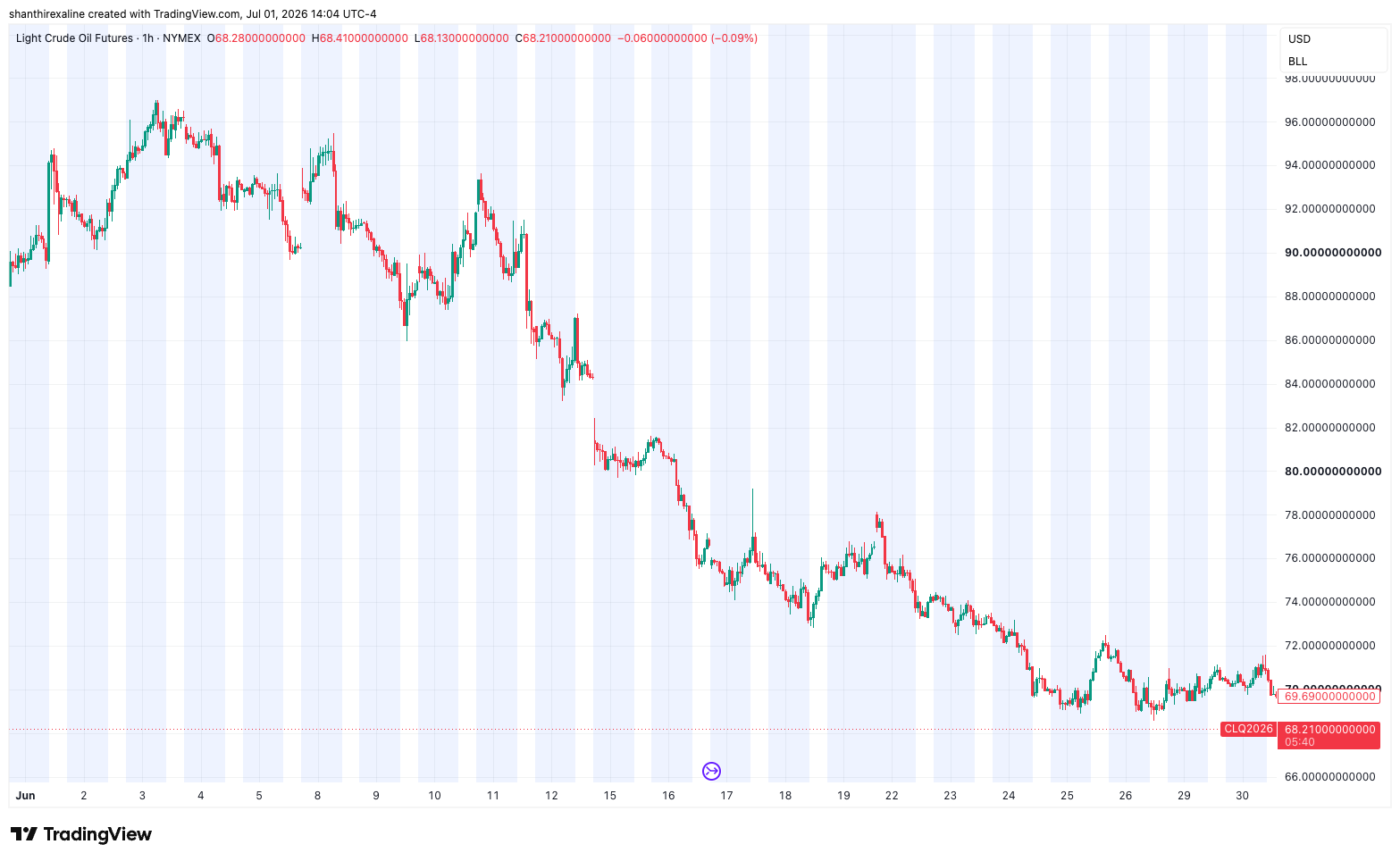
June proved to be a volatile month for many financial assets but it was particularly challenging for oil as supply concerns faced and risk premiums unwound amid indications of a possible de-escalation of the conflict in the Middle East.
The sell-off in oil appears far from over. West Texas Intermediate (WTI) crude oil futures (CL) began July on a weak footing, extending the losses seen late last month. At last check, the front-month contract was trading at $68.07 per barrel, down nearly 2% on the session. Oil remains under pressure on Wednesday and is at risk of falling back to the sub-$68 levels seen before the U.S.-Iran conflict began in late February.
Crude’s Dismal June
Source: TradingView
Barrels Keep Piling Up
The move isn't just about traders feeling less nervous but being driven by real barrels hitting the market.Peace talks between the U.S. and Iran resumed this week in Doha, and tanker traffic through the Strait of Hormuz, the chokepoint that saw clashes and closures during the conflict, has been recovering. Iran says it has shipped more than 40 million barrels of oil since the U.S. lifted its naval blockade. About 10 million barrels/day (mb/d) of oil has begun flowing through the strait, a Bloomberg report stated. Nevertheless, oil volumes are still about 50% below pre-war levels.
Additionally, Russian exports have climbed to record levels, contributing to a sharp buildup of barrels held at sea. Analysts have begun warning openly of a looming glut as exports rebound faster than the market expected, with supply returning from the Persian Gulf even as demand growth stays middling.
The Deal Isn't Actually Signed Yet
The de-escalation narrative driving the sell-off is running ahead of diplomacy. Iran has said it intends to keep overseeing traffic through the Strait of Hormuz even if Oman steps back from its role, and under the current interim arrangement Tehran won't charge transit fees for 60 days. But it hasn't ruled out introducing them afterward, a prospect the U.S., Europe, and Gulf Arab states all oppose.
In short: the supply is flowing, but the underlying dispute that could interrupt it again hasn't been resolved.
Physical Market Weakness
Oil’s sustained downtrend is also a function of a weak physical market, according to ING Commodities strategists. Buyers have deferred purchases in anticipation of further price declines and instead have drawn upon inventories, they said, adding that this is evident from the widening discounts seen for a number of crude grades.
That said, the strategists pointed out that at some point, restocking should begin. “The forward curve still does not provide the biggest incentive to restock, so possibly we may have to see the forward curve flatten and possibly even move into contango for more meaningful restocking to occur.”
The Chart Agrees With the Fundamentals
From a technical standpoint, WTI's price action has turned increasingly bearish. The contract has now fully backfilled the gap created during the initial leg of the rally triggered by the Middle East conflict, effectively erasing the war-related risk premium that had been built into prices.
The break below the psychologically important $70 level has also shifted momentum in favor of sellers. WTI is now testing support in the $68 area, a zone that acted as resistance before the geopolitical spike. A decisive move below this level could open the door for a retest of the pre-conflict lows near $65-$66. The failure of buyers to defend key support levels suggests conviction is fading. Unless fresh geopolitical risks emerge or demand expectations improve materially, rallies are likely to encounter selling pressure.
What's Next
Two catalysts stand between here and the next leg of this move. Diplomats from Washington and Tehran continue talks in Doha this week, and any breakdown, or, alternatively, a durable agreement on Strait access and transit fees will move price quickly in either direction. Separately, OPEC+'s core producers meet on July 5 to review output policy. The group has already approved a modest 188,000 barrel-per-day increase for July, a move some analysts have called largely symbolic given that the real supply story is now about whether barrels can physically reach the market rather than what quotas allow.
Markets are already pricing in a return to normal: plentiful supply, an eased conflict, no lasting disruption. That leaves little room for a positive surprise if talks conclude smoothly, but real room to the upside if they don't. Any snag in Doha, or a repeat of the weekend's tanker clashes, could send prices right back up with the same speed they came down.


