U.S. commercial crude inventories rose by 2 million barrels in the week ending July 17, according to EIA data released Wednesday, bringing stockpiles to 411.7 million barrels. Inventories were, however, about 6% below the five-year seasonal average, and represented a swing from the prior week's 1.7-million-barrel draw. The build wasn't isolated to crude. Gasoline stocks climbed 0.8 million barrels, distillates rose 1.4 million barrels, propane/propylene jumped 6.3 million barrels, and total commercial petroleum inventories increased by 11.6 million barrels on the week.
Under normal conditions, a build this broad would weigh on prices. It didn't. Embedded in the same report is the real story: WTI crude settled at $83.43 per barrel on July 17, up about $11 from the prior week, one of the sharpest single-week price jumps of the year, landing in the very report that showed inventories rising across nearly every category. Prices spiking while stockpiles build is a clean tell that this market is being driven by geopolitical risk premium, not physical supply-demand balance.
Retail positioning data showed heavy short leaning on the CL contract over the past seven days — notable given the rally already underway, since a further push higher could trigger stop-outs that turn shorts into forced buyers and accelerate the move.
The Build, in Detail
Crude: +2 million barrels to 411.7 million barrels
Gasoline: +0.8 million barrels to 211.3 million barrels
Distillates: +1.4 million barrels to 109.6 million barrels
Propane/propylene: +6.3 million barrels, now 34% above the five-year average
Total commercial petroleum stocks: +11.6 million barrels on the week
US Crude Oil Stockpiles
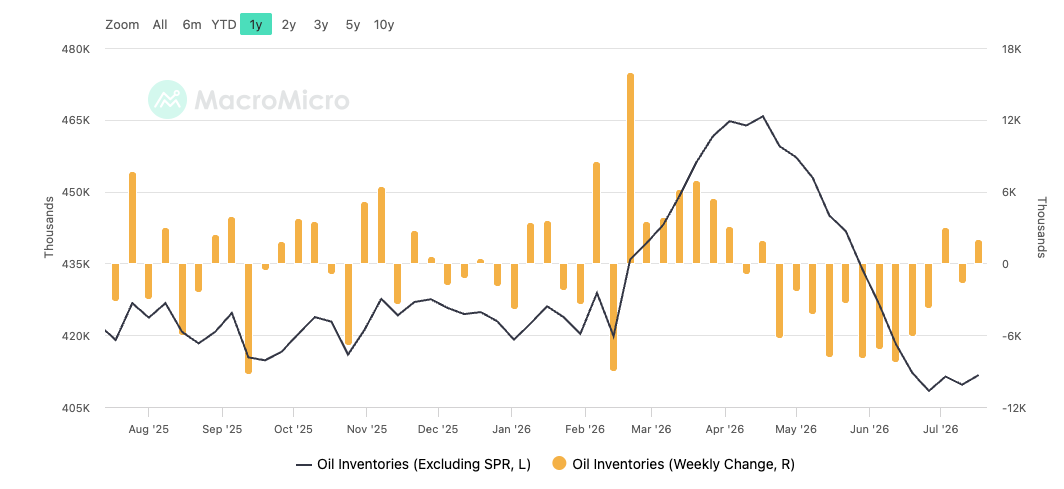
Source: EIA data via MacroMicro
Refinery activity stayed strong throughout. Inputs averaged 17.1 million barrels per day, with refineries running at 96.1% of operable capacity, alongside increased gasoline and distillate production. None of that points to a market straining for supply; if anything, it's a picture of ample throughput and rebuilding stocks.
The Curve Confirms It: This Is a Backwardation Story, Not a Shortage Story
The futures curve backs up what the inventory data suggests. WTI's front-month contracts are trading at a steep premium to deferred delivery, with the prompt-to-second-month spread near its widest point since June — deep backwardation that signals acute near-term supply anxiety rather than a structural shortage.
Crude Contract Price Changes Across Maturities
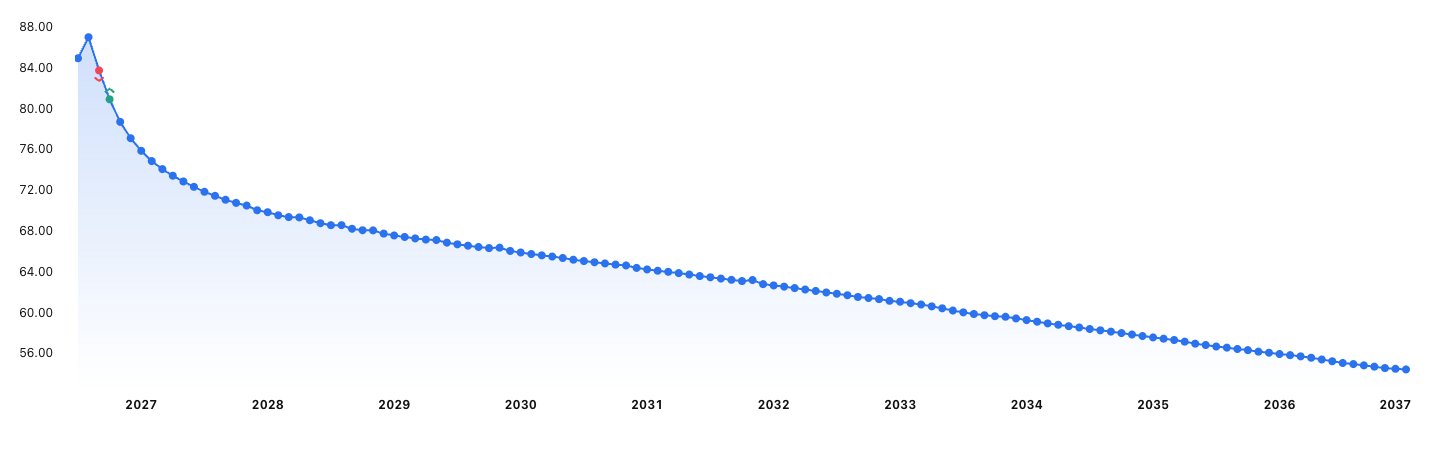
Source: TradingView
Refined product cracks tell the same story even more sharply: the 3-2-1 crack spread breached $71 per barrel intraday this week, an all-time high, before settling near $62, and has now risen for six straight weeks, the longest such streak since 2017. That's the market paying a premium for barrels it can get right now, even as this week's data shows commercial stockpiles quietly rebuilding.
Both confirm this is a market pricing acute short-term disruption risk on top of an adequately supplied physical market, not a genuine barrel shortage.
A Second Front Traders Are Watching: The Red Sea
Compounding the Hormuz risk is a less-covered but potentially larger threat: reported Houthi threats to interdict Saudi shipping through Bab el-Mandeb. If realized, that would eliminate Saudi Arabia's second major export route alongside Hormuz, removing a key mitigant that had capped crude's upside during the earlier ceasefire period. This is arguably the more important headline risk to watch from here, since a serious escalation on this front could extend the rally well beyond what this week's inventory data alone would justify.
Retail Prices Are Already Catching Up
The pass-through to consumers has started moving fast. National average regular gasoline rose to $4.001 a gallon, up $0.146 on the week and $0.880 above year-ago levels. Diesel jumped even harder, to $5.134 a gallon — up $0.338 on the week and $1.322 higher than a year ago. For anyone tracking inflation inputs, a one-week move of that size in a category that flows directly into headline CPI is worth flagging well ahead of the next print.
The SPR Is Still Being Drawn Down
One detail easy to miss in the commercial-stock headline: the Strategic Petroleum Reserve (SPR) kept falling, dropping to 311.4 million barrels from 316.5 million the week before — a 5.1-million-barrel release even as commercial inventories were building. That's the government continuing to lean on the SPR as a stabilizer while the commercial print tells a more ambiguous story, a sign policymakers are still treating supply risk as elevated regardless of what this week's balance sheet shows.
Why the Build Didn't Move the Market
This is the clearest evidence yet that oil has fully shifted from a fundamentals-driven trade to a geopolitical-risk trade. A build this broad-based in crude, gasoline, distillates, and propane all higher in the same week, would ordinarily be an unambiguously bearish print. Instead, WTI posted an $11 weekly gain, meaning the market is now pricing overnight Iran-strike and Strait-of-Hormuz headlines far more heavily than the physical numbers the EIA just published.
What This Means for Positioning
With inventory data no longer functioning as the swing factor, oil has become an almost purely headline-driven trade. That cuts both ways: it means near-term upside can keep running on strike escalation regardless of what stocks do, but it also means the downside is asymmetric. Any credible de-escalation signal — a ceasefire, a reopened shipping corridor, a diplomatic breakthrough — could unwind the current risk premium quickly, especially given that this week's own data shows the physical market actually loosening, not tightening, even as price runs higher.