Nvidia’s (NVDA) earnings have become less about whether the company can beat Wall Street and more about whether it can beat expectations that have already factored in another exceptional quarter.
That distinction matters far more for Nasdaq futures than the headline earnings per share (EPS) number.
Nvidia reports fiscal 2027 second-quarter results after Wednesday’s close, with analysts looking for $92.18 billion in revenue, about double the year-earlier level. Options markets are pricing roughly a 5.4% move in Nvidia, equivalent to about $280 billion in market value, Reuters reported, citing Option Research & Technology Services (ORATS) data. That is a huge single-stock event, but the implied move is actually below Nvidia’s longer-run average post-earnings reaction.
That is the first clue.
The market is not necessarily worried that Nvidia will disappoint. It is becoming harder for Nvidia to surprise the market enough to matter.
The ‘beat’ may no longer be the trade
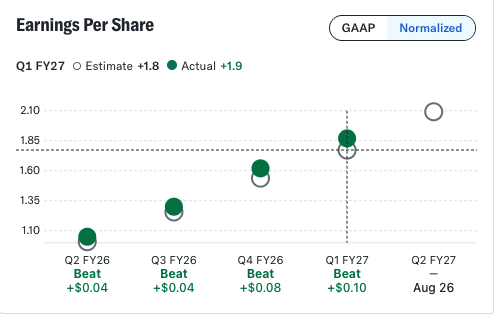
Nvidia has repeatedly delivered what would have been extraordinary results for almost any other company. But the stock has fallen after six of its last eight earnings reports, despite the company’s extraordinary growth.
Source: Yahoo Finance
That creates a different earnings equation for NQ traders.
A conventional earnings setup asks:
Actual results − consensus = surprise
For Nvidia, the more useful equation may be:
Actual results − embedded expectations = market reaction
A $95 billion quarter could therefore be bullish, neutral or bearish depending on what investors had already positioned for.
And that is where the futures story begins.
Nvidia is now a test of the entire AI trade
Nvidia's significance to Nasdaq futures isn't simply its enormous market capitalization. It has become a real-time proxy for whether investors still believe the AI capital-spending cycle can justify the valuations attached to it.
The company is expected to post about 97% year-over-year revenue growth, with data-center revenue alone forecast around $86 billion.
But the market is increasingly looking beyond the current quarter:
- Is hyperscaler AI spending still accelerating?
- Is demand for Blackwell sustaining the next leg of growth?
- How quickly can the Rubin platform contribute?
- Are Nvidia's margins holding?
- Are customers getting enough economic return from their AI investment to keep spending?
Those questions matter to NQ more than whether Nvidia earns a few cents above consensus.
NVDA Tests Key Support As Momentum Cools After Rally
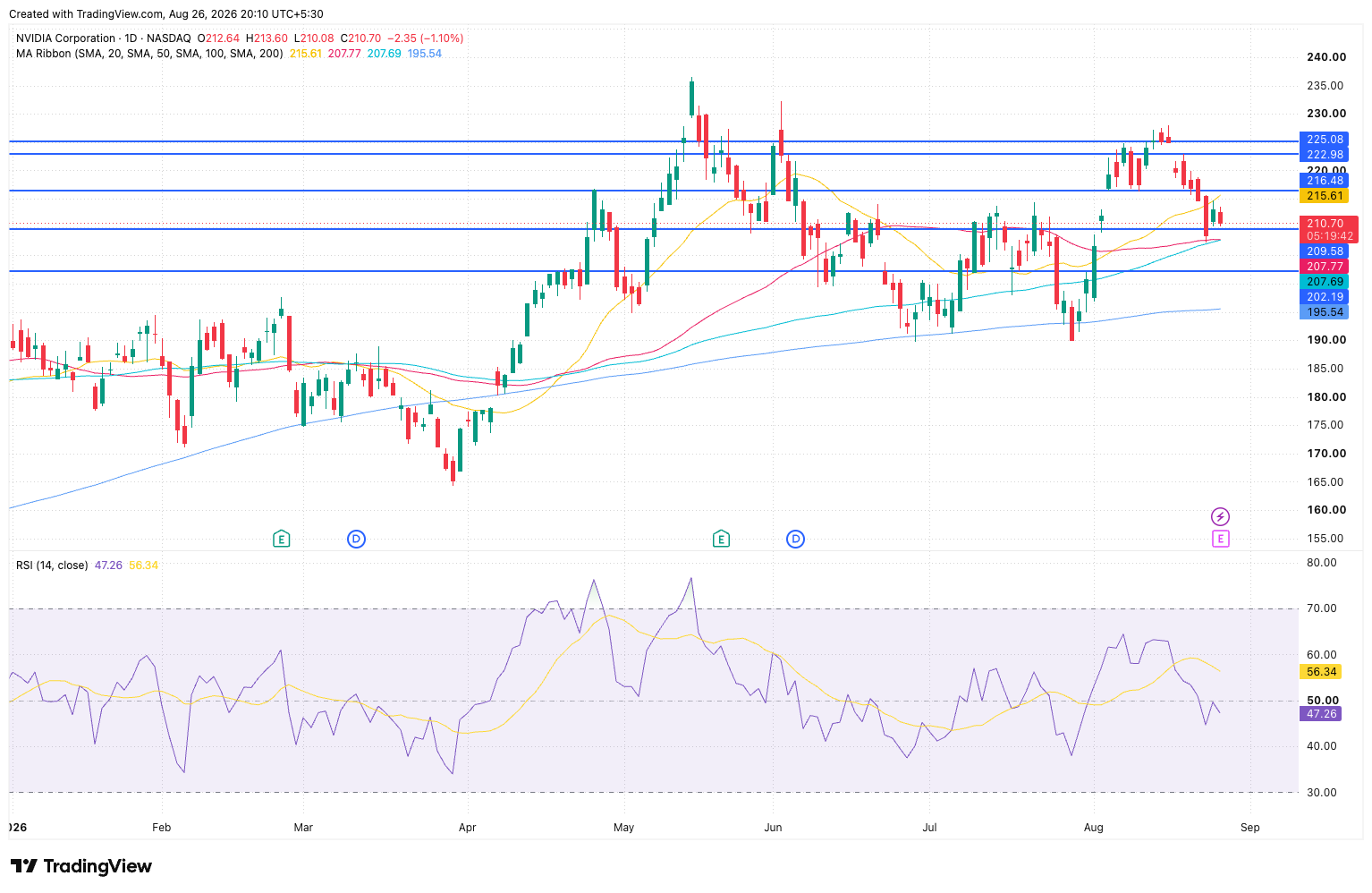
Technically, NVDA is in a short-term corrective phase within a broader uptrend. Price has fallen from the $225–$226 resistance zone and is now around $210.70, sitting just below the 20-day SMA ($215.61) and around the 50-day SMA ($207.77). The key near-term test is therefore $207.7–$209.6. This zone contains the 50-day average and the marked horizontal support. Holding it would keep the structure constructive and could set up a rebound toward $215.6, then $216.5, with $223–225 the major resistance band. A decisive break below $207.7 would weaken the setup and bring $202.2, then $195.5, into play.
Source: TradingView
Momentum has cooled meaningfully. RSI is 47, below its moving average (56), which confirms that buyers have lost short-term momentum but also means the stock isn't oversold yet. The interesting point is that NVDA has pulled back from the upper resistance band while the longer-term moving averages, namely the 100-day ($207.7) and 200-day ($195.5), remain positively positioned underneath price. So, the chart is neutral-to-bullish above $207–$208, bearish below it. For a bullish reversal, the price should reclaim $215–$216, with RSI turning back above 50. That would make a retest of $223–$225 much more credible.
The futures market has another problem: rates
Nvidia is reporting into a market that is not operating in a pure AI-risk regime.
Nasdaq futures (NQ) were already subdued Wednesday as investors digested July PCE inflation data, while the 10-year Treasury yield was around 4.64%. That creates an important interaction.
If Nvidia beats dramatically and its guidance convinces investors that AI earnings growth can continue to outrun higher discount rates, NQ could get a genuine second leg higher.
But if Nvidia beats while Treasury yields remain elevated, the reaction could be very different.
The market could effectively say:
The AI story is still strong—but not strong enough to justify paying more for it.
That is a much more dangerous setup for Nasdaq futures than an obvious Nvidia miss.
Watch the reaction, not the headline
For futures traders, the most interesting setup is therefore a reaction matrix rather than a simple bull/bear forecast.
Reaction Matrix
| Nvidia Outcome | What futures traders may be asking |
|---|---|
| Big beat + big guide raise | Is AI accelerating again? |
| Beat + modest guidance | Was the beat already priced in? |
| Beat + strong margins but no acceleration | Is growth beginning to normalize? |
| Miss + strong forward outlook | Can the market look through the quarter |
| Beat + rising yields | Can earnings growth overcome valuation pressure? |
| Strong Nvidia + weak semiconductor/AI complex | Is the market losing breadth? |
The last one may be particularly important.
If Nvidia rallies but other AI leaders fail to follow, the index reaction could become less durable. Conversely, if Nvidia beats and the move spreads through semiconductors, cloud companies and the broader Nasdaq, the market is validating the earnings signal rather than simply rewarding one stock.
The bigger story
The AI trade may be entering a new phase.
For the past several years, investors could extrapolate enormous growth from Nvidia's numbers. Now the company is approaching a point where even extraordinary growth has become expected.
That changes the risk for futures traders.
The bearish scenario isn't necessarily:
“Nvidia misses.”
It may be:
“Nvidia beats—and the market doesn't care.”
If that happens, NQ could be vulnerable because the earnings report would remove one of the market's biggest sources of upside surprise without actually improving the underlying narrative.
And if Nvidia beats expectations but fails to produce a sufficiently large positive reaction, that would be a potentially important signal: the marginal buyer may be demanding more than good news.
What to watch overnight
The cleanest approach would be to track five things simultaneously:
- NVDA's percentage move versus its 5.4% implied move.
- NQ's reaction relative to NVDA: Does the index amplify or fade the stock move?
- Semiconductor breadth: NVDA versus the rest of the AI complex.
- 10-year Treasury yield: Does the rates market validate or offset the earnings signal?
- The next-quarter revenue guide: Arguably more important than the current-quarter beat.
That produces the real trade signal.
Nvidia doesn't need to disappoint to be bearish for Nasdaq futures. It may simply need to deliver less upside surprise than the market has already priced. And that is the different AI risk now: not an AI earnings collapse, but an AI expectations problem.


