Nasdaq 100 futures are struggling to extend Thursday's technology-led rally, with NQ down about 0.23%, as traders shift their attention from Nvidia's earnings boost to a concentrated cluster of macro catalysts.
Three events scheduled around the same time Friday could reshape the market's view of Fed policy, labor-market strength and consumer health: Fed Chair Kevin Warsh's speech at Jackson Hole, the preliminary annual payroll benchmark revision and the final University of Michigan consumer sentiment reading.
The timing creates an unusually concentrated risk window for NQ. The market is effectively asking whether the U.S. economy remains strong enough to tolerate restrictive monetary policy, or whether weaker employment and consumer signals could give the Fed more room to ease.
For NQ, the answer matters because Treasury yields remain a critical transmission channel. Higher yields increase the discount rate applied to future technology earnings, while falling yields can provide a valuation tailwind for long-duration growth stocks.
Warsh Takes Center Stage at Jackson Hole
The biggest catalyst is likely to be Warsh's first major Jackson Hole speech as Fed chair.
Investors are looking for clues about his approach to inflation, interest rates and the Fed's reaction function. The speech comes after the Fed's July decision to leave rates unchanged and amid renewed concern about inflation and elevated Treasury yields. Markets have recently increased the probability of a September rate hike to roughly one-third.
A hawkish Warsh would be a direct risk for NQ. If he emphasizes persistent inflation or signals that policy may need to remain restrictive for longer, Treasury yields could move higher and put renewed pressure on technology valuations.
A dovish Warsh, by contrast, could trigger a relief rally. If he emphasizes weakening employment or suggests that current policy is sufficiently restrictive, yields could fall and give NQ room to extend its rebound.
The market may therefore react not only to what Warsh says, but also to what he avoids saying. His limited use of forward guidance has already contributed to uncertainty around the Fed's policy path.
LPL Financial Chief Economist Jeffrey Roach expects Warsh's Jackson Hole speech to be light on explicit policy guidance, suggesting investors should look beyond the headline message for clues about his thinking. Roach says the Fed chair's footnotes, citations and references could be more revealing than the speech itself, particularly any discussion of Fed credibility, the limits of central-bank communication, market prices, productivity and AI's potential to ease inflation pressures.
He also flags Treasury buybacks and term premia as potentially market-sensitive topics. Rather than searching for a roadmap for upcoming meetings, Roach believes investors should focus on how Warsh connects inflation, productivity and the bond market, with his references potentially providing the clearest signal of the direction he wants to take the Fed.
Payrolls Revision Could Rewrite the Labor-Market Narrative
The second catalyst is the preliminary annual revision to nonfarm payrolls through March 2026.
This matters because benchmark revisions can reveal that the labor market was materially stronger or weaker than the monthly employment reports initially indicated. The previous preliminary benchmark revision announced in Sept. 2025 was a downward adjustment of 911,000 jobs, When the final benchmark revision was incorporated into the data in February 2026, the final March employment level was revised down by 898,000. This makes the upcoming estimate particularly important for investors assessing the underlying health of employment.
Goldman Sachs has reportedly anticipated a substantial upward revision of as much as 450,000 jobs.
If the revision is sharply positive, it could reinforce the idea that the labor market remains resilient. That would make it harder to argue for a pause and could push yields higher, a potentially negative outcome for NQ.
A large downward revision would have the opposite effect. It could reinforce concerns that the labor market has been weaker than headline data suggested, potentially pulling yields lower and providing NQ with a rate-driven boost.
Consumer Sentiment Adds the Growth Test
The third catalyst is the final University of Michigan consumer sentiment reading for August, due at 10 a.m. ET alongside the other key events.
The preliminary August reading fell to 51.0 from 55.2 in July, highlighting renewed pressure on consumer confidence.
A weak final reading would reinforce the argument that households are becoming more cautious, adding another potential signal of slowing economic momentum.
For markets, however, weaker sentiment creates a complicated reaction function. Bad economic news can be good news for NQ if it causes Treasury yields to fall and increases expectations for Fed easing.
That means the immediate market response may depend less on whether sentiment is objectively good or bad and more on how the data changes the interest-rate outlook.
The Three-Catalyst NQ Scenario
| Catalyst | Market Interpretation | Potential impact on NQ |
|---|---|---|
| Hawkish Warsh | higher-for-longer rates | Bearish |
| Dovish Warsh | greater scope for pausing or even easing | Bullish |
| Large upward payroll revision | labor market stronger than thought | Bearish via yields |
| Large downward payroll revision | labor market weaker than thought | Bullish via lower yields |
| Weak Michigan sentiment | consumer/growth concerns | Potentially bullish, if yields fall |
| Strong Michigan sentiment | resilient consumer | Potentially bearish, if yields rise |
| Dovish Warsh +weak payrolls | stronger pausing/easing case | Most bullish |
| Hawkish Warsh + strong payrolls | Stronger higher-for-longer case | Most bearish |
Positioning Offers Little Cushion
The positioning data adds another layer to the setup.
Profitable NQ traders are currently 68.9% long, compared with 55.2% long among unprofitable traders, leaving only a 14-percentage-point difference. All traders are approximately 60% long.
That is essentially a extremely bullish positioning setup, meaning there is major positioning imbalance in favor of the bulls.
Key Technical Levels
Technically, 29,650–29,680 is the immediate resistance zone for NQ. The area includes the current session highs near 29,710 and the 29,644 4-hour 100-period moving average, which was identified as a key barrier in Thursday’s recovery. A sustained break above 29,700 would strengthen the bullish case and put 30,000 back in focus, with 30,200–30,300 representing the next broader resistance zone.
On the downside, 29,600 is the first nearby support, followed by the 29,500–29,515 area, where the hourly moving averages and recent price structure converge. A deeper break would expose 29,400, a more important pivot; holding above that level would keep the broader rebound intact, while a failure could reopen 29,240–29,300.
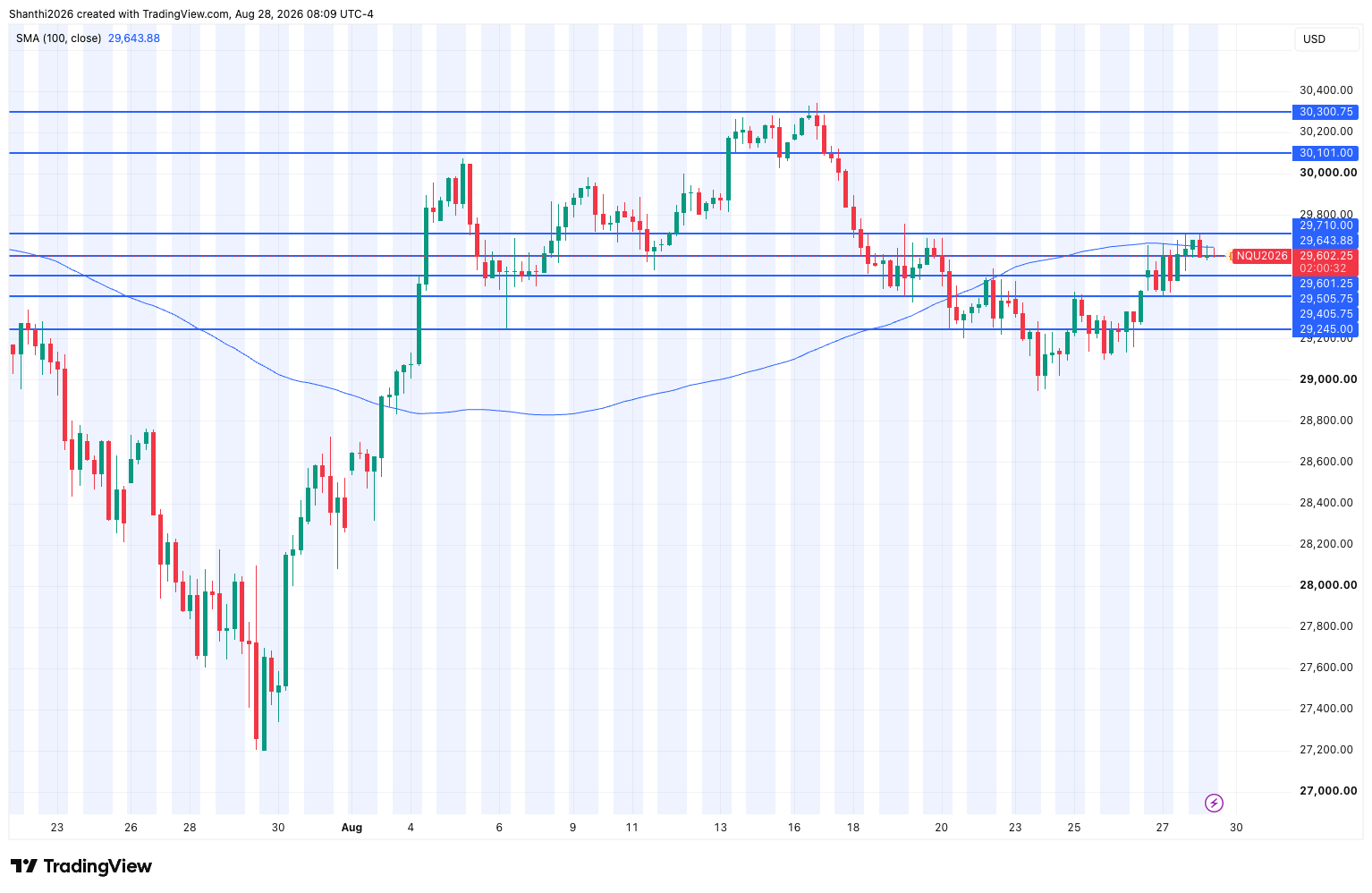
Source: TradingView
Bottom Line: Three Catalysts, One Rate Narrative
NQ's rebound now faces a concentrated macro test. Warsh determines the Fed narrative, the payroll revision tests the labor-market narrative, and consumer sentiment tests the growth narrative.
The most constructive setup for NQ would be a dovish Warsh combined with evidence of a softer labor market, particularly if consumer sentiment also deteriorates enough to pull Treasury yields lower.
The biggest risk would be the opposite combination: hawkish Warsh plus a stronger-than-expected payroll revision, which could push yields higher and revive the duration pressure that has recently made the Nasdaq vulnerable.
With NQ already down 0.31%, Friday's session is less about extending Thursday's tech rally and more about determining whether the rebound has enough macro support to survive the rate test.


