Nasdaq 100 futures pushed above 28,600 on Friday, extending a two-day rebound built almost entirely on the strength of two earnings reports even as two other mega-cap prints this week gave traders reasons to stay cautious. With the bulk of the Big Tech earnings season now behind it, NQ's next move looks less about single-stock surprises and more about whether the index can clear technical resistance before the Federal Reserve’s rate path reasserts itself as the dominant force.
The Setup: A Split Decision From Big Tech
This week delivered one of the more bifurcated Big Tech earnings stretches in recent memory. Two names delivered blowout numbers that reignited the artificial intelligence (AI) trade, while two others delivered results that, on the surface, looked fine but left the market unconvinced.
Microsoft was the standout. Its cloud business posted Azure and other cloud-services revenue growth of 43% on an ex-forex basis for the June quarter — well ahead of the 39.3% consensus and the fastest pace of growth in four years. The print reassured investors that heavy AI infrastructure spending is finally translating into real revenue, and the stock surged double digits.
Amazon followed a similar script. The company beat on second-quarter revenue, with strength in its cloud-computing division doing the heavy lifting, and shares jumped 13% as the results reinforced confidence in the broader AI-capex thesis.
Not every mega-cap earnings story ended the same way, though.
Apple technically beat both revenue and EPS estimates, with iPhone sales climbing 22% year-over-year. But the headline beat was overshadowed by weak forward guidance, which the company attributed to supply constraints, and services revenue that came in below expectations. The stock slid more than 6% in the aftermath — a reminder that with Apple trading near record highs and a $5 trillion valuation heading into the print, the bar for "good enough" had been set unusually high.
Meta had a rougher time. Revenue grew 28% year-over-year and topped estimates, but earnings per share missed by more than 14%, snapping a six-quarter streak of beating expectations. The culprit was a 55% jump in total costs, driven partly by legal charges and severance tied to an 8,000-person headcount reduction, which compressed operating margins from 43% down to 31%. Meta also raised its full-year expense guidance and narrowed capital expenditure guidance upward as its AI buildout accelerates, a signal that the AI spending story is still very much a work in progress for the company.
Earlier this month, Alphabet and Tesla had already set a cautious tone, with both stocks falling on their own reports.
Why NQ Is Still Rallying Despite the Mixed Picture
The net effect of this split-decision earnings week is that NQ's rally is currently riding on a narrower base than headline index levels suggest. Two of the index's largest constituents delivered the kind of cloud-revenue beats that validate the AI infrastructure buildout story, and those two prints have been enough to outweigh disappointments from Apple, Meta, Alphabet, and Tesla — at least for now.
That's a meaningful distinction for traders. A rally driven by broad participation across the mega-cap complex tends to be more durable than one leaning on two or three outsized winners. Right now, NQ's strength looks closer to the latter.
The Technical Picture: Below the 50-Day, Above the 200-Day
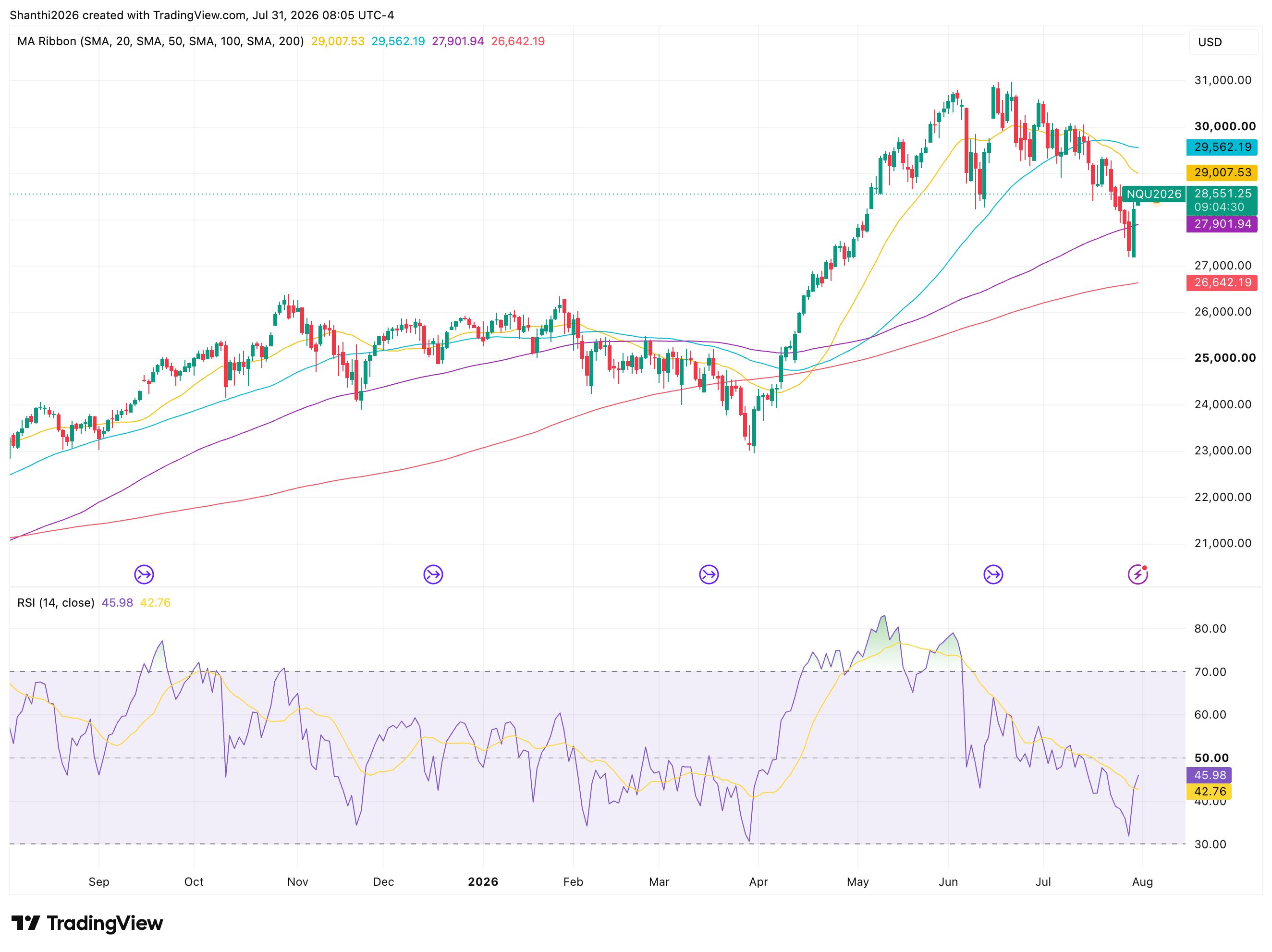
Nasdaq-100 E-mini futures are attempting to stabilize after a sharp late-July pullback, but the short-term technical picture remains mixed. The recent rebound from the 27,900 support zone suggests buyers are defending a key area, yet the contract continues to trade below the 50-day simple moving average (SMA) near 29,560, leaving the intermediate trend under pressure.
Price action has also carved out a series of lower highs since peaking in late June, indicating that sellers continue to emerge on rallies. A decisive break above the the 50-day SMA would be the first sign that bullish momentum is returning and could open the door for a retest of the 30,000 psychological level and, potentially, the July highs.
Source: TradingView
Momentum indicators are beginning to improve but have yet to confirm a trend reversal. The 14-day Relative Strength Index (RSI) has recovered to around 46 after briefly slipping into the mid-30s, signaling that selling pressure has eased but momentum remains below the neutral 50 threshold. This points to a market in recovery mode rather than one that has fully regained bullish control.
On the downside, the 27,850-27,950 support zone remains critical. A sustained break below this area would reinforce the pattern of lower highs and lower lows, increasing the likelihood of a deeper correction toward the 200-day SMA near 26,640. Until buyers reclaim the 50-day SMA, rallies are likely to be viewed as corrective, with upcoming macro catalysts—particularly Fed rate expectations and U.S. economic data—likely to determine whether the recent bounce develops into a renewed uptrend or fades into another leg lower.
Positioning in Nasdaq-100 E-mini (NQ) futures is nearly balanced, with 49.1% of trades on the long side, according to MarketFramework’s Positioning Edge tool. However, the quality of those positions is weak: longs accounted for just 41% of profitable trades but 55.7% of losing trades. This suggests many traders have been buying into recent weakness or attempting to call a bottom too early, while short positions have generally been better timed and more profitable. The data points to cautious sentiment and indicates that bullish conviction has yet to be rewarded consistently.
What Comes Next: Fed Repricing Takes the Wheel
With mega-cap earnings largely finished for this cycle, the catalyst calendar shifts. There are no more major single-stock earnings events on deck this week, which means Fed policy interpretation, Treasury yields, and month-end positioning move to the front of the queue as the dominant forces on index direction.
That's a notable shift in character for NQ. Long-duration technology names — the same stocks that just delivered this week's split-decision earnings — are also the most sensitive part of the market to real-yield moves. A hawkish reading on the Fed's rate path could compress valuations across the board, regardless of how any individual company's quarter went.
The next scheduled hard-data catalyst is the July jobs report, due August 7 — a full week away, leaving a stretch where the market's read on rate expectations, rather than earnings, will likely set the tone for NQ.