
The stage is set for what is arguably the most critical corporate catalyst of the quarter, with the Nasdaq 100 sitting just off its all-time highs. On Wednesday, May 20, after the US market close, artificial intelligence bellwether Nvidia Corp. (NASDAQ: NVDA) will release its Q1 Fiscal Year 2027 earnings report.
Nvidia’s influence on global market sentiment cannot be overstated, as its Q2 forward guidance is poised to determine the market's next directional move. Having surged an astonishing 154% from its April 2025 lows to challenge all-time highs near $236, the stock has effectively become the macroeconomic standard-bearer for the tech sector.
Furthermore, Nvidia currently commands a 13.69% weighting within the Nasdaq 100 Index by market capitalization.
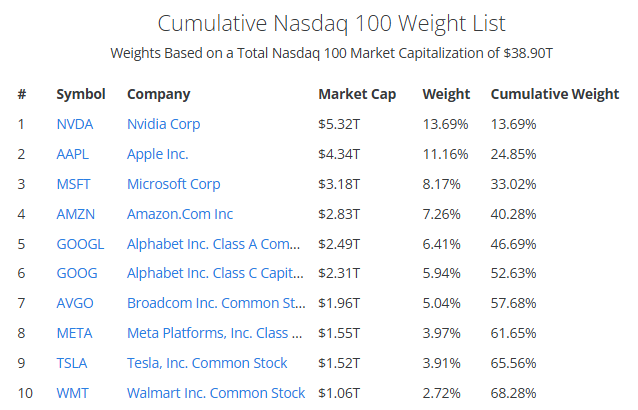
Source: SlickCharts
History shows that Nvidia has fallen on four of its last five revenue beats, a classic "sell-the-fact" pattern. With valuation multiples priced for perfection and the buy-side whisper numbers creeping uncomfortably higher than official consensus, a clean beat on the headline figures may no longer be enough to sustain the bullish momentum.
The Underlying Numbers: What the Street Expects
For Q1 FY2027, Nvidia’s official guidance provided back in February targeted revenue at $78.0 billion (±2%). However, Wall Street analysts have already moved the goalposts higher.
Consensus Revenue: ~$78.8 billion (representing an impressive ~78% YoY growth). Some buy-side whisper numbers are pushing closer to $80.0 billion.
Expected Non-GAAP EPS: $1.75 to $1.78 (up from $1.62 in Q4).
Data Center Revenue: Anticipated to cross the structural threshold of $73.0 billion, up from $62.3 billion in the previous quarter.
Gross Margins: Guided at 75.0% (±50 bps). Keeping margins at or above the 75% mark will be vital to proving that Nvidia retains its absolute pricing power amid rising foundry costs.
Key Focus Areas: Beyond the Headline Numbers
To trigger a sustained post-earnings rally, market participants need to be looking far past the Q1 metrics. The real narrative lies in forward-looking execution and cross-border challenges.
The Next-Gen Chips (Blackwell & Rubin)
Looking at the recent history around NVIDIA earnings releases, markets are likely to care less about past sales and more about how fast Nvidia can make and ship its newest chips.
The Big Questions: Is their manufacturing partner (TSMC) producing the new "Blackwell" chips smoothly without delays? Are the high-end, liquid-cooled servers shipping on time?
Looking Ahead: Any updates on the upcoming "Blackwell Ultra" or the next-generation "Rubin" chips (coming in late 2026) will prove if demand is still booming for years to come.
Next-Quarter Guidance (The Make-or-Break Number)
Nvidia’s financial forecast for the next quarter (Q2) may hold more sway than its actual Q1 results.
The Targets: Wall Street expects Nvidia to predict around $86 billion in revenue. High-expectation market participants may want to see $88 billion or more.
The Risk: If Nvidia forecasts anything under $85 billion, market participants may worry growth is slowing down, which could cause the stock price to drop as people sell to lock in profits.
China Restrictions vs. Global Demand
How the US China relationship evolves moving forward may be key to NVIDIA sales moving forward.
The Fix: While Nvidia made weaker chips specifically for China to follow government rules, sales there are still low.
The Substitute: Market participants may want to know if heavy buying from governments in Europe, Saudi Arabia, and the UAE (known as "Sovereign AI") is big enough to make up for any losses which may arise from the Chinese market.
Possible Market Scenarios and Technical Analysis
From a technical perspective, Nvidia’s heavy market capitalization weight, its earnings will act as a catalyst for the broader indices.
Scenario A: The AI Bull Run Continues (Nvidia Beats & Guides >$88B)
Market Reaction: Violent upside continuation.
Nasdaq 100 / ES Futures: Tech futures will likely break out of recent consolidation patterns to print fresh record highs. Short-sellers will be forced to cover, creating a tailwind across other semi-conductor and hyperscaler names (Microsoft, Amazon, AMD). The path of least resistance will remain firmly to the upside.
Scenario B: The "Good But Not Good Enough" Thrown-Over (Nvidia Beats Q1, Guides In-Line ~$86B)
Market Reaction: Volatile, choppy, and ultimately negative.
Nasdaq 100 / ES Futures: Mirroring previous quarters, an in-line guide will likely trigger an initial pop followed by aggressive selling. Index futures could undergo a healthy 2-3% pullback as institutional investors trim exposure, rotating capital into defensive or lagging cyclical sectors.
Scenario C: The Growth Stall (Nvidia Misses or Guides <$85B on Supply/China Concerns)
Market Reaction: Sharp risk-off correction.
Nasdaq 100 / ES Futures: This would constitute a systemic shock to the "AI trade" narrative. I could see an immediate, aggressive gap down in ES and Nasdaq futures in such a scenario.
Tech indices would likely retest their lower structural support bands, dragging the broader market into a multi-week consolidation phase as the Street reassesses the speed of global AI capital expenditure.
The options market is currently pricing in an implied move of roughly 8% to 10% in either direction following the announcement. This massive expected swing will have an impact on the near-term path for the tech-heavy Nasdaq 100 and ES (S&P 500) Futures.
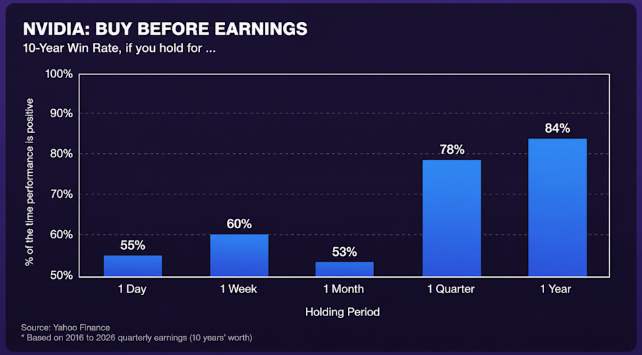
Source: Yahoo Finance
Given that volatility appears to be a certainty, let us take a look at historical performance of NVIDIA after the earnings release. The chart above shows that longer holding periods after the earnings release tend to perform better.
Nvidia has finished higher 55% of the time after one day, 60% after one week, and 53% after one month. Those odds jump to 78% over one quarter and 84% over one year.
Let us take a look at the technical outlook. The E-mini Nasdaq-100 is undergoing a healthy and expected retracement after a massive 28% run from its March lows.
E-mini Nasdaq 100 Futures Daily Chart, May 19, 2026
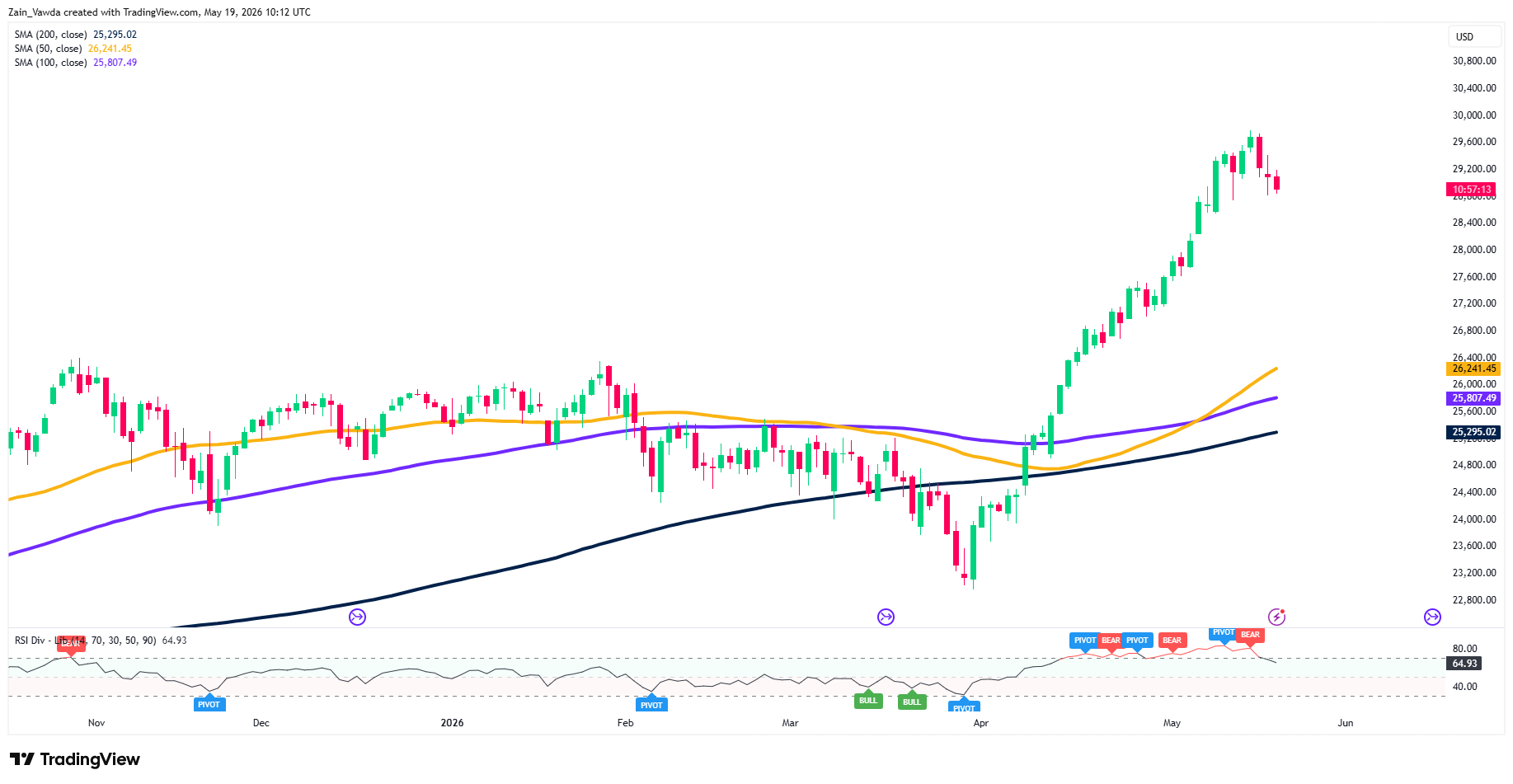
Source: Tradingview
The structure remains firmly bullish. The immediate focus is on whether buyers defend the 28,500 region. Heading into the earnings release, a significant miss could bring the 50-day MA into play which currently rests at 26,241 and potentially 25,000 in the days that follow.
If the 28,500 support level holds, the index may form a higher low to attempt another assault on the psychological 30,000 milestone.


