
Regional Federal Reserve manufacturing surveys surprised to the upside, with both the Empire State and Philadelphia Fed surveys showing a sharp improvement in business activity. New orders strengthened, shipments improved, and overall sentiment recovered from the weakness seen earlier this year.
On the surface, the data appears supportive of a stronger growth outlook. For futures traders, the surveys matter because rate cuts have largely been priced out. As a result, stronger factory activity no longer works mainly by reducing easing expectations; instead, it risks nudging markets toward assigning a higher probability to renewed policy tightening if broader economic data remain firm.
But the labor details tell a different story.
Manufacturers Are Expanding Output Without Expanding Payrolls
The most important signal in the surveys is not the rebound in activity. It is the reluctance to hire.
Rather than significantly increasing headcount, manufacturers appear to be relying on their existing workforce to meet improving demand. Work schedules, overtime, and labor utilization are rising faster than employment.
Early Read of July Manufacturing Conditions
| Philadelphia Fed survey | Empire State Survey | |
|---|---|---|
| Business Conditions Index | 41.4 (up 31.1 pts) | 15.6 (up 9.9 pts) |
| New Orders Index | 37 (up 9.7 pts) | 22.2 (up 18.7 pts) |
| Shipments Index | 33.7 (up 18.8 pts) | 24.4 (up 15.8 pts) |
| Number of Employees | 10 (up 2.1 pts) | 11.4 (up 1.8 pts) |
| Average Workweek | 14 (up 20.5 pts) | 2.8 (down 2.3 points) |
The Philly Fed’s current employment index of 10, however, masks the weak hiring signal. Of the firms surveyed, just 13% reported an increase in headcount, while 83% reported no change at all, and 3% cut staff. Fewer than one in seven manufacturers in the district actually added a worker this month, a more precise picture of restraint than the index alone conveys.
The Forward-Looking Data Makes the Case Stronger, Not Weaker
The current-month numbers tell only half the story. Both surveys' six-month outlook components are cooling on the labor side.
- The six-month outlook of the Philly Fed survey showed a 1.3-point dip in the employment index to 29.5 and a steeper 22.3-point plunge in the average workweek index to 12.
- The forward-looking employment index of the Empire Fed survey showed a 6.5 drop to 20.9 and the average workweek index fell 5.9 points to 2.
In New York, firms appear to be absorbing stronger demand without meaningfully increasing labor input on either margin — hours or heads. Now layer in the outlook. It mirrors the caution already visible in its current data.
Put together, this means: neither district's manufacturers are currently expanding hours or headcount aggressively, and neither expects to meaningfully ramp up labor input over the next six months either. That's a materially different signal than "firms are cautiously waiting to see if demand holds before hiring." It reads more like manufacturers believe they can meet stronger demand with existing capacity and labor — a signal about productivity and capacity utilization, not just hiring timing.
If expectations for employment and hours worked are cooling even as current orders and shipments strengthen, the case for a near-term manufacturing payrolls catch-up becomes less compelling. It also tempers the more hawkish interpretation of the surveys. While factory activity is improving, firms do not appear to be preparing for the kind of sustained hiring and wage growth cycle that would typically accompany a broad-based economic acceleration. That nuance is worth considering alongside the relatively hawkish Fed funds futures curve, which continues to assign some probability to policy tightening later this year.
Fed Funds Futures Pricing
That caution matters because futures markets have already moved decisively toward pricing tightening rather than easing. CME FedWatch data shows the market now assigns an 80%+ probability to a hike by the October 28 meeting, with the September meeting also carrying majority odds. This month's manufacturing data's current-activity strength is consistent with that near-term hike pricing holding.
Futures Market Rate Pricing
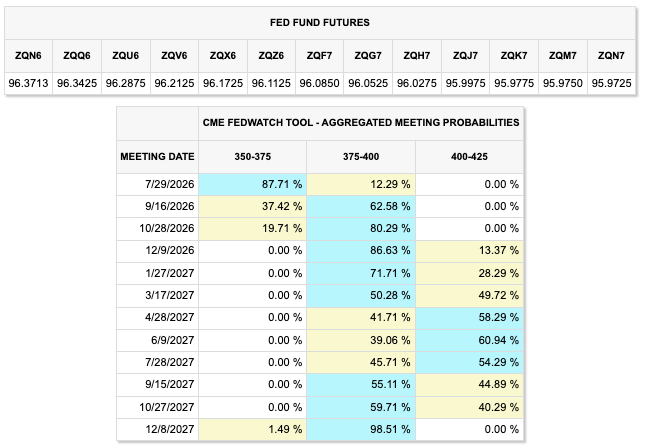
Source: CME FedWatch Tool
But the forward-looking labor components — cooling hours and headcount expectations in both districts — argue against building a case for additional tightening beyond what's already priced. A labor market that isn't bracing for a hiring or wage cycle doesn't give the Fed much cover to lean more hawkish than the curve already reflects.
Click here to access MarketFramework's Trade Validator tool for insights into retail trader positioning.
The Next Data Points That Matter
Both regional surveys are released two to three weeks ahead of the ISM Manufacturing PMI, and their signals—particularly Philadelphia's, given its longer history and larger sample—have often provided an early indication of the direction of the national index. The next key data points will be the upcoming ISM Manufacturing report and the manufacturing component of the monthly jobs report, which will help determine whether the recent strength in factory activity is translating into broader hiring or remains concentrated in output and hours worked.


