
The S&P 500 traded modestly higher by the mid-session on Friday, with the benchmark remained poised to record its second straight week of gains. The E-mini S&P 500 futures (ES) tied to the contract also advanced suggesting traders continue to lean cautiously bullish.
Fed's Hawkish Shift Hasn't Derailed the Rally
The resilience comes despite an uncertain macro and geopolitical backdrop. Investors have largely looked through concerns about inflation and interest rates, focusing instead on a still-solid labor market, steady economic growth, and optimism surrounding artificial intelligence (AI)-driven earnings growth. The result has been a market that continues to grind higher even as expectations for Federal Reserve rate hikes have firmed up.
The futures market currently assigns a 24% probability to a quarter-point hike at the July Federal Open Market Committee (FOMC) meeting. By September, the odds of additional tightening rose to 62%, underscoring the sensitivity of equity markets to upcoming economic data and Fed commentary that could reshape the interest-rate outlook.
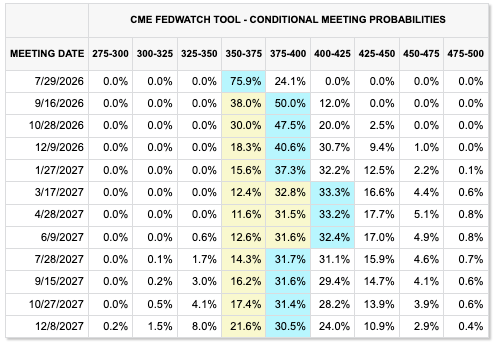
Source: CME
The Fed adopted a notably hawkish stance at its June meeting, the first chaired by Kevin Warsh. Policymakers removed the easing bias from the post-meeting statement, raised their forecasts for Personal Consumption Expenditures (PCE) inflation, and revised the dot plot to show that nine of the 18 FOMC participants expected at least one rate hike before year-end.
Adding to the uncertainty, Warsh declined to submit an individual dot, opting instead to let incoming economic data guide market expectations. His decision highlighted a preference for data-dependent policymaking rather than providing explicit forward guidance, leaving investors to draw their own conclusions about the likely path of interest rates.
The FOMC minutes released this week largely confirmed the Fed's hawkish tilt but also revealed a more nuanced picture. Although officials unanimously agreed to hold rates steady in June and remained concerned about inflation risks, the minutes showed a growing divergence of views regarding the future trajectory of monetary policy.
That divergence leaves markets especially sensitive to incoming economic data, as each release has the potential to shift expectations toward either renewed tightening or an extended pause.
The Real Risk: Data and Fed Speakers
That resilience will be tested next week as traders navigate a packed calendar of economic releases and appearances from the Fed. For ES traders, the challenge is less about predicting individual data points and more about managing positioning through a series of events capable of reshaping interest-rate expectations.
The week's focal point will be the inflation data.
- Consumer Price Index (CPI) and Producer Price Index (PPI) reports (Tuesday and Wednesday, respectively) will offer fresh insight into whether price pressures are continuing to moderate or proving more persistent than policymakers anticipated.
- Retail sales figures (Thursday) will provide an important read on the health of the U.S. consumer, which remains the backbone of economic growth.
- Investors will also monitor the University of Michigan preliminary Consumer Sentiment survey (Friday), particularly its inflation-expectations components.
- Beyond economic data, a slate of speeches from Fed officials could generate additional volatility. Chief among them Warsh's Semi-Annual Monetary Policy Testimony before Congress on July 14 and 15. Investors will be looking for clues on how the Fed chair interprets recent inflation data, the growing divide within the FOMC over the rate outlook, and the conditions that could justify further policy tightening in the months ahead.
- The Beige Book, which summarizes economic conditions across the Fed's 12 districts, will offer clues about the economic backdrop policymakers will consider ahead of their next meeting.
Treasury auctions also warrant close attention. Recent auction results have become an important gauge of investor demand for U.S. government debt. Weak demand could push Treasury yields higher, tightening financial conditions and creating headwinds for equities. Strong auction results, by contrast, could help stabilize yields and provide support for risk appetite.
Why It Matters for ES Traders
For ES traders, the key takeaway is that no single event may determine the market's direction. Instead, it is the cumulative impact of inflation data, growth indicators, Fed communication, and Treasury market dynamics that will determine whether the S&P 500 can extend its advance or faces a period of consolidation after two consecutive weeks of gains.
The key transmission mechanism remains Treasury yields.Stronger-than-expected economic data and/or hawkish comments by Fed officials could push yields higher, beefing up rate hike bets. This potentially pressures richly valued growth stocks that dominate the S&P 500. Conversely, softer data could reinforce expectations for lower rates and provide another tailwind for equities.
Low VIX Meets Short-Heavy Positioning Ahead of CPI Week
Leveraged speculators went into deep net-short territory as Middle East tensions escalated in June, then trimmed that positioning somewhat by month-end. But the aggregate stance remains decisively bearish/short, not neutral. That's a meaningful data point heading into next week's CPI and Fed testimony. A heavily net-short leveraged fund base sets up potential short-covering fuel if the data comes in dovish, which could amplify any upside surprise in ES beyond what the fundamentals alone would suggest.
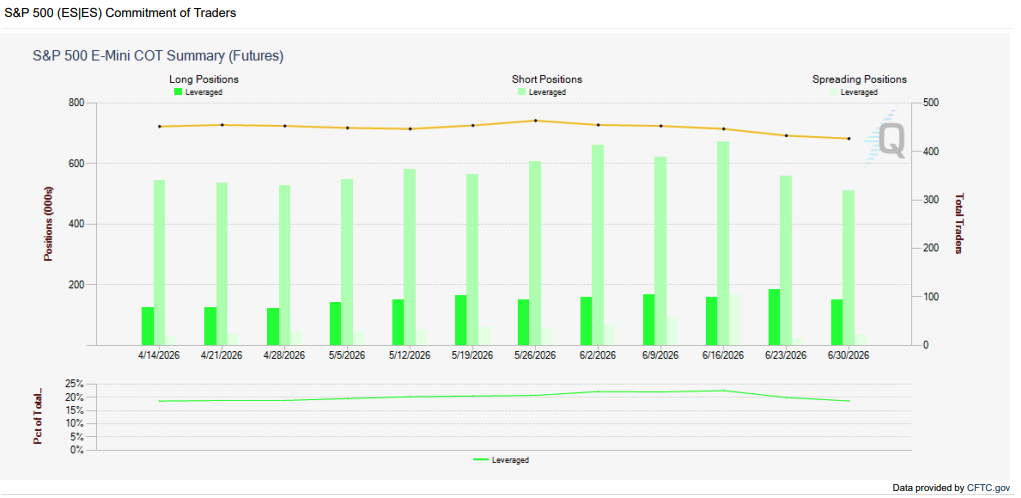
Source: CFTC data via CME
The CBOE Volatility Index (VIX) is trading in the 15.40 -17.27 range this week, which is relatively low. This suggests the market is pricing in relatively calm near-term conditions right into a week stacked with CPI, Fed testimony, and earnings. However, subdued volatility can also leave markets vulnerable to sharp reactions if incoming data surprise significantly. Conversely, if economic releases broadly align with expectations, the VIX could remain contained, supporting the view that pullbacks are to be bought.
MarketFramework's Trade Validator tool flags mixed sentiment in ES — the majority of profitable trades are short positions, while the majority of unprofitable trades are long.
ES uptrend intact, eyeing key 7,636 breakout
The ES contract stays in an uptrend. The moving average ribbon is rising and properly stacked, with price above all of them. RSI at 58 leans neutral, suggesting it still has room to climb before hitting overbought territory near 70. The contract has struggled to clear resistance near 7,636 recently; a clean break above that level on friendly data could open the next leg higher. If data disappoints instead, the 20-day MA (7,516) and 50-day MA (7,467) are the levels likely to cushion any pullback.
Source: TradingView
Scenarios For ES Into Next Week's Data/Fed Deluge
| Scenario | Catalysts/Catalysts Combination | ES Reaction |
|---|---|---|
| Bull Case | Soft CPI, PPI+dovish Fed commentary+strong Treasury auction demand | Short-covering rally amplifies upside |
| Base Case | In-line CPI/PPI print+ data-dependent Fed commentary+steady retail sales | Choppy two-way trade; consolidation likely |
| Bear Case | Hot CPI, PPI print+ hawkish Fed commentary+weak Treasury auction | Tech-heavy ES futures comes under pressure |
| Wildcard | Mixed data+Fed officials diverging | Volatile reaction; single-event reactions get overridden by next day's data |
The key question for ES traders next week is not whether volatility will return, but whether incoming data and Fed commentary are strong enough to alter the market's prevailing narrative of resilient growth and eventual policy easing. Until that narrative changes, dips may continue to find buyers, even as traders brace for a week filled with potential catalysts.


