
The steady climb in the U.S. 10-year Treasury yield since June 25 reflects more than just a shift in Federal Reserve expectations. While hawkish signals from the June Federal Open Market Committee (FOMC) meeting have prompted investors to price in rate hikes this year, markets are also grappling with persistent inflation risks, elevated fiscal borrowing needs, and geopolitical tensions that have kept bond investors demanding higher compensation.
As yields approach levels that have historically pressured stock valuations, the bond market may be signaling a more challenging environment for risk assets ahead.
US10Y at 4.59%, near its highest level in over a month
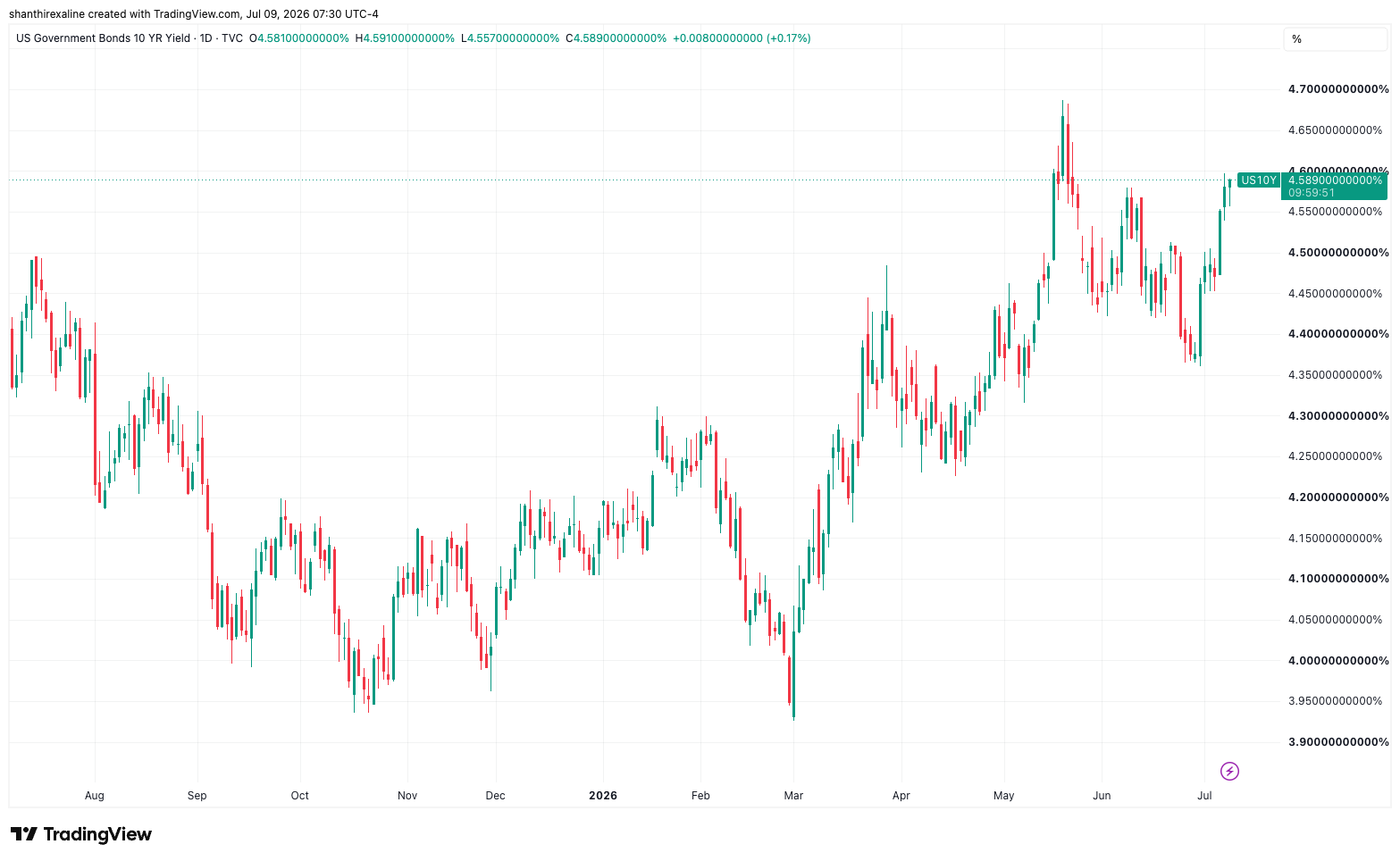
Source: TradingView
What's driving the move?
The recent rise in Treasury yields reflects a combination of hawkish Fed expectations, persistent inflation concerns, and growing geopolitical uncertainty. The June FOMC minutes reinforced the view that policymakers are divided over the rate outlook even as they remained concerned about inflation, prompting markets to reprice the path of monetary policy.
At the same time, higher oil prices linked to Middle East tensions have renewed concerns about inflation. After Iran violated the mid-June preliminary peace deal earlier this week, prompting the U.S. to retaliate, oil prices that had given up its war premium resumed its climb. Shipping traffic that began limping toward normalcy after the peace deal has crawled since the week’s escalation. Saxo’s strategists said in Thursday note that the disruption is a reminder that the Strait of Hormuz never fully reopened and that the recent removal of the geopolitical risk premium may have been premature.
Additionally, the ongoing fiscal deficits and heavy Treasury issuance may be pushing investors to demand higher yields to hold long-term government debt. Together, these factors have fueled the latest move higher in benchmark rates
Why it matters for stocks
Rising Treasury yields can pressure equities through several channels. They can become a headwind for equities by increasing the discount rate used to value future corporate earnings. This tends to weigh most heavily on growth-oriented sectors such as technology, where a large portion of valuations is based on expected future profits.
For now, major stock market gauges are trading near record highs, with techs remaining the backbone of the current bull run, although the rally has been broadening out now. Retail traders' positioning in the futures market suggests a cautious near-term outlook for equities. Sentiment toward E-mini Nasdaq 100 (NQ) futures remains broadly neutral, with long positions only marginally outnumbering shorts, according to MarketFramework data.
The balanced positioning indicates a lack of strong conviction among traders, reflecting uncertainty over the market's next directional move.,
Higher yields also make government bonds more attractive relative to stocks, potentially prompting investors to shift capital away from risk assets. In addition, elevated borrowing costs can pressure corporate investment, earnings growth, and share buyback activity. If yields continue to climb, investors may increasingly question whether current equity valuations can be sustained in a higher-rate environment.
Inflation scare or structural shift?
A growing number of investors believe the recent rise in Treasury yields may reflect more than just shifting expectations for Fed policy. Increasing attention is being paid to the term premium, which is the extra compensation investors demand for holding long-term government debt instead of rolling over a series of short-term securities.
Persistent fiscal deficits, rising Treasury issuance, geopolitical uncertainty, and concerns about the long-term inflation outlook are leading some investors to demand higher compensation for tying up capital in 10-year bonds.
If yields are rising primarily because of a higher term premium rather than stronger economic growth and inflationary pressure, the implications for financial markets could be more significant. Unlike shifts in Fed rate expectations, which can reverse quickly as economic data changes, an increase in the term premium tends to be more structural and longer-lasting. That would suggest the bond market is repricing the risks associated with inflation, government borrowing, and long-term policy uncertainty.
For equity investors, this distinction matters. A rise in yields driven by stronger growth can often support corporate earnings and offset some valuation pressure. But when yields rise because investors require a larger risk premium to hold long-term debt, stocks may face a tougher environment as borrowing costs increase and valuation multiples come under pressure.
What investors should watch next
Investors should watch three things:
- inflation data,
- Fed commentary
- Treasury auction demand
Together, these factors will determine whether the recent rise in yields proves temporary or evolves into a more structural repricing of long-term interest rates. Oil prices and Middle East developments also remain important, as renewed inflation fears could keep upward pressure on yields and test equity valuations.
For now, equities have remained relatively resilient. However, if Treasury yields continue to climb, the bond market could emerge as the biggest challenge to the stock market's rally. The coming weeks will reveal whether this is merely another inflation scare or the beginning of a broader repricing of interest-rate risk across financial markets.


