Alphabet's earnings delivered strong revenue growth and upbeat AI commentary, but beneath the headlines was a development that futures traders may find harder to ignore: cash flow is starting to buckle under the weight of the AI buildout.
Traders promptly bid down the stock in Thursday's session, down more than 6%.
Free Cash Flow Turns Negative for the First Time in Years
The clearest signal came from free cash flow, which fell to negative $5.86 billion in the second quarter, marking the first quarterly cash burn of this magnitude in more than a decade. Free cash flow represents the cash left after operating expenses and capital expenditures, making it one of the market's preferred gauges of whether growth is creating value or simply consuming capital.
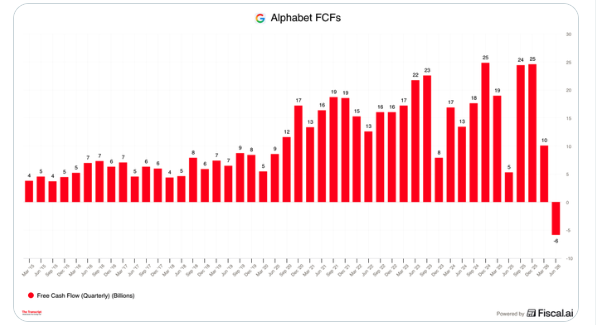
Source: Fiscal.ai chart, via The Transcript’s X account
The culprit was not difficult to identify. Alphabet spent a staggering $44.9 billion in capital expenditures during the quarter, up 100% year over year (YoY), driven largely by the race to expand AI infrastructure.
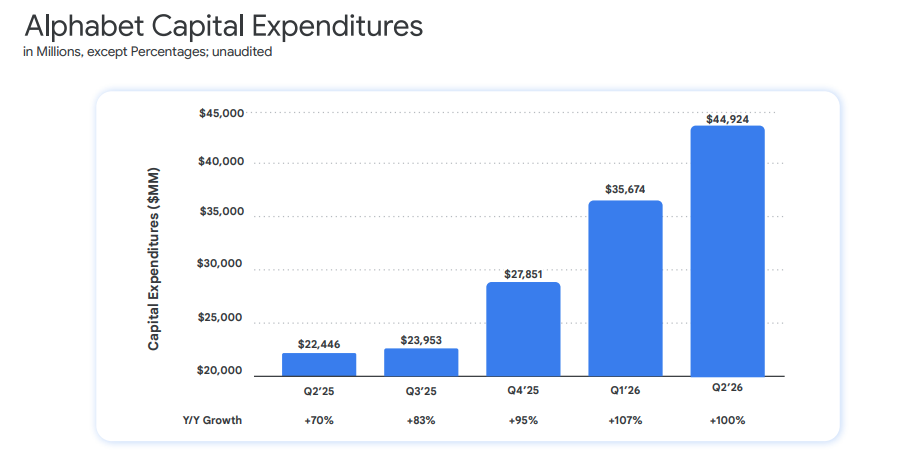
Source: Company
More importantly, management signaled that the spending surge is far from over. CFO Anat Ashkenazi raised full-year capital expenditure guidance to $195 billion-$205 billion, up from the prior $180 billion-$190 billion range, underscoring the company's willingness to keep investing aggressively despite the near-term hit to cash generation.
Ashkenazi warned that FCF will remain under pressure due to investments in technical infrastructure.
Lloyd Financial Chief Investment Strategist Colin Symons, however, thinks the company is justified in spending to develop services people want. “And the reason that they're not slowing down spending is the demand is there and the demand is there so strongly that they're talking about using third parties to supplement,” he said. Symons expects capex to slow down in 2028, or even 2027 if the company chooses to.
How Much AI Spending Is Too Much?
The honest answer is that there's no single dollar figure that separates disciplined AI investment from overreach but there are four signals that, together, tell traders when spending has crossed from "ambitious" into "alarming."
Capex growth outpacing revenue growth: Alphabet's capital expenditures roughly doubled year over year while revenue grew 24% and Cloud grew 82%. A widening gap between how fast a company spends and how fast it earns is the clearest mathematical warning sign. If that ratio keeps stretching for multiple quarters running, the buildout is compounding faster than the business can absorb it.
A lengthening payback runway: A $514 billion Cloud backlog looks reassuring until you ask when that revenue actually converts to cash. Management has already said meaningful TPU system sales won't show up until 2027, meaning today's spending and tomorrow's return are separated by a multi-year lag that keeps extending even as the checks get larger. Spending becomes "too much" not when it's big, but when the runway to recoup it keeps pushing further into the future.
A shift in how the spending gets financed: Alphabet covered part of this quarter's cash gap with a $49.6 billion equity raise and $20.3 billion in new debt. Capex funded out of operating cash flow is a sign of strength; capex funded by issuing shares or bonds is a claim against future earnings — dilution or interest expense that erodes the eventual payoff. The tripwire is when external financing turns from a one-off into a recurring quarterly habit.
Whether it's a company problem or a sector problem. One mega-cap posting negative free cash flow is a company-specific story. If Microsoft, Meta, or Amazon report the same capex-driven cash squeeze in the same earnings season, that's no longer about Alphabet — it's the market discovering the entire AI infrastructure cycle may be overbuilt, a far bigger repricing event for the Nasdaq than any single stock's guidance.
In the meantime, the market has already cast an early vote. A revenue beat that still triggers a 5%+ premarket sell-off shows that strong growth alone no longer buys AI spenders a pass. Investors are now pricing capex as a risk to be justified, not a story to be celebrated by default. That reaction, more than any guidance number, is the real-time answer to how much is too much: it's whenever the spending outruns the market's patience for proof.
The Other Side of the Story: Google's AI Investments Are Producing Results
Otherwise, Alphabet’s print more than satiated Street expectations:
EPS: $9.11 Vs. year-ago’s $2.31 (the strong increase reflected unrealized gains in equity securities portfolio)
Revenue: $119.80 billion (+24%) Vs. $116.93 billion consensus
Alphabet’s Cloud revenue jumped 82% to $24.8 billion, accelerating from the 63% rate in the first quarter, due to strong demand for AI infrastructure, and AI solutions. More importantly, cloud backlog grew to $514 billion. Symons said third-party TPU chip sales are also included in the cloud numbers, creating some noise there. But the strategist thinks the backlog is very solid right now,
Why Nasdaq Futures Trade Should Care
For Nasdaq futures traders, the significance of capex spike extends well beyond one earnings report. The AI trade has largely been built on the assumption that massive infrastructure spending today will translate into outsized profits tomorrow. Alphabet's results highlight the growing tension between that promise and the mounting costs required to pursue it. As long as revenue growth keeps accelerating, investors may tolerate the spending. But if returns fail to scale as quickly as expenditures, the market's focus could shift from AI opportunity to AI efficiency.
The question for NQ bulls is no longer whether companies will spend on AI. It's whether the eventual payoff can justify an investment cycle that is beginning to consume cash faster than even the largest technology companies can generate it. If Alphabet is any indication, the AI arms race may be entering a phase where investors scrutinize returns as closely as innovation.
Lloyd Financial’s Symons thinks investors will live through the capex fears. Investor skepticism is primarily due to higher real rates, he said, adding that people want near-term earnings due to the higher real rates. “So, what we really need to see is for real rates to calm down. I actually think that's pretty likely in the short term at least because we have priced in a lot of stress.”