Gold climbed more than 2.5% and silver outperformed with a nearly 3.5% advance, both bouncing off recent lows, as the June consumer price inflation (CPI) print came in cooler than expected. But with oil still climbing on renewed U.S.-Iran tensions, the rally may be facing its first real test almost as soon as it started.
What Sparked the Precious Metal Rally
A Bureau of Labor Statistics report released Tuesday showed a let up in energy prices in June dragged the monthly inflation reading to its lowest level in more than six years . The softness was broad based, as reflected by the core rate, which was unchanged relative to the previous month and also represented a 5-½ year low.
On an annual basis, headline inflation eased to 3.5% and core inflation slowed to 2.6%, matching March's rate and marking its lowest level since February.
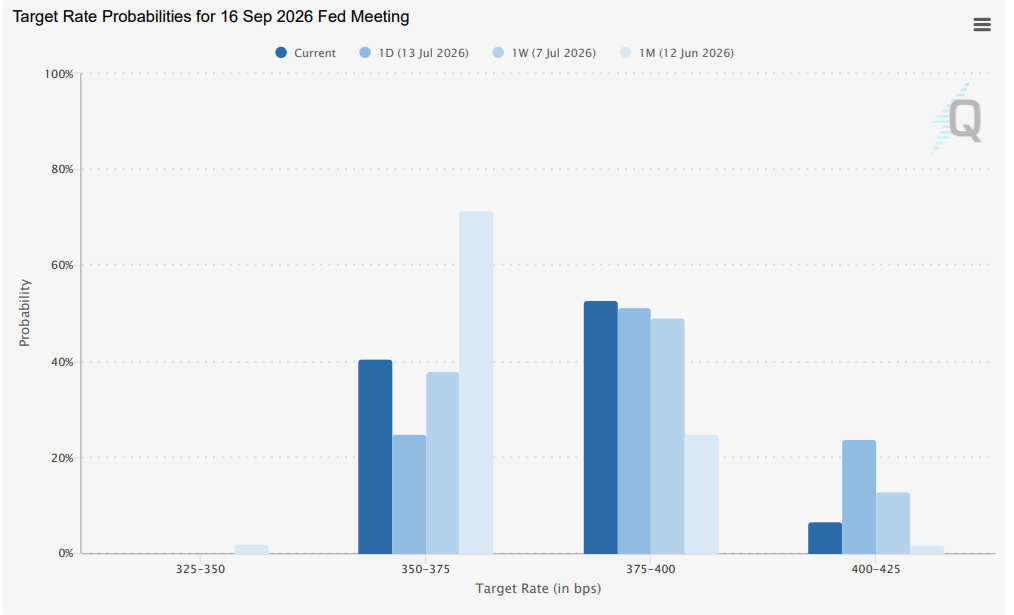
The reaction across markets was immediate, with particularly gold and silver seeing strength. The mechanism is straightforward: softer inflation data compressed expectations for further Fed tightening, with fed funds futures pricing an 87.71% probability of a pause at the July meeting, up sharply from 58.3% the day before, while odds of a September hike fell to 59.5% from 75.1%.
September Meeting Rate Move Probabilities
Source: CME FedWatch Tool
That repricing pulled the 10-year Treasury yield down to 4.577% and knocked the U.S. Dollar Index (DXY) down 0.38% to 100.85 — both of which mechanically support dollar-denominated metals by lowering real yields and the opportunity cost of holding non-yielding assets.
The Oil Risk Premium Complication
The catch is that this disinflation narrative is colliding with a live inflation risk from an entirely different direction. Brent crude has climbed above $85 and WTI above $80 as the U.S. and Iran both claim authority over the Strait of Hormuz, with Washington carrying out further strikes and Tehran declaring the corridor closed "until further notice,” a claim U.S. Central Command has dismissed.
Strategists have argued the current oil spike looks like a risk premium rather than a genuine supply shock, since the futures curve isn't pricing sustained disruption and no major energy infrastructure has been directly hit. But the risk to gold and silver is less about whether oil eventually retreats and more about what happens if it doesn't. A prolonged energy-price shock could feed back into future inflation prints and complicate the Fed's path, even after a cooperative CPI report. Ahead of Tuesday's release, LPL Head of Macro Strategy Kristian Kerr had flagged exactly this dynamic. A soft print could be read as backward-looking if refined fuel markets keep signaling future price pressure.
Silver's Extra Variable: Industrial Demand
Silver's setup is more layered than gold's. Roughly 58% of annual silver demand is industrial and therefore the white metal is exposed not just to the monetary/real-yield channel that drives gold, but also to growth expectations. A hawkish Fed or an oil-driven growth slowdown hits that industrial demand engine directly, on top of the standard rate-sensitivity silver shares with gold.
That dual exposure helps explain why silver sold off harder than gold during the market's more hawkish stretches this month. The gold-to-silver ratio currently sits near 70, well above its 50-year average of roughly 60. This suggests silver is relatively undervalued versus gold rather than reflecting any structural shift in the relationship between the two metals. It's a level worth watching: a narrowing ratio would suggest silver catching up as risk appetite improves, while a widening ratio would signal the industrial-demand headwind dominating.
Gold’s Structural Floor Beneath Near-term Noise
Gold is also a beneficiary of central bank buying. The People's Bank of China (PBoC) added roughly 14.93 tonnes to its gold reserves in June, its largest single-month purchase since 2023 and its 20th consecutive month of buying.
That kind of buying reflects decade-long reserve-diversification mandates rather than a reaction to any single CPI print, and it offers a structural floor that's independent of this week's data.
That distinction is likely to matter most in the coming days. Tuesday’s bid in gold and silver is a rate-repricing trade, sensitive to Warsh's tone, Wednesday's PPI print, and where oil settles. Whether that near-term move evolves into something more durable will depend less on any single data point and more on whether the disinflation trend holds up against a live and unresolved energy-price risk.


