
Gold futures (GC) for December delivery briefly broke above $4,500 immediately after the U.S. July consumer price inflation (CPI) print, marking the first time the yellow metal went past the psychological barrier in more than two months. The contract has since pulled back, although still trading with a decent gain.
Why did the data add sheen to gold?
A Boring Print
With no major surprises, all the numbers that mattered in the report came in line with expectations, offering no ammunition to the rate-hike camp. The CPI report failed to revive expectations for further Fed tightening, removing a potential headwind for gold, with the CME FedWatch tool now showing the odds of a rate hike at nearly 40%, down sharply from over 48% a day earlier.
Rate Hike Odds Drop Further
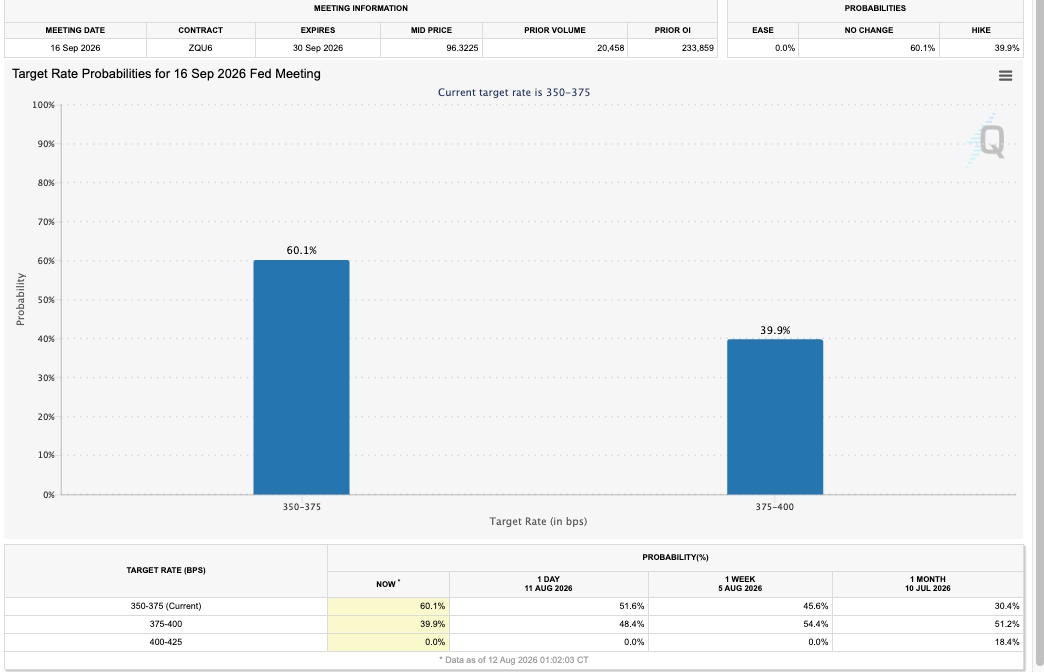
At the same time, inflation remained sticky enough to preserve the metal’s appeal as a hedge against persistent price pressures.
The bigger question now is whether the metal can hold above $4,500 as markets turn their attention to the Federal Reserve's Jackson Hole symposium later this month.
Why $4,500 Matters
The intraday move above $4,500 is significant not only because of the round-number psychology but also because it shows that buyers were willing to chase the metal higher even without an unequivocally dovish CPI report.
A sustained break above the level could reinforce bullish momentum and encourage traders who had been waiting for confirmation to add exposure.
An intraday break, however, is not the same as a confirmed technical breakout.
Gold needs to demonstrate that $4,500 can transition from resistance into support. A sustained close above the level would carry more technical significance than a brief post-CPI spike above it.
If the level holds, traders who had been waiting for confirmation could be encouraged to add exposure, potentially reinforcing the bullish momentum.
If gold repeatedly fails around $4,500, however, the move could begin to look more like a liquidity test than the start of another sustained leg higher.
That makes the next few sessions particularly important.
The gold chart shows a strong recovery from the June–July correction, with December futures now around $4,468, having reclaimed the 20-day and 50-day moving averages. The next immediate hurdle is the $4,501 area, where the 200-day SMA sits. A sustained move above that level would strengthen the bullish reversal and put $4,589.5 as well as the recent swing area into focus. Above that, the larger breakout trigger is around $4,900.
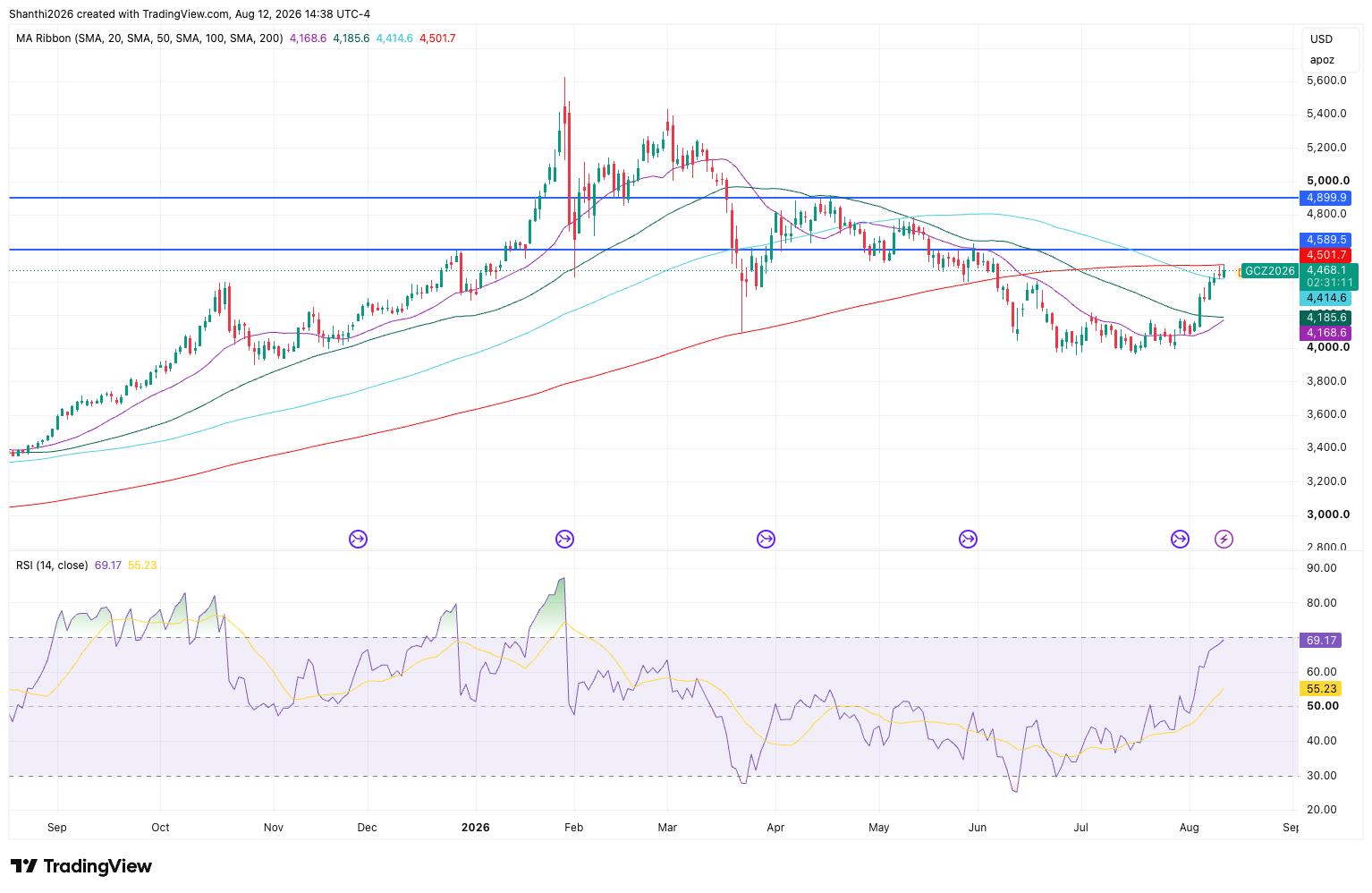
Source: TradingView
Momentum is also supportive but approaching a key threshold. RSI has surged to 69.17, up sharply from the July lows, putting it just below the conventional 70 overbought level. That means gold has room to extend higher, but the rally is becoming increasingly vulnerable to a pause around $4,500–$4,590. On the downside, $4,414.6 (100-day SMA) is the first important support, followed by the $4,185–$4,169 zone where the 20- and 50-day SMAs are clustered. The technical setup remains bullish as long as gold holds above the 100-day average, but a decisive break above $4,590 would provide a much stronger confirmation of the next leg higher.
Gold Needs Confirmation From the Bond Market
The next major test for the breakout is likely to come from Treasury yields.
Gold does not pay interest, so rising real yields increase the opportunity cost of holding the metal. Falling real yields, by contrast, can make gold more attractive.
The relationship is more nuanced than simply saying “lower yields are bullish for gold.”
Real yields broadly reflect nominal yields adjusted for inflation expectations. Therefore, gold can remain supported even if nominal yields are relatively stable, provided inflation expectations rise enough to keep real yields contained.
That is why traders should watch the 10-year real yield alongside the nominal Treasury curve.
If nominal yields stabilize while inflation expectations rise, real yields could soften and provide additional fuel for gold.
If nominal yields rise faster than inflation expectations, real yields could climb and make it harder for gold to sustain the breakout.
The Dollar Is the Other Half of the Equation
The dollar is another important confirmation signal.
The post-CPI decline in the dollar was supportive for gold, as a weaker U.S. currency makes dollar-denominated bullion relatively cheaper for overseas buyers. The DXY fell to an intraday low around 99.64 after the CPI release.
A continued dollar decline would therefore reinforce the bullish case.
But a dollar rebound, particularly if accompanied by higher Treasury yields, would make the $4,500 breakout considerably more vulnerable.
The strongest bullish combination for gold would be a weaker dollar alongside falling or contained real yields.
Jackson Hole Becomes the Next Big Test
The next major event on the radar is the Federal Reserve’s annual Jackson Hole symposium, scheduled for Aug. 27-29
Markets will be looking beyond the headline CPI number for clues about how policymakers interpret the inflation outlook and, more importantly, how much confidence they have in returning inflation sustainably toward 2%.
A dovish message could strengthen gold's breakout. If Fed officials acknowledge continued progress on inflation and leave the door open to easing, traders could increase bets on lower rates, potentially weighing on yields and supporting gold.
A hawkish message would present a different challenge. If policymakers emphasize persistent inflation, resilient economic activity or the need to keep policy restrictive for longer, Treasury yields and the dollar could rise. That would increase the opportunity cost of holding gold and potentially trigger a pullback below $4,500.
Positioning Could Determine Whether the Breakout Has Legs
Price action is only one side of the equation. Positioning could determine whether the move above $4,500 develops into a sustained trend or becomes an opportunity for existing longs to take profits.
If speculative positioning has already become heavily long, a move above $4,500 could initially attract momentum buyers but leave the market vulnerable to a sharp reversal if the macro backdrop fails to confirm the breakout.
Conversely, if positioning remains relatively restrained, the move could have more room to run as sidelined traders respond to the technical confirmation.
This is where MarketFramework's positioning data can provide an additional read-through: whether profitable traders are becoming more aggressively positioned for further upside, and whether unprofitable traders are moving in the opposite direction.
The distinction between fresh buying and short covering will also matter. A rally driven by new long exposure is generally a stronger signal of conviction than one driven primarily by traders exiting losing short positions.
Can Gold Hold Above $4,500?
For now, the CPI has done enough to keep the bullish narrative intact. The report did not provide the inflation shock that could have forced markets to price out easing expectations or revive the prospect of another Fed hike.
But the CPI alone does not validate a sustained move above $4,500.
Gold now needs confirmation from the broader macro backdrop. A decline in Treasury yields, a softer dollar and growing confidence that the Fed's next policy move will eventually be toward easing would strengthen the case for the breakout to hold.
Jackson Hole could provide that confirmation—or challenge it.
The key question for traders is therefore no longer whether gold can sustainably move above $4,500. The question is whether the Fed will give the market enough reason to believe that the metal can stay there.


