Gold gave traders a round trip on Thursday. After surging more than 4% on Wednesday, the metal pushed to an intraday high of about $4,527, its strongest level since early June before reversing and slipping back under $4,500, ending the day slightly lower near $4,481.
That is a classic whipsaw: a sharp move in one direction that quickly snaps back the other way, leaving both bulls and bears bruised.
The tug-of-war behind that round trip is the story worth understanding, because it tells you what gold needs in order to break higher from here.
What Lit the Fire: The Treasury Buyback
The rally started with a surprise from the U.S. Treasury. On Wednesday it said it would at least double the size of its "buyback" operations for longer-dated government debt — lifting the cap from $2 billion to at least $4 billion per operation in the 10-to-30-year part of the market, running from September through early November.
A buyback is simply the government purchasing its own bonds back, which supports their price and pushes yields (the interest rate on those bonds) lower.
It worked, at least for a day. The 30-year Treasury yield dropped roughly 9 basis points to 5.18%, and the 10-year fell about 5 basis points to 4.63%. (A basis point is one-hundredth of a percentage point.) The U.S. dollar also broke below 99 on its index for the first time in three months.
Both moves are pure fuel for gold. The metal pays no interest, so when yields fall, the "opportunity cost" of holding it, the return you give up by not owning a bond instead shrinks. And because gold is priced in dollars, a weaker dollar makes it cheaper for buyers using other currencies.
Lower yields plus a softer dollar is about as friendly a backdrop as gold gets, and it responded by ripping to a two-and-a-half-month high.
Why it Faded: The Relief Didn't Last
Then Thursday flipped the script. Yields rebounded, with both the 10-year and 30-year climbing back around 3 to 5 basis points as traders decided one day of Treasury support does not fix the deeper problems which include large budget deficits, heavy bond issuance, and sticky inflation.
As yields turned back up, gold's tailwind became a headwind, and the metal handed back its intraday gains to finish in the red.
What kept the drop shallow was the dollar. Even as yields bounced, the greenback stayed weak and continued to slide, which cushioned gold's pullback. So rather than a clean breakout or a clean reversal, we got a stalemate, the whipsaw.
The Cross-Currents Pulling Gold Both Ways
Right now gold is caught between two forces:
On the bullish side, the dollar is at a three-month low, and the standoff between the U.S. and Iran keeps a safe-haven bid under the metal.
President Donald Trump escalated the rhetoric again this week, threatening a sweeping new economic campaign against Tehran, and with shipping through the Strait of Hormuz still heavily restricted, higher energy prices feed the inflation story that often sends investors toward gold as a hedge.
On the bearish side, the minutes from the Federal Reserve's July meeting showed many policymakers still lean toward raising interest rates if inflation does not cool. Higher rates are gold's natural enemy, because they lift the opportunity cost of holding a metal that yields nothing. That hawkish tilt is what capped the rally and keeps a lid overhead.
The steady bid underneath it all comes from central banks, which have kept buying gold to diversify their reserves a slower, structural source of demand that doesn't move day to day but quietly supports the floor.
The Technical Picture
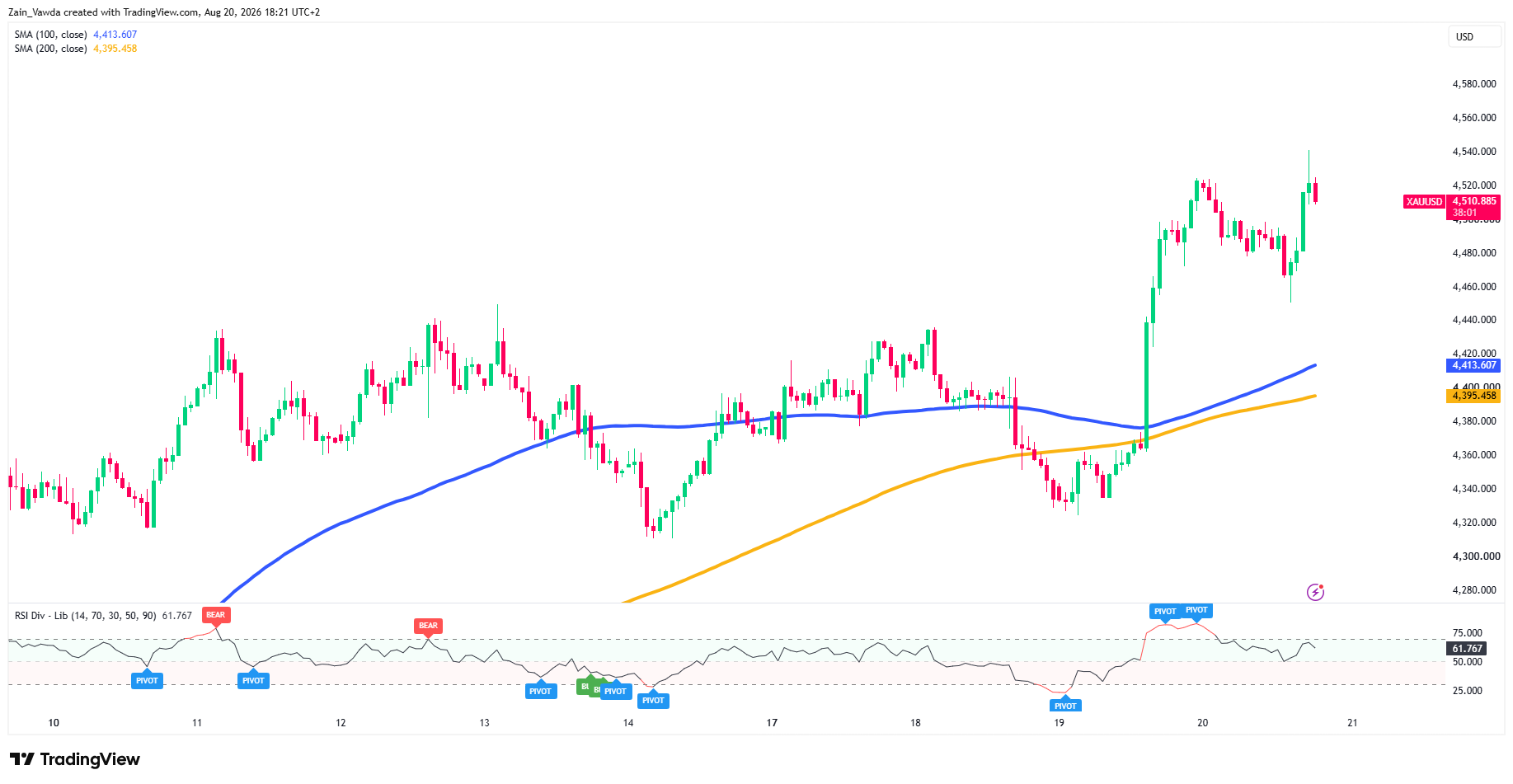
Gold displays strong bullish momentum following a powerful breakout, surging to a high near 4,540 before consolidating around 4,510.
Price trades well above both the 100-period MA (4,413.61) and 200-period MA (4,395.46). Both MAs are sloping upward, confirming solid underlying trend structure.
Gold One-Hour Chart, August 20, 2026
Source: TradingView
The RSI sits at 61.77, pulling back from overbought levels (>70) into neutral-bullish territory, pointing to brief consolidation rather than a reversal.
Key Technical Levels:
- Resistance: 4,540 (recent high). A breakout targets psychological extension levels above.
- Support: 4,480 (minor intraday base), followed by 4,413 (100 MA dynamic support).
What to Watch into the Week's End
The immediate catalyst is Friday's S&P Global flash PMIs early monthly surveys of business activity.
A soft reading would revive worries about growth and could pull yields down again, helping gold; a firm reading would keep the higher-for-longer rate story alive and pressure it.
Beyond that, next week does the heavy lifting: Nvidia's earnings on Wednesday, and then new Fed Chair Kevin Warsh's first Jackson Hole keynote on Friday, August 28. With the Fed still openly debating a hike, Warsh's tone could be the single biggest swing factor for gold into month-end.
The bottom line: gold's Wednesday spike was real, but it was built on a one-day rates move that partly reversed.
Until the market is convinced yields are heading lower for good not just for a day, expect more of this two-way chop around the 200-day average, with a weak dollar and the Iran risk premium keeping the dips relatively shallow.
Retail Trader Positioning
Looking at the latest Positioning Edge data on trader positioning, we can see extreme bullish divergence over a 4-hour window, driven by a sharp split in positioning between trader cohorts.
Profitable traders have rapidly increased their long exposure to 57% with a +421 average trade metric.
With smart money aggressively accumulating long positions while losing traders reduce exposure, the positioning structure signals high-conviction bullish sentiment.


