
The U.S. Dollar Index (DXY) is receiving a modest lift from renewed Middle East tensions, which have revived safe-haven demand for the U.S. currency. Yet the index has remained trapped mostly above the 101 level since mid-June, as traders struggle to reconcile a cooling labor market with expectations of future Federal Reserve rate hikes. With neither narrative gaining a decisive edge, the upcoming Federal Open Market Committee (FOMC) minutes could provide the catalyst needed to break the deadlock.
Rate Repricing Fuels Dollar's Revival
The U.S. dollar, which sank to a four-year low near the 95 level in late January, has staged a notable recovery since then. The greenback's trajectory has been broadly higher, aided in part by the U.S.-Iran conflict that erupted on Feb. 28 and revived demand for safe-haven assets. At the same time, the U.S. economy has remained relatively resilient, prompting markets to reassess the monetary policy outlook. Expectations that were once firmly centered on Fed rate cuts gradually shifted toward a higher-for-longer stance, with some traders even entertaining the possibility of further tightening as stronger growth and energy-driven inflation pressures persisted.
As a result, the DXY has gained roughly 2.9% since the start of the year, marking a sharp reversal from 2025, when the index tumbled 9.4%. Much of last year's weakness stemmed from an aggressive repricing of Fed policy, as investors increasingly anticipated a series of rate cuts amid slowing inflation and concerns about economic momentum.
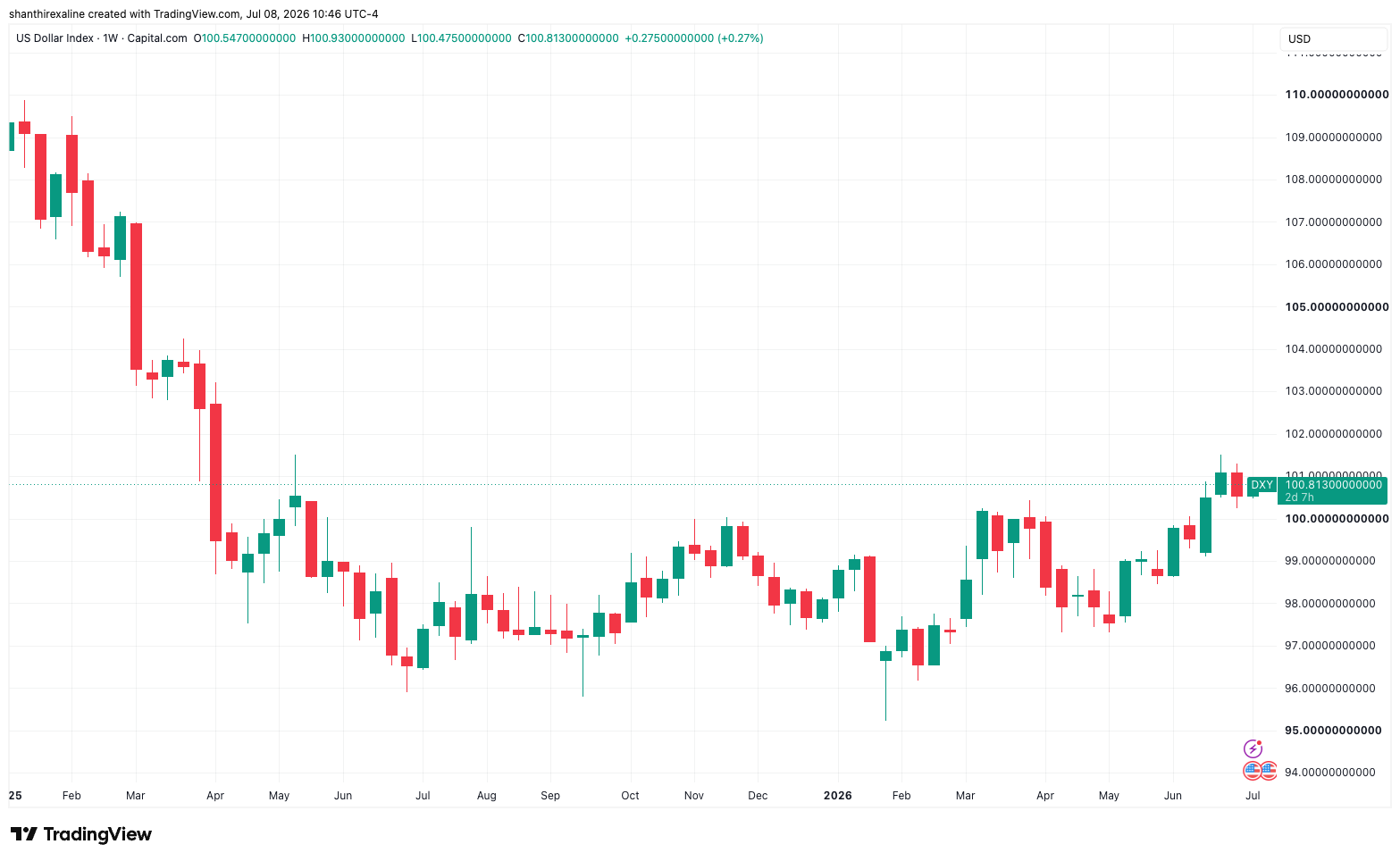
Source: TradingView
That recovery, however, appears to have lost momentum in recent weeks. Despite geopolitical support and a resilient labor market, the dollar has struggled to build on its gains, suggesting traders remain unconvinced that the Fed will abandon its easing bias altogether. This tension between economic resilience and lingering rate-cut expectations has left the DXY trapped in a relatively narrow range, setting the stage for the upcoming FOMC minutes to potentially determine the index's next directional move.
June Jobs Jolted Dollar — Only Briefly
The June jobs report initially weighed on the dollar, as softer-than-expected non-farm payrolls (NFP) growth reinforced expectations that the Fed could begin lowering interest rates in the coming months. Treasury yields edged lower following the release, dragging the DXY down as traders increased their bets on monetary easing.
However, the weakness proved short-lived. Renewed geopolitical tensions in the Middle East and the resulting flight to safety helped the greenback regain its footing, allowing the index to remain comfortably above the 101 level. The swift recovery suggests that while economic data remains an important driver, broader risk sentiment and safe-haven flows are currently limiting the dollar's downside.
Check out MarketFramework's Trade Validator tool for insights into retail traders' positioning in futures contract.
Why Safe-Haven Flows Are Currently Winning
Renewed Iran-linked flight-to-safety demand is reinforcing the hawkish-Fed case rather than competing with it. If Middle East escalation pushes crude back up, that revives the same energy-driven inflation pressure that helped justify Fed Chair Kevin Warsh's hawkish June pivot in the first place, alongside the classic risk-off bid for Treasuries and dollars that accompanies any geopolitical shock.
It’s two aligned narratives (hawkish Fed + inflation-reviving oil shock) against one (a softening labor market that argues for easing). This potentially explains why the DXY has held above 101 despite a payrolls miss.
What the FOMC Minutes Need to Show
The minutes sometimes reveal much more than what the vote-count tells. It pays to look for the consensus behind the unanimous June vote and committee members’ commentary on labor market and inflation, especially in light of the Middle East-driven oil shock.
How the FOMC Minutes Could Move DXY
| Scenario | How Minutes Would Read | DXY Reaction |
|---|---|---|
| Strongly Hawkish | Broad consensus behind the hawkish dot plot; limited internal dissent; energy inflation flagged as a persistent, not transitory risk | DXY breaks above 101.8 resistance and pushes toward next technical level |
| Moderately Hawkish | Unanimous vote masked real debate; some officials wanted softer language; June jobs weakness wasn't yet visible to the committee | DXY stays rangebound around current levels, awaiting next catalyst |
| Dovish Tone | Multiple officials flagged downside growth and labor market risks even before the June miss; hawkish conditioned on incoming data | DXY retreats toward 99.4-100 support |
| Non-committal | Minutes emphasize preference for data-dependence over forward guidance | Muted reaction and rangebound move until next first-tier data readout |
DXY's stall above 101 reflects two aligned forces: a hawkish Fed and an inflation-reviving oil shock. These two forces are collectively holding off one softening signal from the labor market. Wednesday's minutes won't end that standoff outright, but will show which way the Fed is leaning. A confirmed hawkish tone likely pushes DXY through 101.8, while any sign of internal hesitation sends it back toward 99.4-100. Either way, this range doesn't survive the next data cycle for long.


