The Dow is running well behind the rest of Wall Street, down roughly 850 points (−1.7%) intraday and shaping up as the weakest of the major indices as an oil spike and renewed U.S.–Iran tensions drain risk appetite in the countdown to the Fed.
Oil has jumped 6.9% to $89.88 and Brent is back above $90 after President Donald Trump vowed to hit Iran “hard” in response to the overnight surprise attacks — a war premium that lands squarely on the Dow’s industrial and cyclical core.
What’s Actually Dragging the Blue Chips
Read the point-move carefully, because it flatters the story.
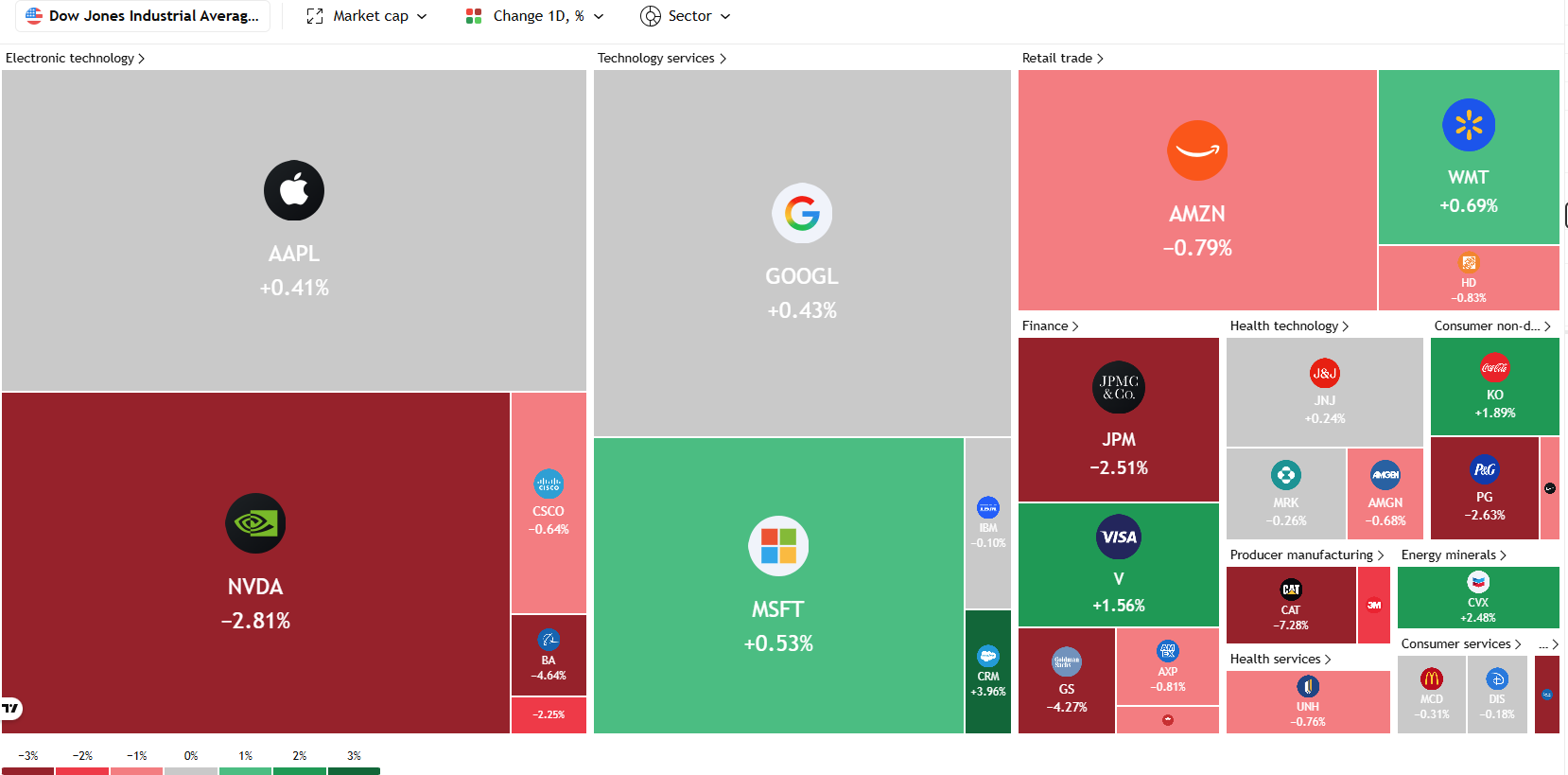
Today’s weakness is not a semiconductor event — it is oil bleeding into industrials and cyclicals. Caterpillar, Boeing and Goldman Sachs are among the heaviest drags, compounded by a Procter & Gamble revenue miss.
Nvidia — the Dow’s only pure semiconductor, at roughly 2.3% of the price-weighted index — is close to a rounding error inside this move, and Ford’s 5% post-earnings jump is actively cushioning it.
Dow Jones Heatmap
Source: TradingView
The tell is in the dispersion: the S&P is down about 0.9% and the Nasdaq about 1.2%, so a 1.6% Dow drop overstates the damage. A large blue-chip point-move is best read against breadth and the other benchmarks — not taken as a full-market verdict on its own.
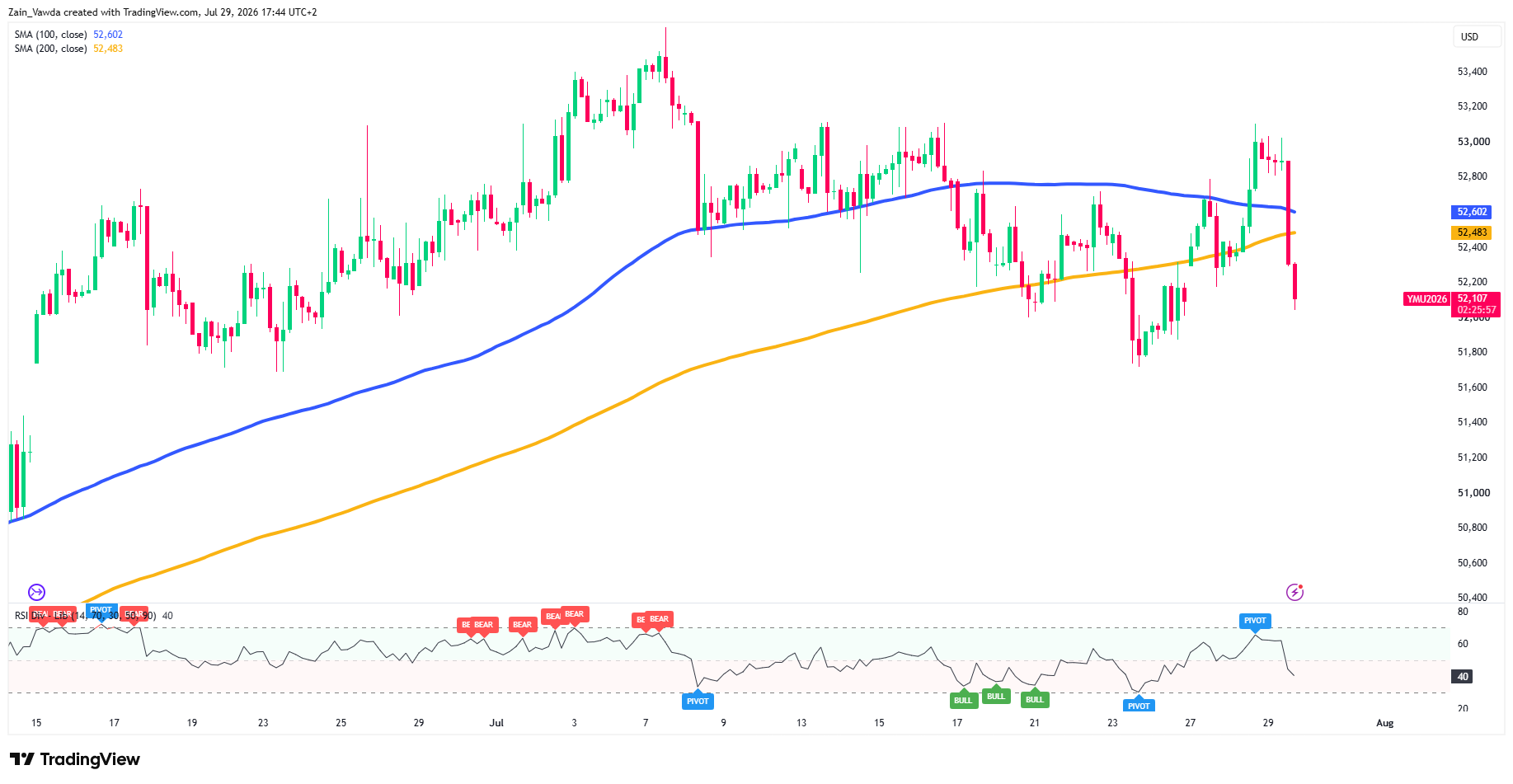
The Technical Picture (YM, H4)
The break is decisive. Price sliced through the 100/200-MA cluster (52,602 / 52,483) in a single impulsive candle and now prints 52,107 on the H4, flipping that moving-average band into overhead resistance.
RSI at 40 is rolling off its pivot high — momentum has turned lower rather than merely paused.
First support is the late-July 51,800–52,000 base; a loss there opens an air pocket toward 51,600 with the weekend gap from July 15 at 51,400 next.
Dow Jones (YM) Four-Hour Chart, July 29, 2026
Source: TradingView
The Warning Beneath the Calm
Barclays is flagging exactly that complacency. Strategist Emmanuel Cau warns that stocks are vulnerable to a reversal investors aren’t appreciating: despite the Iran re-escalation, the market stays relaxed on inflation risk, visible in rising oil short positions and muted inflows into inflation-protected Treasuries. Yet financial conditions keep tightening — Fed hike expectations are climbing and U.S. real yields are approaching levels that have historically become a headwind for equities.
With trend-followers already short Treasuries and summer liquidity thinning, Barclays argues the positioning cushion is limited and tactical hedging looks prudent — even with the Q2 earnings backdrop still strong.
What’s Next
The 2:00 pm ET Fed decision is the swing. A hold at 3.50–3.75% is expected, but a live 35% hike tail and Warsh’s press conference make the 2:30 tone the real volatility event, with Microsoft and Meta earnings after the close.
To put it simply, any Fed surprise could accelerate the selloff.