The Dow Jones Industrial Average closed the final day of August with a thud, falling 374 points (–0.7%) to 53,185.90, as fresh US–Iran strikes over the weekend lifted oil, pushed Treasury yields higher, and drained risk appetite.
The S&P 500 slipped 0.33% to 7,686.14. Yet for all the red on the screen, the bigger story is that Wall Street still closed out a turbulent August in the green, the Dow’s fifth straight monthly gain.
What Drove the Session
The catalyst was geopolitical. Over the weekend the US and Iran exchanged fire for the first time in about a month: US forces struck rocket launchers on Iran’s Larak Island in the Strait of Hormuz, and Iranian state media said Tehran hit back at US bases in the region.
The renewed hostilities dashed hopes that traffic through Hormuz would settle down, and crude jumped: WTI settled up 2.83% at $85.76 and Brent rose 2.71% to $90.49. Higher oil feeds inflation fears, and those fears pushed longer-dated Treasury yields up, with the 10-year hitting its highest level since January 2025.
Pricier oil plus higher yields is a headwind for stocks, and it landed on a market already digesting Friday’s hawkish message from Federal Reserve Chair Kevin Warsh, who stressed the Fed still has work to do on inflation.
Money markets now lean toward a September rate hike.
Inside the Dow Jones
The Dow bore the brunt, and the damage was concentrated in its heaviest hitters. Because the Dow is price-weighted, higher-priced shares move the index more than lower-priced ones, its most expensive members carry the most sway.
Goldman Sachs and Caterpillar, two of the priciest names in the index, each fell about 1% and did an outsized share of the point damage. Alphabet’s roughly 2.4% slide and Amazon’s 2% drop piled on.
Breadth was poor: around 23 of the 30 Dow components ended lower. The lone bright spot came from energy, Chevron, the Dow’s main oil name, firmed as crude rallied, the very move hurting the rest of the tape.
Other Movers
Away from the blue chips, the sharpest moves were in utilities. PG&E tumbled about 19% and Edison International slumped roughly 24% after California lawmakers blocked a proposal to cap what individuals can claim from utilities whose equipment sparks wildfires; several analysts downgraded the pair afterward.
Apple slipped nearly 2% after Bloomberg reported that Phil Schiller, who runs the App Store and product events, is stepping back from those roles, a day before John Ternus formally takes over as CEO from Tim Cook.
On the winning side, Tesla jumped about 4% on a Model 3 price cut, and defense contractor SAIC rose around 4% after lifting its full-year forecast.
August in the Books
Step back, and August was a win despite the turbulence.
The Dow finished the month up around 1%, its fifth straight monthly gain and 15th positive month of the last 16.
The S&P 500 rose about 2.6% and the Nasdaq Composite about 3.9%, both their first monthly gains since May, and the S&P and Dow each set record highs along the way. Tech did much of the heavy lifting, with energy catching a late bid as oil climbed.
The catch: the same inflation worries that drove Treasury yields to multi-year highs are still here, which is why a strong month ended on a sour note.
The Chart: Dow futures (YM)
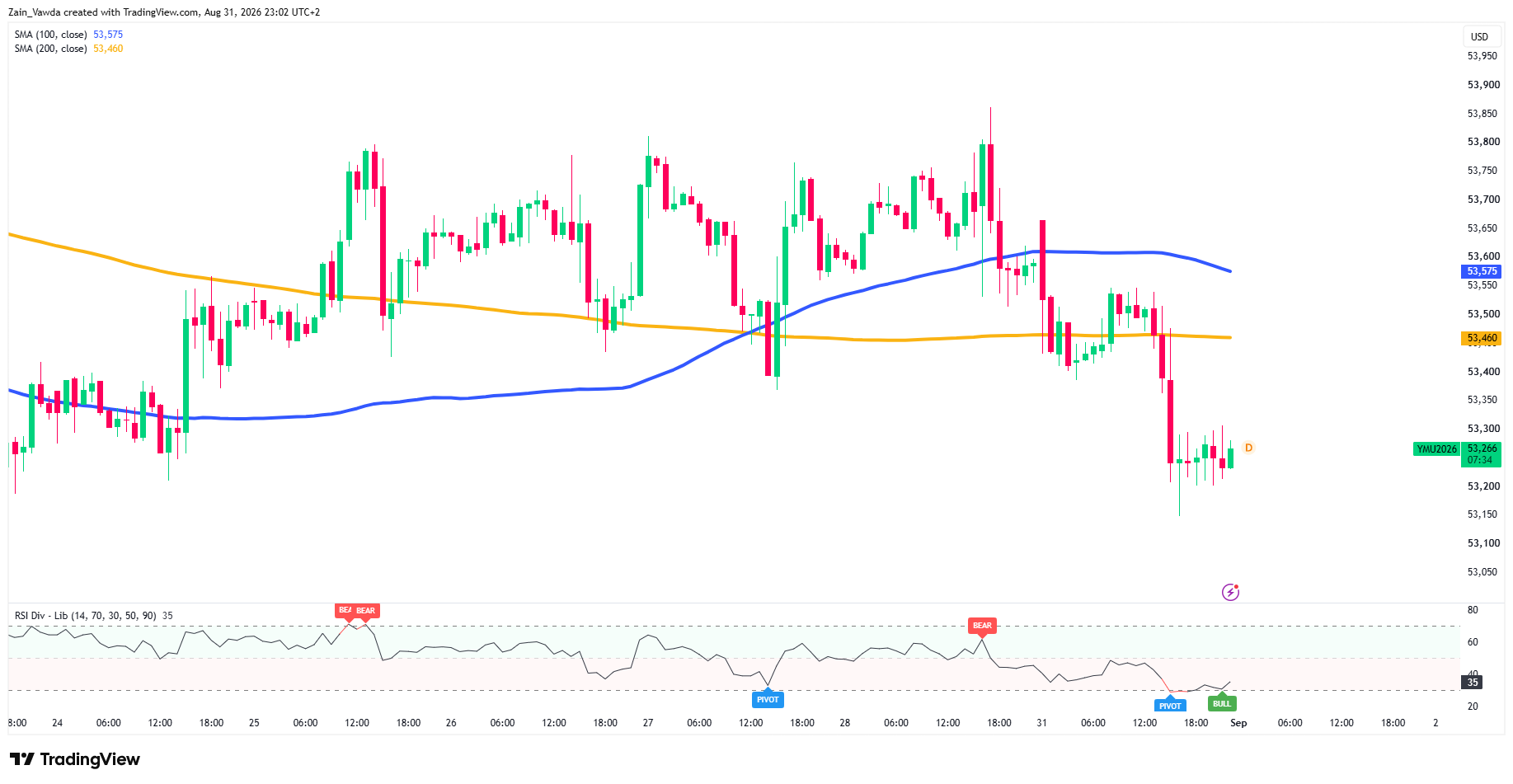
On the hourly chart, Dow futures sold off hard into the close, breaking below both their 100-period average (~53,575) and 200-period average (~53,460) to print a low near 53,150 before steadying around 53,270.
That leaves the short-term trend pointing down, with those two averages, roughly 53,460 and 53,575 now the first resistance overhead.
The one tentative positive: momentum (RSI) flashed a bullish divergence at the lows, an early hint the selling may be tiring. A rebound needs to reclaim 53,460–53,575 to matter; lose 53,150 and the next support sits lower.
Dow Jones (YM) One-Hour Chart, August 31, 2026
Source: TradingView
What’s Next
The week is data-heavy. The August jobs report lands Friday and is the marquee event for September rate-hike odds; ISM manufacturing and services surveys are due earlier in the week, and G20 finance ministers are meeting in Asheville, North Carolina.
Expect the tape to keep taking its cues from oil, yields, and any fresh Iran headlines until the jobs number arrives.


