Thursday’s job report tempered rate hike odds, which proved negative for the dollar. Following the downside job surprise, the U.S. Dollar Index (DXY) pulled back below the 100 psychological barrier, settling 0.52% lower at 100.86. But the index, which measures the dollar’s performance against a basket of six major foreign currencies, has rebounded quickly as the market reopens after the long weekend in observance of the Independence Day holiday.
The DXY was last seen trading up 0.20% at 101.06. Among individual pairs, the greenback was particularly strong against fellow safe havens: up 0.61% against the Japanese yen, and 0.29% firmer against the Swiss franc.
Check out MarketFramework’s Trade Validator tool for how futures traders are leaning.
Dollar on Bullish Trajectory
The DXY has been broadly higher this year since bottoming in late January. The strength is a function of traders pushing back expectations of aggressive Federal Reserve easing as the domestic economy remained resilient despite the conflict between the U.S. and Iran that engendered an oil shock.
The bullish dollar trend, however, faced one of its biggest tests last Thursday as the all-important June payrolls report, the last key labor market statistics ahead of the July Federal Open Market Committee (FOMC) meeting, showed job gains that were about half of what the market braced for. Downward revisions to the previous two months’ data exacerbated the weakness.
Soft Job Numbers Cloud Fed Outlook
The soft June non-farm payrolls (NFP) report reset the clock on interest rate expectations. The CME FedWatch Tool, which is constructed based on futures traders’ expectations, now see the odds of a September hike at 54.4%, down from the 62% seen earlier.
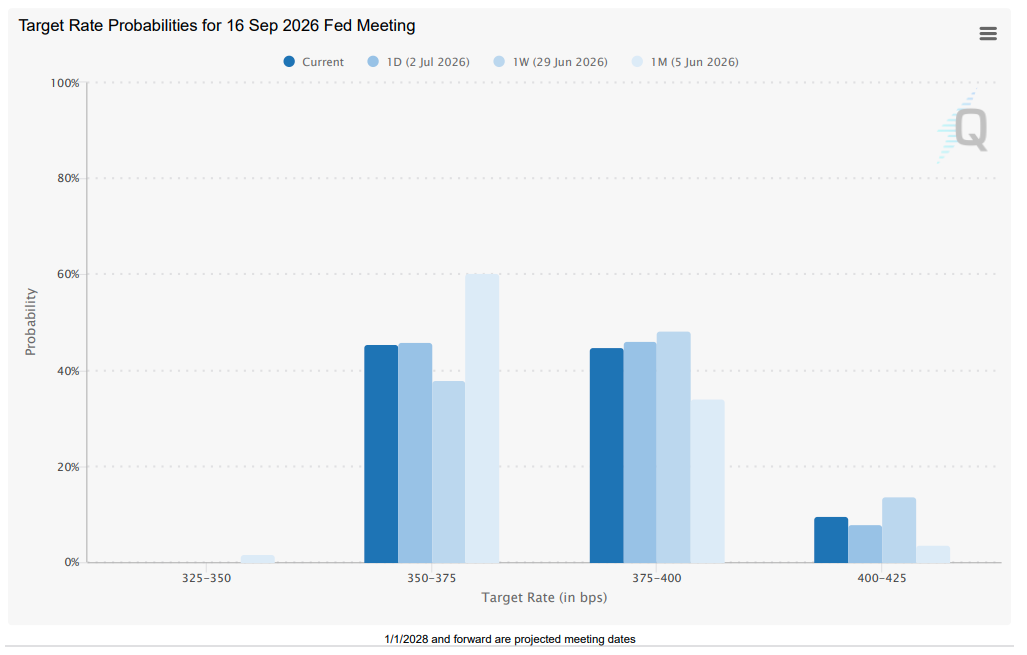
Source: CME
Lower interest rate expectations typically weigh on the dollar by narrowing the yield advantage of U.S. assets relative to their global peers. The two-year Treasury note, which has the highest correlation to the Fed funds rate, saw yields dipping as low as 4.104% following the jobs report, before recovering partially and ending the session at 4.164%.
Why the Dollar Has Rebounded Anyway
Despite the initial selloff, the dollar has managed to recover much of its losses. That resilience reflects the fact that one employment report alone is unlikely to convince policymakers that the labor market has weakened sufficiently to justify immediate easing.
Several other factors continue to support the greenback:
- Treasury yields remain historically elevated, keeping U.S. assets attractive to global investors.
- Geopolitical uncertainty in the Middle East continues to generate periodic safe-haven demand.
- Economic growth outside the U.S. remains uneven, limiting the appeal of alternative reserve currencies.
- Positioning dynamics have also helped, with traders reluctant to unwind bullish dollar bets after months of persistent strength.
ING strategists expect the DXY support of 100.60 to hold on Monday, with a bias for an upward shift. They also noted that the dollar was partly supported by a “no-show” by the Bank of Japan despite the yen weakening beyond the 162 level. The strategists said the next intervention window could be July 16-18, ahead of the next public holiday in Japan. Goldman Sachs has already raised its USD/JPY target for the year to 165, citing higher-for-longer U.S. yields and only gradual BOJ tightening.
Inflation Could Decide the Next Move
The next major catalyst for the dollar is likely to come from the June FOMC meeting minutes and the upcoming inflation data.
The FOMC minutes, due Wednesday, will provide greater insights into the thinking behind the pause decision in June and policymakers’ expectations concerning the rate trajectory.
If upcoming consumer price figures show that price pressures remain sticky, expectations for a Fed easing could be pushed further into the future, allowing the dollar to extend its recovery.
Conversely, another round of softer inflation data coupled with continued evidence of labor market cooling would strengthen the case for rate cuts, potentially placing renewed downward pressure on the greenback.
Some of the key inflation data to watch out for include:
- ISM’s price indices data due on Monday
- New York Fed’s consumer inflation expectations for June due on Tuesday
- June consumer price inflation due on July 14
- June producer price inflation due on July 15
- University of Michigan preliminary inflation expectations data due on July 17
The Technical Picture
From a technical perspective, the DXY remains constructive as long as it holds above the 99.40–99.50 support zone, which marks the higher low underpinning the current rally. A decisive break below that area would signal that bullish momentum is fading and could expose the index to a deeper retracement toward the 98 handle. On the other hand, the swift recovery above the psychologically important 101 level suggests buyers remain active on dips.
Dollar Momentum Constructive — For Now
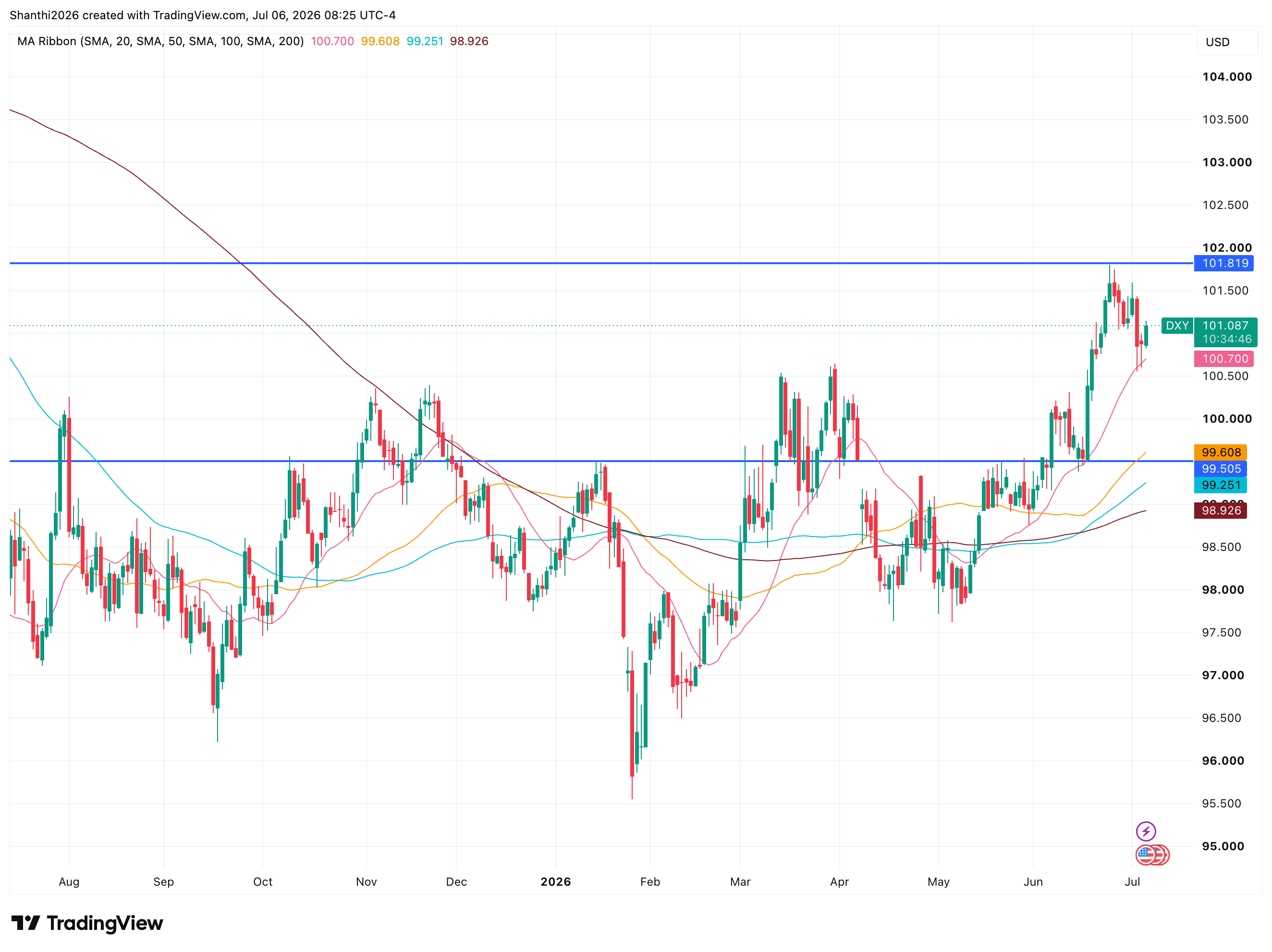
A sustained move above recent highs would reinforce the broader uptrend and could open the door toward the 102 area. On the downside, failure to hold above 101 could encourage additional profit-taking, with the 100 psychological level remaining the first major support for bulls.
Verdict on the Dollar
The softer June jobs report has undoubtedly challenged the bullish dollar narrative by reviving expectations for Federal Reserve rate cuts. However, the broader backdrop of elevated Treasury yields, lingering geopolitical risks, and continued relative strength in the U.S. economy suggests the dollar's uptrend has not been decisively broken.
For now, investors are likely to treat the payrolls report as an important warning sign rather than definitive evidence that the Fed is ready to pivot aggressively. Whether the dollar rally survives will ultimately depend on whether upcoming inflation and labor market data confirm that the slowdown is becoming entrenched or prove that June's weakness was merely a temporary setback.


