The U.S. dollar is entering September with a catalyst that was missing for much of the summer. Rising oil prices are now reinforcing, rather than undermining, the case for higher U.S. interest rates.
Renewed U.S.-Iran hostilities have pushed crude sharply higher, with WTI nearing $90 and Brent crossing $94 as concerns over disruptions around the Strait of Hormuz return to the market.
In the latest on the Middle East geopolitical front, the U.S. Central Command confirmed that at 12 p.m. ET “U.S. forces began striking Islamic Revolutionary Guard Corps (IRGC) targets in Iran.”
https://x.com/CENTCOM/status/2094826294466810366
While oil prices spike, the global bond sell-off has pushed the U.S. 10-year Treasury yield to around 4.80%, its highest level since early 2025.
That creates an unusually powerful combination for the greenback. Higher oilraises the inflation risk; higher inflation makes a Fed tightening easier to justify; and higher Treasury yields increase the relative appeal of dollar and dollar-denominated assets.
Iran Is Changing the Inflation Equation
The immediate catalyst is geopolitical. The latest escalation has taken crude back toward levels that can materially affect the inflation outlook. Brent has climbed above $90, while WTI has moved toward the upper-$80s as the market reassesses the risk of prolonged supply disruptions.
That matters for the dollar because this is not simply a conventional risk-off shock.
If oil rises because of a supply disruption, the initial reaction can be negative for economic growth. But if the shock also keeps inflation elevated, the Federal Reserve has less room to respond with rate cuts. That is precisely the tension markets are beginning to price.
Yields May Be the Dollar's Bigger Catalyst
The Treasury market could ultimately matter more than the geopolitical headlines.
As the 10-year yield climbed to roughly 4.80%, global government bond yields have also surged to multi-year highs. The move reflects a combination of inflation concerns, heavy government borrowing and expectations that central banks may need to remain restrictive for longer.
For the dollar, that creates a favorable rate differential.
The market is now pricing a materially greater probability of a September Fed hike following Kevin Warsh's hawkish messaging at Jackson Hole. The Fed futures had moved to a roughly 68% probability of a September hike, versus 35% before Warsh's comments.
That repricing gives the dollar something it has lacked: a credible rates-driven bullish narrative.
Positioning Has Flipped
The Euro FX (6E) futures trader base that was "Strong Long" and 100% long on Monday has now flipped entirely to "Strong Short." MarketFramework's Top Traded Contracts tool shows zero long positions and full short exposure. That's a late adjustment. After getting caught offside on the long side as the dollar rallied on Warsh's hawkish turn, this week's Iran escalation and the surge in yields, the crowd appears to have capitulated and chased the move.
Meanwhile, 80% of winning trades were long and 86% of losing trades were short, meaning the long trades had paid off before the reversal. It has been the shift into shorts that has been the weaker trade overall.
Read together, this looks like informed positioning and more like a trend-chasing crowd that was late to both sides of the move, ie long into dollar strength, then short only after most of the euro slide had already happened.
The Trade: Watch DXY's Reaction to 100
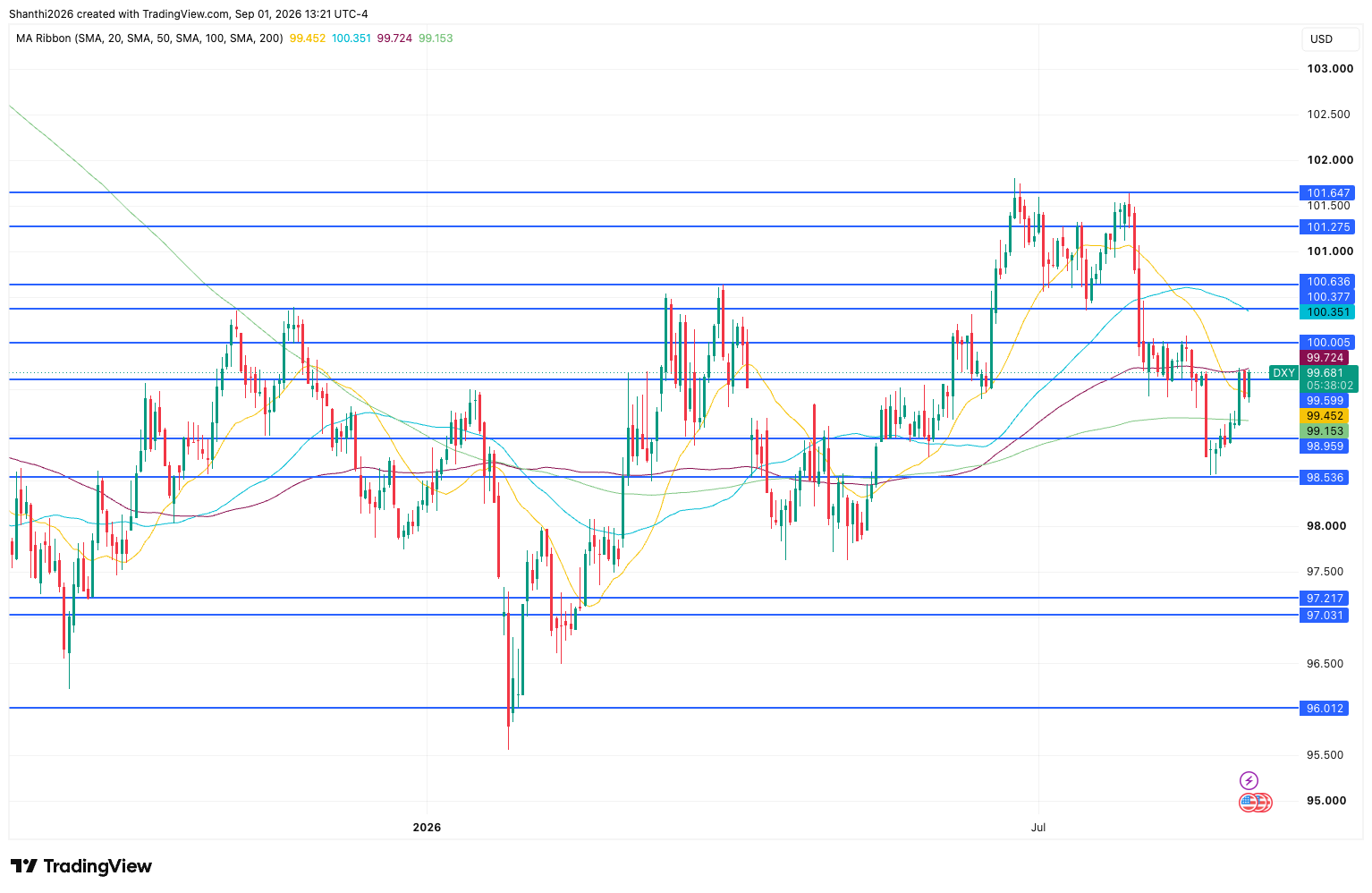
The U.S. Dollar Index (DXY) is trading around 99.70, putting the psychologically important 100 level directly in focus.
A sustained move through 100 would matter because it would transform the current dollar rebound from a short-term reaction into a potentially broader technical breakout.
DXY has staged a sharp rebound from the 98.536 support zone, reclaiming the 20-day SMA at 99.452 and pushing back above 99.599. Price is now hovering around 99.68, but the 100-day SMA at 99.724 represents an immediate hurdle. A sustained move above that average could strengthen the recovery and put the 100.005 resistance level back in focus.
The bigger test sits at 100.377–100.636, where the 50-day SMA near 100.351 converges with horizontal resistance. A break above that zone would improve the technical picture and open the door toward 101.275 and 101.647. Conversely, failure to clear 99.724–100.005 would leave the rebound vulnerable, with 99.599 as first support, followed by the 200-day SMA at 99.153 and 98.959.
Source: Y Charts
The upside case becomes more compelling if the macro backdrop continues to favor the dollar. If crude stays above $90 and the 10-year yield approaches or breaks 4.80%, the macro backdrop remains supportive of further dollar gains.
Conversely, a rapid de-escalation between Washington and Tehran could unwind the trade quickly: oil would retreat, inflation expectations would ease and Treasury yields could fall, removing two of the dollar's most important current catalysts.
For this week, therefore, the dollar isn't just a safe-haven trade. It is increasingly becoming a bet on whether the Iran-oil shock forces the Fed to stay hawkish.


