WTI crude is back above $86 a barrel, as renewed U.S.-Iran military tensions revive fears of further disruption around the Strait of Hormuz.
U.S. forces struck Iranian rocket launchers on Larak Island in the Strait of Hormuz, while Iran retaliated with missile attacks on U.S. bases in Jordan. These missiles, however, intercepted. The escalation has injected fresh uncertainty into efforts to restore more normal shipping through the critical energy corridor.
Commenting on the development, ING Commodities Strategists Warren Patterson and Ewa Manthey said, “This reinforces concerns about a prolonged stalemate between both sides and, as a result, disruptions to energy flows from the Persian Gulf.”
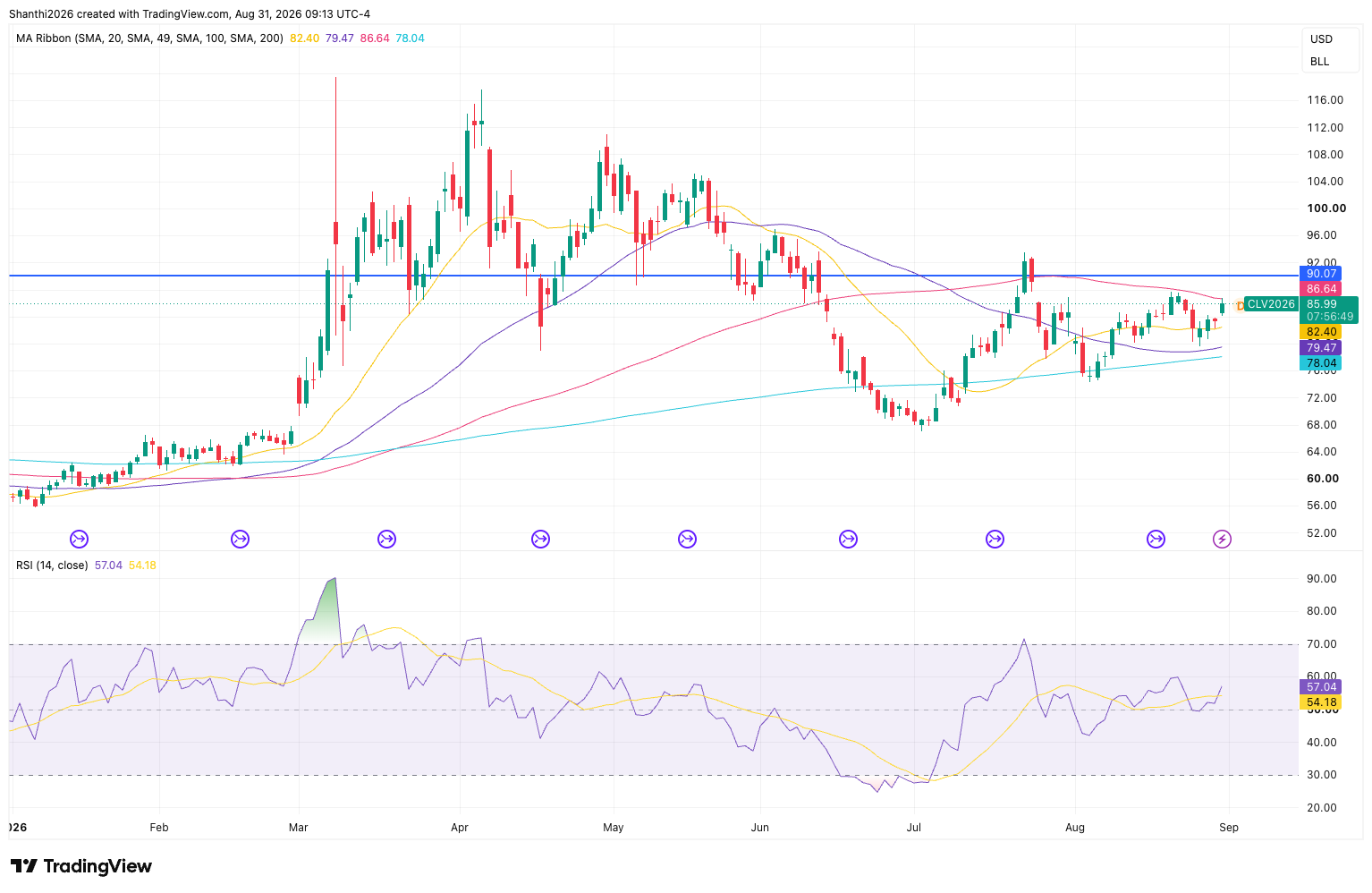
The timing is significant. Oil had been losing its geopolitical premium as markets focused on negotiations aimed at reopening the waterway. WTI fell more than 4% last week, but Monday's move has abruptly shifted the focus back toward supply risk. The WTI climbed more than 3.5%during Monday's session, with the contract reaching around the mid-$86 area.
Source: TradingView
$86 Becomes the First Test for Bulls
The move above $86 puts crude at an important technical juncture.
For bulls, the key question is whether WTI can hold above $85-$86 rather than simply spike through the area on geopolitical headlines. At $86.26, WTI is already testing the upper end of the recent trading range. A decisive extension above the Monday high would put $87-$88 on the radar before the psychologically important $90 level.
That makes $90 more than just a round number. It could become the next major test of whether traders are willing to price a more persistent supply disruption into crude.
The $90 Question: Breakout or Risk Premium Spike?
A move toward $90 would represent another important escalation in the oil market's risk pricing, but the sustainability of that move will depend heavily on what happens to actual flows through Hormuz.
The Strait remains the central variable. Roughly a fifth of global oil flowed through the waterway before the conflict, making any sustained disruption potentially far more consequential than a temporary geopolitical headline.
That distinction matters because the market has repeatedly shown that geopolitical fear can lift crude quickly, but prices need evidence of physical supply disruption to sustain a larger premium. Recent market commentary has similarly emphasized that actual oil flows through Hormuz, rather than tensions alone, will ultimately determine the durability of the rally.
COT Data: Shorts Could Fuel a Move Toward $90
The latest ICE WTI positioning data adds another layer to crude's rebound. Managed Money remained net short 10,359 contracts as of August 25, while Swap Dealers held a much larger net-short position of 76,442 contracts. That leaves a sizeable amount of bearish exposure that could come under pressure if WTI extends its move above $86.
But the positioning picture also carries a warning. Open interest fell by 37,177 contracts, or about 4.6%, to 778,174, suggesting the latest advance has not yet been accompanied by broad-based growth in outstanding positions. If WTI breaks higher while open interest begins to rebuild, the move toward $90 would look considerably more convincing. Until then, traders need to distinguish between a fresh bullish buildup and a geopolitical-driven short-covering rally.
Retail Positioning Tilts Bullish as WTI Reclaims $86
Retail positioning is also leaning in favor of a sustained crude rebound. The latest positioning data shows 67% of traders long WTI, with the contract carrying a “Strong Long” seven-day bias, according to MarketFramework’s Top Traded Contract tool.
More importantly, the crowd split suggests that the long side is currently outperforming. Winners are 71% long, while losing traders are 63% short. That is a constructive signal because it indicates that traders positioned for higher crude prices have, so far, been on the right side of the move.
The combination of bullish retail positioning and a still-net-short speculative position in the ICE COT data creates an interesting setup. If WTI holds above $86 and pushes through its recent highs, the short exposure highlighted in the COT report could provide additional buying pressure through short covering, while successful retail longs could remain incentivized to hold or add to positions.
However, there is an important distinction: retail positioning is already heavily long, so a failure to hold $85-$86 could expose those longs to a reversal. In that scenario, the crowded long positioning could accelerate the downside rather than provide support.
Three Scenarios for WTI
| Scenario | What to watch | Potential WTI path |
|---|---|---|
| Bullish breakout | WTI holds above $85-$86 and breaks Monday's high | $87-$90, with $90 becoming the next major test |
| Range-bound | Tensions remain elevated but shipping flows continue | $84-$88, as traders balance geopolitical premium against supply realities |
| Geopolitical Unwind | De-escalation or credible progress reopening Hormuz | $84-$88, as traders balance geopolitical premium against supply realities |
The Bigger Risk: A Geopolitical Feedback Loop
The danger for crude bulls is that the conflict creates a feedback loop.
Further attacks around Hormuz could reduce tanker activity, increase shipping and insurance costs and make physical barrels more difficult to move. That would give the market a fundamental reason to maintain a higher geopolitical premium rather than simply reacting to headlines.
At the same time, a sustained oil rally could feed back into inflation expectations, particularly through gasoline and other refined products. That would make the oil move relevant beyond energy markets, especially for interest-rate-sensitive assets.
Danish investment bank Saxo, however, opined that the upside risk is for now being capped as an estimated 6 million barrels per day (mb/d) to 7 mb/d. This is despite the recent re-escalation reducing the prospects of bringing the conflict to an end.
For now, however, $86 is the immediate battleground.
A sustained move above this area would shift the focus toward $88 and ultimately $90. Failure to hold $85-$86, by contrast, would suggest that Monday's surge was primarily a geopolitical shock rather than the beginning of a durable new leg higher.
For WTI traders, the message is straightforward: $86 is no longer just a price level—it is the line separating a geopolitical rebound from a potential breakout toward $90.


