Crude oil futures are doing something that frustrates both bulls and bears equally right now: refusing to commit. WTI (CL) has been struggling to trade above $100 a barrel since Thursday May 21. Price action has been breaking in one direction on a headline, reversing on the next, and leaving traders who chased the move holding the bag.
The market is pricing in two fundamentally incompatible future scenarios simultaneously and until one of them wins, this is what trading it looks like.
Where Things Stand Right Now for Oil Prices
The current state of play is genuinely complex. Let us break it down.
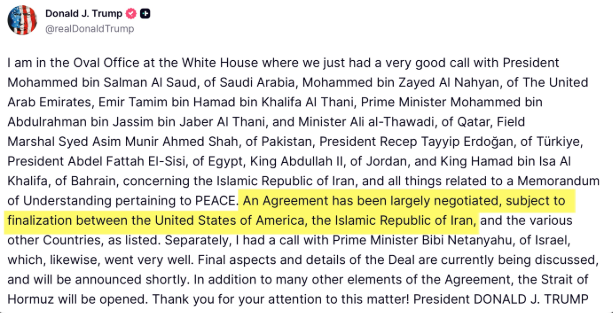
On the diplomatic front: Over the weekend, Trump stated publicly that a deal had been "largely negotiated" and that the Strait of Hormuz "will be opened." The framework reportedly involves a 60-day ceasefire extension, during which Iran would reopen the strait, be allowed to freely sell oil again, and broader nuclear negotiations would begin.
Multiple regional mediators such as Pakistan, Qatar, Saudi Arabia, the UAE, Turkey, Egypt, Jordan, and Bahrain have all been involved in pushing toward a resolution. Secretary of State Rubio described the proposed agreement as "a pretty solid thing on the table."
Source: TruthSocial
On the military front: Despite those diplomatic signals, the U.S. military conducted fresh "self-defense strikes" in southern Iran on Monday, targeting missile launch sites and vessels suspected of preparing to deploy mines near the strait. Iran's Revolutionary Guard then claimed it fired on an F-35 fighter jet and several drones it said had entered Iranian airspace.
These incidents didn't just rattle nerves, they caused an immediate 4% surge in CL prices on Tuesday, erasing the prior session's deal-optimism-driven losses in a single session.
On the negotiating details: Iran has not officially confirmed the proposed agreement. Semi-official Iranian news agencies which are routinely used to signal the government's position reported that "one or two" unresolved issues remain that are jeopardizing the deal. A senior Iranian diplomat stated Iran has made no commitment on nuclear issues including highly enriched uranium.
The two sticking points: Tehran's frozen assets and its insistence on retaining sovereign control over the Strait of Hormuz, which its parliament has described as "non-negotiable."
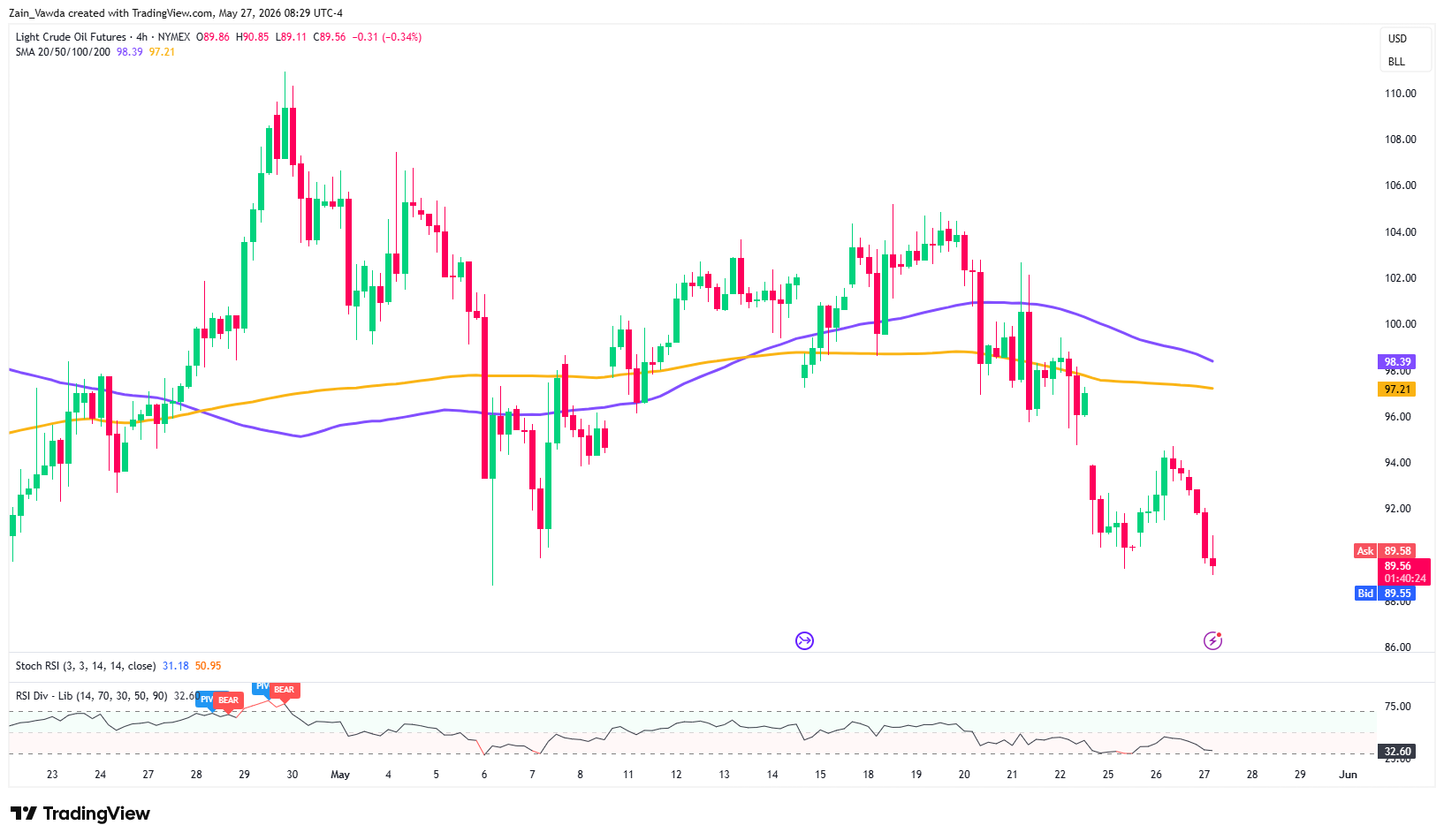
The result is a market that surged on deal optimism over the weekend, sold off further on Monday's diplomatic tone-down, spiked on Tuesday's military escalation, and is now pulling back again on Wednesday as traders seek clarity.
WTI is currently trading around the sub-$90 per barrel mark, down from Tuesday's bounce highs.
The Headline Traders Are Missing
Here is the critical insight that is getting lost in the daily whipsaw: even the most bullish deal scenario for crude oil bears may not play out the way they expect.
The bear case is built on a straightforward premise: deal signed → Hormuz reopens → Iranian barrels flood the market → crude prices collapse. Logical on paper. Incomplete in practice.
The inventory picture is the story the market keeps ignoring. Global oil inventories have been drawn down aggressively since the conflict began. Estimates from Kpler place the drawdown at approximately 60 million barrels since late March. The IEA has reported that global oil supply has been falling at a rate of 3.9 million barrels per day versus a demand decline of only 420,000 barrels per day. That is an extraordinary supply-demand mismatch.
Saudi Aramco has publicly warned that inventories now represent the market's last meaningful safety cushion, and that once they are depleted, any supply disruption would hit price directly with no buffer to absorb the shock.
What this means practically: Iran returning to the market doesn't flood a normal, well-supplied global oil system. It returns to a system that has been severely depleted. The early barrels of Iranian supply will not push prices into a bear market. They will simply begin refilling a critically undersupplied storage system. That is structurally supportive, not bearish.
Supply restoration is not instant. Even if the deal is signed tomorrow, the timeline for crude flows to normalize through the Strait of Hormuz involves tanker re-routing, insurance market normalization, port logistics, and Iranian production ramp-up. None of that happens overnight.
The physical market will remain tight for weeks, potentially months, after any diplomatic resolution. The market is not going to fully price out the Hormuz risk premium on a 60-day ceasefire with unresolved nuclear issues still on the table. Some premium remains regardless.
The Two Scenarios and What They Mean for Crude Oil
Crude Oil Futures (CL) Four-Hour Chart, May 27, 2026
Source: TradingView
Scenario A — Deal is signed and Hormuz reopens: The initial reaction will almost certainly be a sharp algorithmic sell-off. The headline alone will trigger significant stop runs as algorithmic systems price out geopolitical risk. WTI could flush toward the $88–$90 zone on the initial move, potentially lower if sentiment-driven selling accelerates.
However, the physical market fundamentals argue strongly that this dip would represent a buying opportunity rather than the beginning of a sustained bear market. Traders who understand the inventory reality and the slow pace of supply normalization should watch for capitulation and reversal signals rather than chasing the initial sell.
Scenario B — Talks break down, escalation resumes: A credible breakdown in negotiations particularly if accompanied by fresh U.S. strikes on Iranian energy infrastructure or Iranian retaliation against Gulf state assets would send WTI back through $100 rapidly. The prior highs around $112–$114 would come back into scope, and the broader macro situation (sticky inflation, tight supply) would amplify the move. The gap between current prices and the April highs represents significant upside for anyone positioned for a deal failure scenario.
The asymmetry right now arguably favors the upside. The downside case (deal signed, prices fall to $88–$90) is bounded by physical market fundamentals. The upside case (deal collapses, escalation resumes) is unbounded in the short term and could move far faster and farther than the bear case.


