The energy market is no longer trading as one broad, unified bet on geopolitical risk.
Crude oil is beginning to shed some of the war premium that propelled prices higher this summer, while natural gas remains exposed to a very different set of forces: scorching temperatures, electricity demand, LNG flows and tight regional inventories.
That divergence is becoming one of the clearest signals in commodities markets.
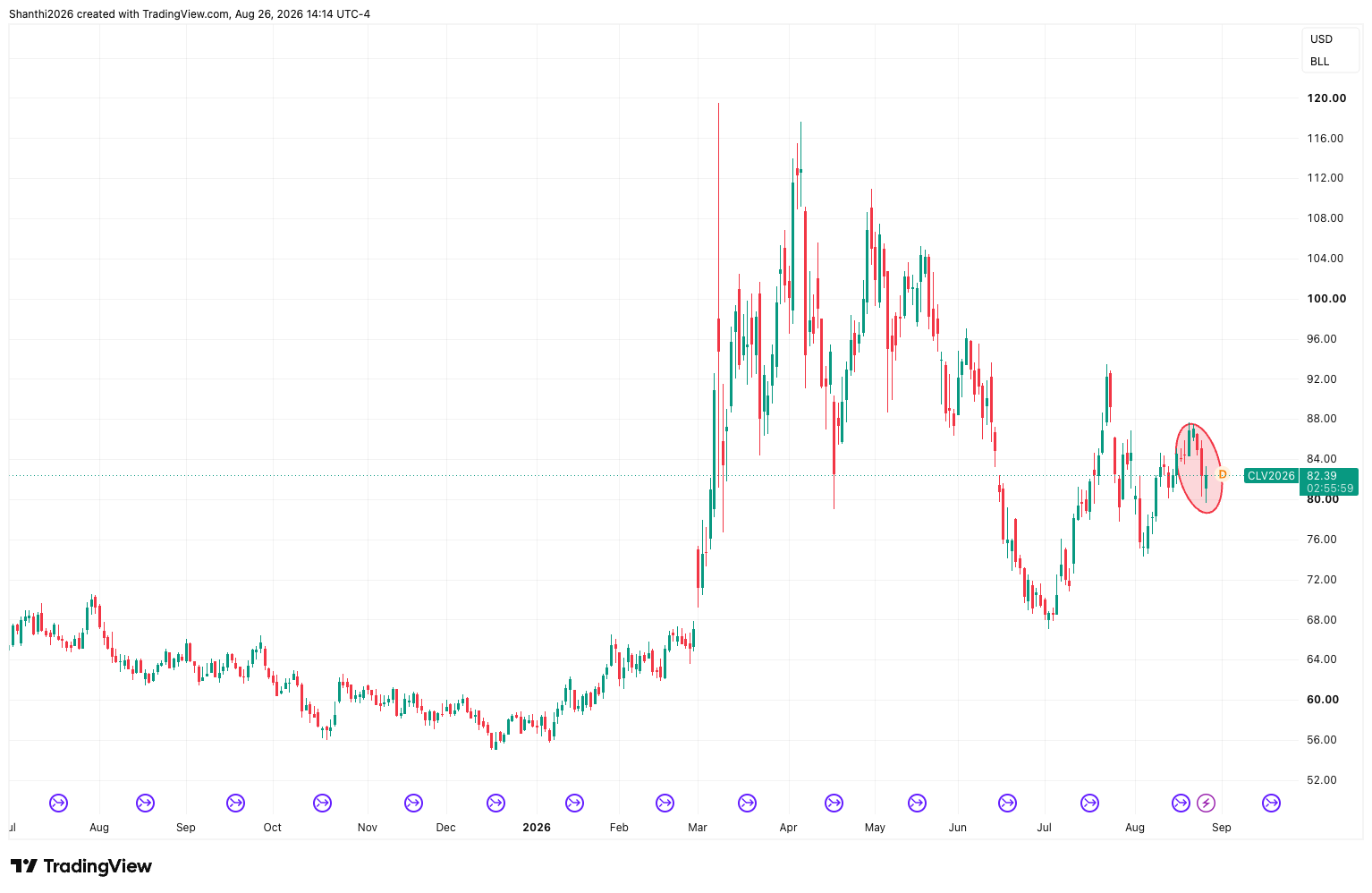
WTI and Brent crude have recently fallen as investors weigh the possibility of greater traffic through the Strait of Hormuz and renewed diplomatic efforts involving Iran and Oman. The former traded around $82.84 on Wednesday, down from a $89 near-term peak reached last week.
Source: TradingView
But the easing in crude does not mean the geopolitical risk has disappeared. The war has disrupted energy flows through a chokepoint that normally handles a huge share of global oil and LNG shipments, leaving both markets unusually sensitive to headlines.
Crude's War Premium Is Starting to Unwind
For oil traders, the central question is increasingly whether the physical supply disruption will prove as severe or as prolonged as feared.
The prospect of a framework for reopening the Strait of Hormuz has encouraged investors to price out part of the risk premium. Oil fell sharply over the past few sessions as hopes for negotiations improved.
The move is significant because crude had spent months carrying a substantial geopolitical premium. The conflict has constrained shipments and pushed oil materially above its prewar level, but ample production outside the Gulf and relatively healthy global inventories have helped prevent an even larger supply shock.
This week's U.S. petroleum data provide a more nuanced picture of the underlying crude balance. The Energy Information Administration (EIA) said U.S. commercial crude inventories increased by just 100,000 barrels in the week ended Aug. 21, leaving stocks at 428.9 million barrels, about 1% above the five-year average. At the same time, crude imports fell by 435,000 barrels per day to 6.2 million barrels per day, while refinery utilization remained elevated at 97.4%.
The tighter signal is coming from refined products. Gasoline inventories declined by 2.5 million barrels and distillate inventories fell by 2.2 million barrels, leaving gasoline stocks 6% and distillates 14% below their respective five-year seasonal averages. That suggests refiners are still processing crude at a strong pace even as product inventories remain relatively lean. The counterweight is demand: total products supplied averaged 20.5 million barrels per day over the past four weeks, down 3% from the same period last year.
That combination is important for CL traders. The EIA data do not point to an outright U.S. crude shortage, but they also do not provide a strong fundamental reason to aggressively sell the market on the assumption that supply is abundant. With refinery utilization high, product inventories below seasonal norms and crude imports falling, the physical market retains some underlying support even as the geopolitical premium unwinds.
The positioning data favors a bullish CL bias because winners are long while losers are heavily short. However, with the long-heavy crowd still losing money, chasing longs at current levels may carry near-term risk. A better setup would be to look for a pullback or confirmation that buyers can regain control before adding exposure.
Natural Gas Has a Different Problem
Natural gas is responding to a different equation.
In the U.S., the immediate driver is summer weather. Extreme heat pushes households and businesses to run air conditioners harder, increasing electricity demand and the amount of gas burned by power generators.
That can tighten the gas market even when crude prices are falling.
U.S. natural-gas futures have recently remained relatively subdued compared with European prices, with the October contract around $2.917 per million British thermal units. Moderating cooling demand and seasonal factors have weighed on the U.S. market.
But the picture can change quickly when temperatures surge. Earlier in the summer, a heat wave pushed U.S. power-sector gas demand to roughly 45.6 billion cubic feet per day, according to an August market review.
That sensitivity makes gas a weather market as much as a geopolitical one.
Europe Is Still Paying the Geopolitical Bill
The split becomes even more pronounced when the global gas market is considered.
European gas prices remain elevated because the region entered the conflict with relatively low storage levels while LNG supplies face disruptions connected to the Middle East and Hormuz.
European LNG prices recently climbed to their highest level since early 2023, while Dutch TTF gas remained elevated as traders worried about winter supply. European storage was reported at about 63%, below the five-year average and below the level targeted for the coming heating season.
That creates a potentially uncomfortable combination: crude can fall as geopolitical risk is discounted, while gas stays expensive because physical supply remains constrained.
For Europe, the problem is particularly acute because LNG cargoes are competing across continents for limited flexible supply.
LNG Keeps the Two Markets Connected
The separation is not absolute.
LNG has become a bridge between regional gas markets and global geopolitics. A disruption in the Middle East can simultaneously affect shipping, European inventories and Asian competition for cargoes.
The Strait of Hormuz is particularly important because it carries a major share of globally traded energy. Traffic has fallen dramatically from prewar levels, constraining the movement of both oil and LNG.
That means a diplomatic breakthrough could have an outsized effect on both markets but not necessarily in the same direction or at the same speed.
Crude could respond immediately by losing part of its geopolitical premium. Gas could remain supported if buyers still need to rebuild inventories ahead of winter.
The Bigger Market Signal
The most important takeaway is that "energy prices" are becoming an increasingly inadequate shorthand for what is happening in commodities.
Crude is primarily negotiating with geopolitics, inventories and expectations for restored supply.
Natural gas is negotiating with weather, power demand, LNG exports, storage and shipping.
Those forces can reinforce one another, but they can also move in opposite directions.
A decline in crude is welcome news for transportation fuels and inflation but it does not guarantee cheaper electricity, LNG or heating costs.
The energy complex is splitting. And for now, the weather may matter almost as much as the war.


