Monday should have been a bullish day for crude oil futures. The Trump administration unveiled its toughest sanctions against Iran to-date, warning any country that continues to do business with Tehran that it could face secondary penalties too. Treasury Secretary Scott Bessent dubbed the actions “Operation Economic Outcast,” describing it on social media as an economic version of D-day, with no carve-out even for China.
The West Texas Intermediate (WTI) contract ended Monday down 2.4% at $85.01. The losses have extended into Tuesday’s session, down more than 3% at just above $82-a-barrel in the afternoon session in New York. Brent crude futures extended their slide for a second straight session, falling 3.8% to $87.10 on Tuesday after a 2.3% drop on Monday as traders priced in easing geopolitical risk premiums. In the process, both benchmarks dropped to their lowest levels in more than a week.
For a market that has spent months trading on every Iran-related news, a muted reaction to the toughest rhetoric yet is the real story.
The Run-up Explains the Fade
Crude didn’t fall from a period of consolidation. It fell from a near-term peak. Both benchmarks had already climbed hard over the past two weeks as the oil market began factoring in such an eventuality. From an early August low, WTI crude had rallied nearly 16%, before the two-day sell-off. By the time Bessent announced the measures, much of it had already been factored in, giving less reason to keep buying.
This is the classic “buy-the-rumor, sell-the-news” setup, as positioning gets ahead of the news itself.
Escalation in Name, Restraint in Substance
Another explanation for the muted behavior is that the sanctions were lighter on specifics than traders feared. Strategists also suspect whether the U.S. would walk the talk. Given China is the biggest importer of Iranian crude, ING’s Warren Patterson and Ewa Manthey said it remains unclear whether the U.S. would risk a fragile trade truce with Beijing over secondary sanctions.
“The market is still awaiting further details on a possible timeline for trading partners to wind down ties with Iran.”
Despite the aggressive framing, Treasury Department officials stopped short of immediately imposing penalties, declined to specify which countries might eventually be targeted, and gave no timeline for when secondary sanctions could take effect. Iran, for its part, has pledged to retaliate and expressed confidence that its major trading partners wouldn’t succumb to Washington’s pressure campaign.
The market reads the gap between big rhetoric and vague enforcement accurately.
What the Sell-off Isn’t Pricing
The price drop, however, hasn’t priced in the underlying supply crisis. The International Energy Agency’s (IEA) estimates show a 1.8 million barrels per day (bpd) deficit for the third quarter, more than double its previous estimate. Shipping through the Strait of Hormuz, which had historically carried around a fifth of the world’s seaborne oil, remains badly disrupted, months into the conflict.
The sell-off appears less like the market concluding that the crisis is over but more like a repricing of how the pressure on Iran will be applied. For now it is assumed that Washington’s stance will be economical rather than military. The market is pricing that economic warfare is less disruptive to physical oil supply than any renewed military conflict.
This bet could unwind fast in either direction. A retaliatory move from Iran, a breakdown in the current relative calm around Hormuz, or actual enforcement details naming specific countries facing secondary sanctions could reverse the fade quickly. On the contrary, any real recovery in Hormuz shipping would validate the sell-off and open room for crude to drift further lower.
Oil Tests Key Support
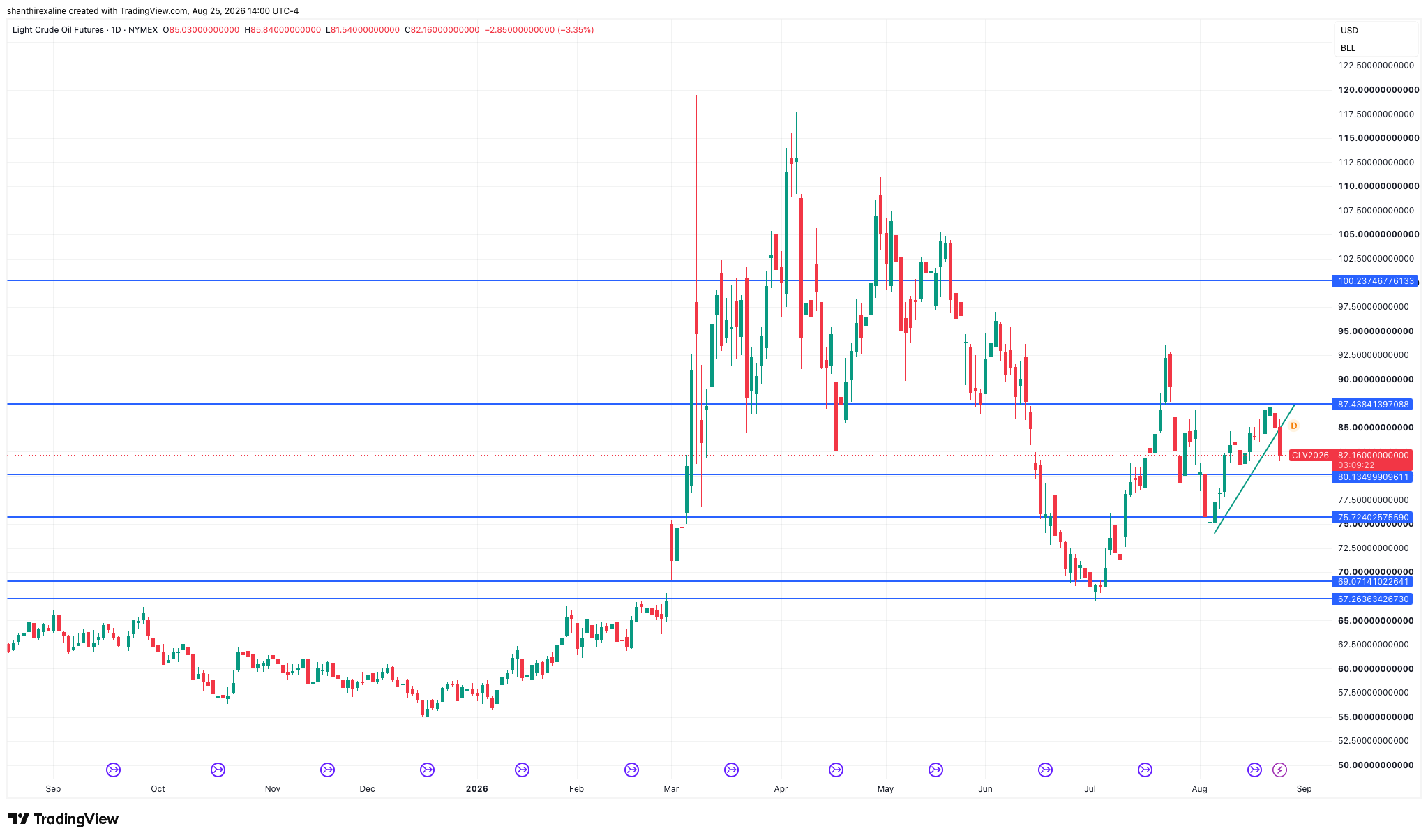
WTI crude oil futures are facing renewed technical pressure after failing to sustain the recent recovery toward the $87.44 resistance level. Tuesday’s sharp decline has pushed prices back toward the $80.13 support zone, while the rising trendline from the July low remains an important near-term floor. A decisive break below $80.13 would weaken the recovery structure and expose the next support around $75.72. The broader technical picture has also turned more cautious, with current technical indicators pointing to a sell bias.
Source: TradingView
On the upside, WTI would need to reclaim $87.44 to restore momentum and reopen the path toward the $90 area. Until then, the failed attempts to break higher and Tuesday’s sharp reversal leave the market vulnerable to further downside. A sustained break below $80.13 would be the more significant bearish signal, while a rebound from that level could keep the recent higher-low structure intact and give bulls another attempt at $87.44.
MarketFramework’s Top traded contract tool shows that traders are overwhelmingly positioned for further downside, with the sentiment gauge showing a “Strong Short” bias and no long exposure among the tracked traders. Despite the bearish positioning, the crowd split reveals an important nuance: 79% of profitable traders this week are holding long positions, while 60% of losing traders remain long.


