Oil is having its best week in months. The West Texas Intermediate (WTI) grade crude oil futures (CL) contract changed hands in the high-$70s to a little over $80 range after starting the week closer to $74. The front-month contract appears on track to end the week with a gain of nearly 14%,
On the surface, this looks like a straightforward supply-shock story: Iran and the U.S. are exchanging strikes, and tanker traffic through the Strait of Hormuz has fallen to two-month lows. Just 10 ships transited the Strait of Hormuz in the past 24 hours, according to Hormuz Strait Monitor, a sharp drop from the typical daily flow of 130–140 vessels. The collapse in traffic highlights how security concerns are disrupting one of the world's most critical energy chokepoints.
Several things suggest crude’s rally is thinner and more reversible than the percentage move implies.The rally is real, but it's sitting on top of a market that was oversupplied weeks ago
The rally is real, but recent oversupply risks still linger.
Just a few weeks earlier, oil prices had fully round-tripped back toward pre-war levels, pressured by weaker Chinese imports, rising exports from producers outside the Middle East, and a coordinated release of strategic reserves. OPEC+ was still adding barrels: the group approved another output increase in early July, lifting quotas by roughly 188,000 barrels per day for August on top of similar hikes in June and July, specifically because Hormuz exports had started to recover.
In other words, the structural backdrop heading into this week's spike was one of returning supply and softening prices, and not scarcity. That makes the current move look more like a headline-driven repricing of geopolitical risk than a fundamental shift in the physical balance of the market.
Hormuz bent, not broken
The Strait of Hormuz remains the market's biggest concern because it handles nearly a quarter of global seaborne oil trade. However, traders have seen this pattern before in 2026: geopolitical tensions trigger a sharp oil rally, shipping flows prove more resilient than feared, and prices retreat as disruption fears ease. Oil surged about 10% in June on Hormuz closure concerns, but vessel traffic continued and prices later gave back much of the gain. If this week's tensions follow a similar path, the risk for oil may be skewed to the downside.
IEA figures suggest supply concerns may be overstated.
The International Energy Agency's (IEA) July report offers a more nuanced read than "oil is short." Global oil supply actually rebounded by a sharp 4.1 million barrels a day in June to 98.8 million barrels a day, as flows through the Strait partially recovered. The IEA's base case still expects the global oil market to swing back to surplus toward the end of the year, contingent on tanker flows continuing to normalize. That's a materially different picture than a market genuinely short of crude. It also means this week's renewed exchanges of fire are a risk to a recovery already underway, rather than a fresh shock to an already-tight market. This distinction matters for how durable the price reaction should be.
Where the real tightness is: refined products, not crude itself
If there's a genuinely durable signal in this week's move, it's not in crude prices — it's in the products. Refining margins and crack spreads have rallied to four-year highs, driven by a disconnect between well-supplied crude markets and much tighter product markets, with gasoline cracks moving sharply higher even as jet fuel concerns have eased. Middle East export refineries have yet to restart, Russian throughput remains curtailed by attacks, and Asian refiners are still running below capacity — all of which point to a products-driven story that could persist even if crude itself gives back this week's gains. For traders, that argues for distinguishing between the crude benchmark trade and the refiner/crack-spread trade, since they may not move together from here.
WTI Snaps Back Above $78, Eyes $83.47 Resistance Test
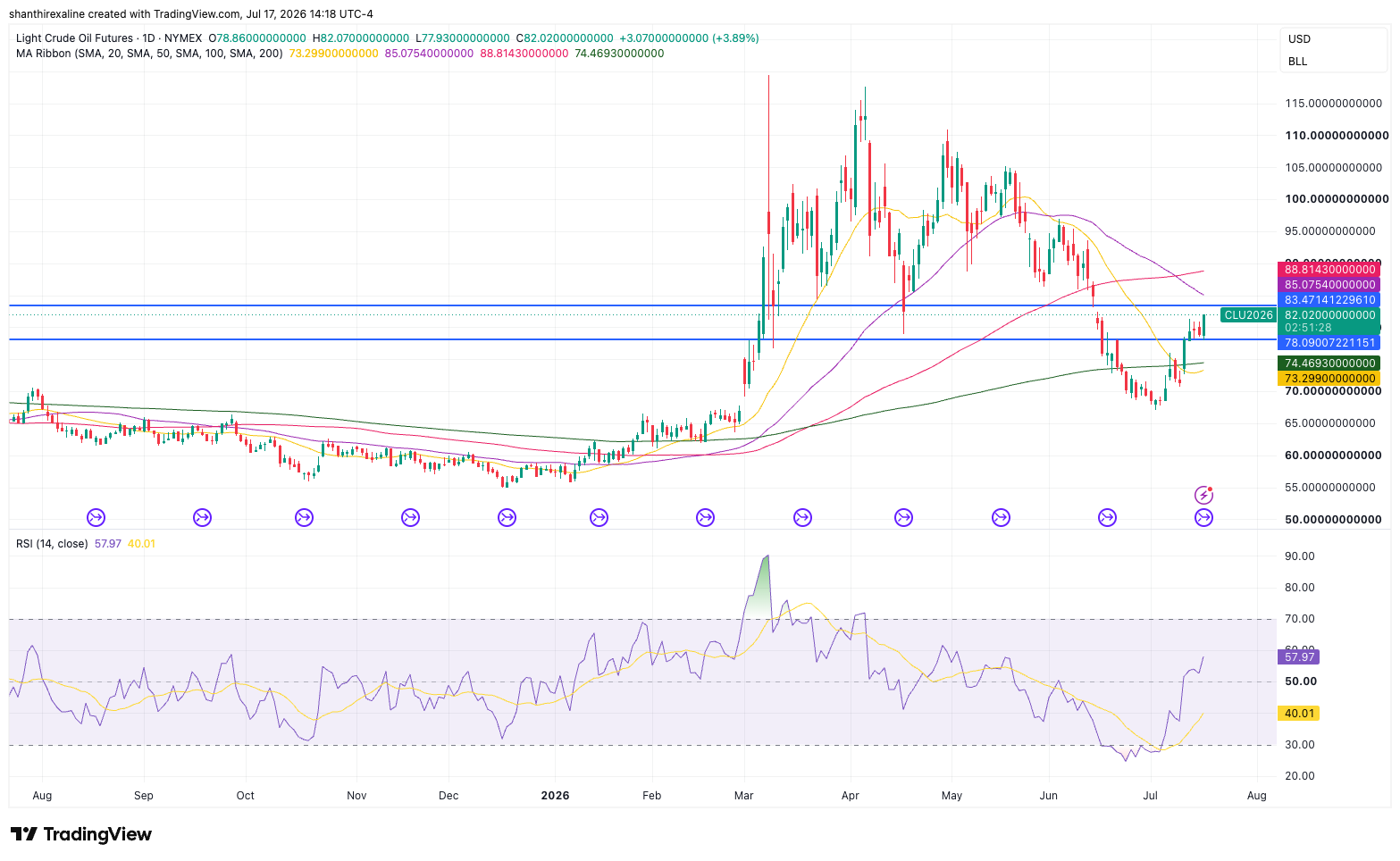
The daily chart shows WTI staging a sharp reversal off its early-July lows, with today's +3.89% rally on strong volume pushing price back above the 78.09 level that had capped rallies through most of July, and now testing the next resistance shelf at 83.47. Price has reclaimed both the 20-day (73.30) and 200-day (74.47) moving averages, though it remains below the 50-day (85.08) and 100-day (88.81), meaning the moving-average ribbon is still stacked bearishly, rendering the reversal as a recovery within a larger downtrend rather than a confirmed trend reversal.
Source: TradingView
RSI(14) at 57.97 has climbed out of the low-30s oversold zone from late June and is now trending higher without yet reaching overbought territory, leaving room for further upside before momentum becomes a headwind. The 83.47 level is the key near-term test: a clean break and hold above it would open the path toward the 85-88 zone where the 50-day and 100-day SMAs converge, while a rejection there would suggest today's move is a bounce within the broader range rather than the start of a fresh leg higher.
Check out MarketFramework’s Positioning Edge toolto assess how futures traders are positioned on major contracts.
The setup for next week
None of this means the rally reverses on cue — Iran has warned of further escalation, and President Donald Trump has said the U.S. could target Iranian infrastructure directly if diplomatic efforts don't produce a breakthrough, which is the kind of headline that can extend a move regardless of the underlying fundamentals. But the combination of resilient tanker flows, OPEC+ actively adding supply as recently as early July, and an IEA base case still pointing toward surplus by year-end all suggest this week's gain is more a repricing of tail risk than a fundamental repricing of scarcity. The more durable trade may not be crude direction at all, but the refining margin story sitting underneath it.


