Taiwan Semiconductor Manufacturing Company (TSMC), which supplies the lifeblood to the AI ecosystem, is reportedly mulling price increases for its chip production services in 2027, according to a Nikkei report that cited multiple sources.
The scale of the proposed increases is notable: a 5%-10% base price hike has reportedly been discussed for both mature-node (12-nm to 28-nm) and advanced-node production, with mature-node pricing facing increases of up to 10%. On top of that, customers placing orders for high-performance computing chips beyond previously agreed volumes could face an additional 10%-15% surcharge, pushing total increases on some advanced AI chip orders past 10%.
TSMC shares rose on the report, a signal the market is reading this less as a cost-pressure warning and more as confirmation of pricing power in an industry where the largest supplier can raise prices without customers walking away. Incidentally,TSMC's stellar resultsreported earlier this month did not generate this much enthusiasm. Thus, what looks like a cost shock several steps downstream is being read as a bullish signal at the source.
This Isn't an Isolated Data Point
TSMC's move lands inside a pricing environment analysts have started calling "chipflation." Morgan Stanley has reportedly used the term to describe 2026's semiconductor market, where AI server demand, high-bandwidth memory shortages, and tight wafer capacity have pushed prices up at a pace unusual even by the industry's cyclical standards.
Specifically, memory price inflation, aka “memflation” has been accelerating at a stronger pace. Gartner estimates that DRAM and NAND flash prices will rise 125% and 234%, respectively in 2026, with no relief expected until late-2027.
Gartner Senior Principal Analyst Rajeev Rajput warned of AI demand overriding non-AI use cases. “Memflation will destroy, or at least delay, non-AI demand into 2028, to varying degrees depending on the application,” he said.
The memory price inflation has helped memory chipmakers clock in mouth-watering margins so much so that TSMC’s Chairman C.C. Wei expressed jealousy over it. “I'm really jealous about the memory companies, 86% gross margin,” he said, but did say that he was happy about his company’s 58% margins.
Unlike prior semiconductor cycles, which tended to self-correct within a year or two as demand normalized, this one is being described as structural. AI infrastructure buildout is consuming the bulk of high-bandwidth memory and advanced-node wafer capacity, leaving standard consumer and industrial demand to compete for what's left, with new capacity not expected to ease the shortage until around 2028. TSMC's 2027 pricing plan reads less like a new development and more like the largest player in the industry confirming a trend that's already been running for over a year.
Who Eats the Cost
Nvidia and Apple are TSMC's two largest customers for advanced-node production, and the pass-through mechanism isn't hypothetical. It's already visible. Apple raised pricesacross parts of its device lineup last month, with CEO Tim Cook calling the move "unavoidable" and citing the rising cost of memory and storage chips. Microsoft has made similar moves. That's the pattern likely to repeat once 2027 pricing takes effect: companies with strong brand pricing power pass costs to consumers, while thinner-margin manufacturers either absorb the hit, redesign products to use fewer or cheaper components, or accept compressed margins.
The Fed Angle
This is where the story stops being a semiconductor-sector footnote and becomes a monetary-policy problem. Chip-cost inflation is a supply-side phenomenon, driven by capacity constraints and AI-linked demand, not by an overheating consumer economy. Standard rate policy is built to cool demand-driven inflation; it does very little to add wafer capacity or unlock more high-bandwidth memory supply. Raising rates in response to chipflation would mostly just suppress spending elsewhere in the economy while chip-linked costs keep climbing on their own trajectory regardless.
That mismatch matters for the inflation narrative the Fed has been leaning on. Core goods prices have been a disinflationary force in CPI for most of the past two years, helping offset stickier services inflation. If electronics, appliances, and vehicles start seeing durable price increases again as 2027 chip contracts lock in, one of the categories that's been pulling headline inflation down starts working against it instead — a shift in composition, not just a sector-specific blip.
That's a harder problem for policymakers than a one-time price spike that eventually falls out of year-over-year comparisons.
The timing compounds an existing dynamic. Fed officials have already been delivering hawkish messaging that softer recent inflation data hasn't changed their focus, and markets have been pricing persistent inflation concern into gold and rate expectations for weeks. A slow-moving, multi-year chip-cost pass-through gives that hawkish case another data point, one that's structural and hard to dismiss as noise.
Where It Shows Up Beyond Tech Headlines
Two channels are easy to overlook because they don't carry "AI" in the headline:
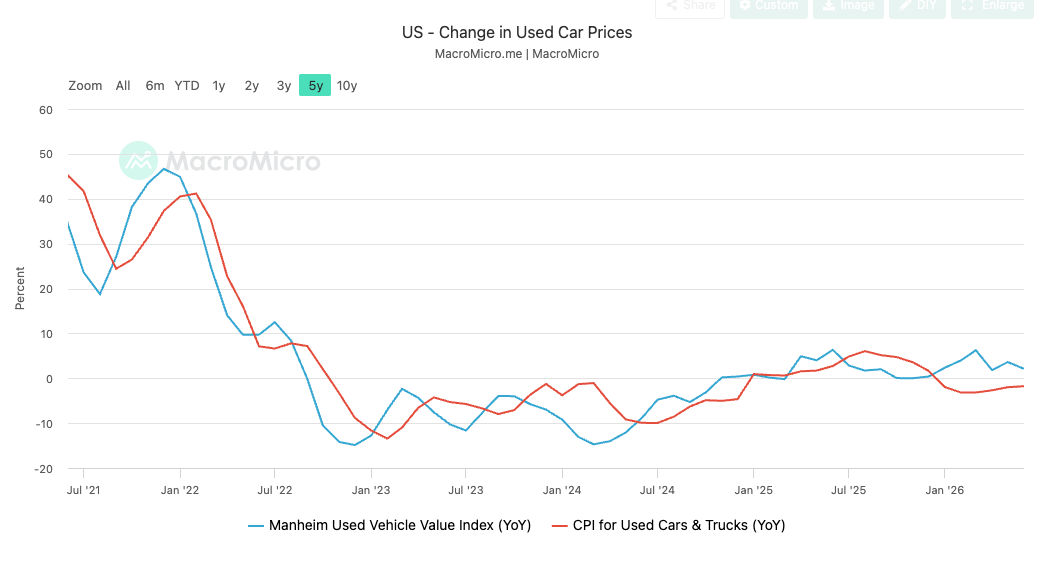
Automotive: Mature-node chips (12/16/28nm): The 2021-2022 chip shortage already demonstrated how much semiconductor supply constraints can move new- and used-vehicle prices, and by extension CPI, given autos' outsized weight in the index. A repeat cost shock here, even at a smaller scale, reintroduces a transmission channel with a proven track record of moving headline inflation.
Used Car Prices Inflation
Source: MacroMicro
AI infrastructure capex. The HPC surcharge specifically raises the input cost of the chips underlying the data-center buildout that's currently the market's dominant bullish narrative. That's a genuine headwind to margin assumptions embedded in AI capex forecasts, arriving the same week Alphabet's earnings and capex guidance are being treated as the market's next major test of AI-spending conviction.
Check out MarketFramework's Positioning Edge live data on where the crowd is positioned versus where the money is actually being made.
The Open Question
The key question is whether rising chip prices are just a temporary adjustment that fades within a few quarters or the start of a longer-term trend that keeps adding to inflation as new supply contracts are signed through 2027. That's not something the Fed can solve with interest rates alone. For now, investors see TSMC's price hike as a positive sign for growth, while economists see a potential new source of inflation. Which view prevails will depend on how much of the higher chip costs are absorbed by cash-rich AI companies and how much is ultimately passed on to consumers through products like phones, laptops, and cars.