China's latest inflation data, released by the National Bureau of Statistics on Thursday, presented a split picture. While June consumer price inflation (CPI) softened and came in slightly below expectations, producer price inflation (PPI) accelerated. What explains this divergence, and what are the implications of these contrasting inflation trends for the futures market.
Before analyzing the implications, here’s how inflation readings fared against expectations:
China Inflation Data
| June (Actual) | Consensus | May | |
|---|---|---|---|
| CPI (YoY) | +1% | +1.1% | +1.2% |
| PPI (YoY) | +4.1% | +4.1% | +3.9% |
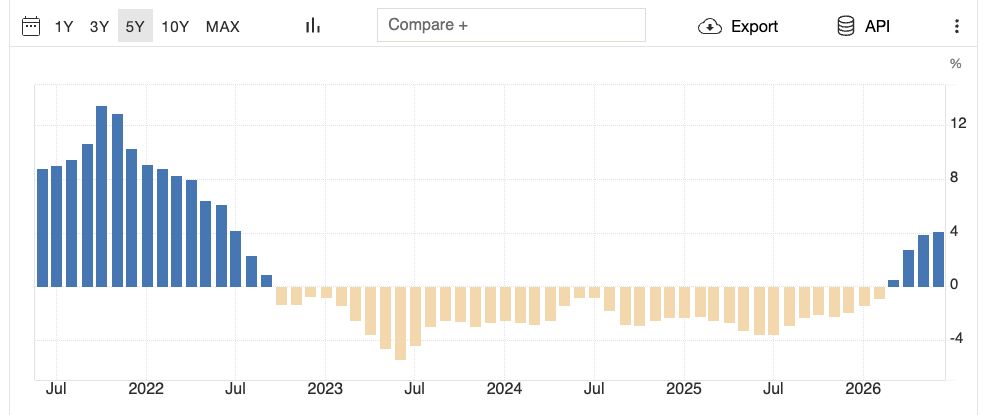
Core CPI, which strips off food and energy, also slowed to 1% from 1.1%. Meanwhile, the 4.1% PPI rate marked the fastest pace of factory-gate inflation since July 2022.
Annual China PPI Inflation Spikes
Source: NBS data via Trading Economics
The monthly PPI rate, however, was a negative 0.3% This suggests that part of the strong annual inflation reading reflects favorable base effects rather than a continued monthly acceleration in prices. Nevertheless, producer inflation remains at its highest year-over-year level in four years, indicating that cost pressures in the manufacturing sector are still elevated.
The dissonance between the CPI and PPI is not a tale of mixed inflation but it highlights the two different economic stories happening simultaneously, and having different implications for the different futures markets.
Why the CPI-PPI Anomaly
The divergence traces back to two separate forces. On the producer side, the war-driven spike in energy and input costs from the Iran conflict has been working its way through Chinese supply chains for months, compounded by surging demand for materials tied to AI infrastructure buildout and electrification.
NBS officials specifically flagged industrial upgrading and rising demand for computing power as contributors to the June PPI strength, alongside new materials and industrial robotics.
On the consumer side, none of that cost pressure is translating into higher prices at the register. Elevated energy costs are sapping domestic demand rather than being passed through. Food prices remain in outright decline (down 1.6% YoY), with retail prices of pork, fresh fruit, fresh vegetable and grain all declining. Non-food inflation fell 0.4 points to 1.5%, impacted by a slower pace of increases in transportation fuel prices.
ING Strategists noted that Beijing N92 gasoline prices were cut twice in June, and once already in July. If the Middle East re-escalation fears do not materialize, gasoline prices could continue to see a let-up in July, they said.
The read-across? Chinese households are not spending at a pace that lets producers raise consumer prices to match their higher input costs, and instead choosing to suffer margin compression.
Bullish Read for Industrial Metals
For copper, aluminum, and broader industrial metals futures, this data is a genuine confirmation signal, not noise. China is the world's largest industrial consumer, and its producer price data showing sustained cost pressure from AI- and electrification-linked material demand corroborates the same thesis that's been driving copper's rally on COMEX and the LME all year. The PPI data is an independent evidence from the real economy that underlying demand for these inputs remains structurally strong.
For traders who are bullish on copper or other industrial metals, this remains a positive signal rather than a reason to reconsider their positions.
The COMEX-traded Copper futures contractfor September delivery was up more than 2.5% at last check.
China's Demand Could Limit Crude Upside
China has reduced crude oil imports by about 20% since the Iran conflict began, relying more on its existing stockpiles instead of purchasing oil at higher market prices. As the world's largest oil importer, this matters because China is currently contributing less demand to the global oil market.
For traders betting on higher oil prices amid renewed U.S.-Iran tensions and fresh military strikes, China's reduced buying activity is an important factor to consider. During past geopolitical disruptions, strong Chinese demand often amplified price gains. This time, that support appears weaker.
While the situation does not eliminate the risk of an oil price spike, it could limit how far crude futures rise compared with previous geopolitical shocks. The market is still focused on supply risks, but softer Chinese demand may act as a counterweight.
China rates and yuan futures — resist the easing trade
A soft CPI print is typically a strong motivation for central bank stimulus, and it would be easy to assume the PBOC is about to cut rates. But a four-year-high PPI complicates that calculus significantly. Easing aggressively amid accelerating producer-price inflation risks reigniting cost-push pressures. The more likely outcome is a People’s Bank of China (PBoC) that stays measured and cautious rather than decisively dovish. Traders positioning in China Government Bond (CGB) futures or yuan-denominated instruments on an assumed easing cycle should treat this data as a reason for caution, not confirmation.
ING, however, sees a growing case for easing, given very weak loan growth, and softness in consumption and investment. That said, the firm looks ahead to second-quarter GDP, key June data points and the July Politburo meeting to help gauge the urgency needed in terms of policy support. It calls for 10-basis-point easing in the second-half of the year, most likely in the third quarter.
China and China-Exposed Stocks: A Warning on Profit Margins
The gap between China's CPI and PPI suggests that many companies are facing higher production costs but are struggling to pass those costs on to consumers. As a result, profit margins could come under pressure, especially in manufacturing and industrial sectors.
This is important not only for investors in Chinese equity indices and related futures contracts and the Hang Seng, but also for U.S. companies that generate significant revenue from China. Many industrial, materials, and multinational firms represented in the S&P 500 and Nasdaq could feel the impact if weaker pricing power hurts corporate profitability.
In short, rising producer prices may appear positive at first glance, but if companies cannot raise selling prices accordingly, higher costs become a drag on earnings rather than a sign of stronger growth.
Check out MarketFramework's Trade Validator tool for retail's positioning in the futures market.
US rates and Fed-sensitive futures — Small but real inflation-import risk
Rising Chinese factory-gate prices have a way of eventually surfacing in U.S. import costs. If PPI strength persists, it's a modest upside risk to U.S. inflation expectations. Therefore, this data is worth keeping on the radar for Treasury futures and Fed funds futures positioning, especially with June U.S. CPI due July 14. It is not a dominant driver, but it is one more data point arguing against aggressive dovish positioning heading into that print.
Don't treat the China inflation data as a single bullish signal. In other words, the CPI and PPI data carry different market implications, so investors should evaluate each signal separately rather than assuming they both support the same trade.


