
China’s economy grew more slowly than expected in the second quarter on a year-over-year basis, but a series of stronger-than-expected June data releases suggested economic activity gained some momentum toward the end of the quarter.
China's Shanghai Composite Index, which saw a small lift immediately after the data release, has since turned lower. At last check, the country's key stock market gauge was down about 0.40% even as the other major indices in the region traded higher.
GDP Growth at Multi-year Low
The YoY second-quarter GDP growth slowed to 4.3% from 5% in the previous quarter, marking the slowest expansion since the fourth quarter of 2022 when China abruptly abandoned the Zero-COVID policy. The growth also trailed the 4.5% consensus estimate.
The quarterly growth also slowed markedly to 0.9% from 1.3%, although the slowdown was in line with expectations. The expansion pace matched the level seen in the second quarter of 2024 and was the slowest since the fourth quarter of 2022.
Q-o-Q Growth Eases Yet In-line
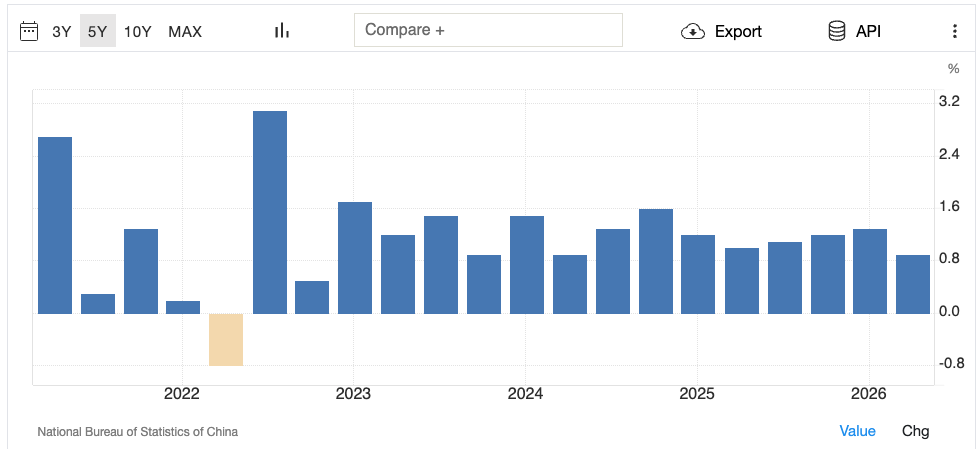
Source: NBS data via Trading Economics
June Activity Shows Broad Beat With One Glaring Exception
Meanwhile a slew of numbers, including June retail sales, industrial production and jobless rate all came in better than expected but fixed asset investment for the month fell sharply.
June Numbers at a Glance
| June (YoY Growth) | Consensus | March (YoY Growth) | |
|---|---|---|---|
| Retail Sales | +1% | -0.1% | -0.6% |
| Industrial Production | +5.3% | +4.7% | +4.5% |
| Jobless Rate | 5% | 5.1% | 5.1% |
| Fixed asset investment | -5.7% | -4.1% | -5% |
Trade Data Corroborates June Strength
The stronger June figures were also corroborated by a surprisingly robust trade performance. China's June trade data released Tuesday came in far stronger than expected, with exports rising 27% YoY to a record $412.39 billion, the fastest growth since October 2021, and imports surging 36% to an all-time high of $286.76 billion, the sharpest jump in five years. As such, the trade surplus swelled to $125.62 billion, up from $105.43 billion in May, the second-largest monthly surplus on record.
The Real Divergence: External Demand vs. Domestic Investment
This divergence between investment and the other data suggests external demand (exports) and household spending (retail sales) are both accelerating, while capital formation is contracting at a worsening pace. That's consistent with the property downturn continuing to drag on investment even as private-sector caution persists elsewhere.
This raises the question of whether June's consumption and trade strength is durable or partly pulled forward. Possibly, retailers/exporters are front-running tariffs, and consumers are responding to subsidy timing, rather than reflecting a genuine broadening of domestic demand. China announced in late-2025 a 62.5 billion yuan (roughly $9 billion) ultra-long special treasury bond funds to provide consumer subsidies to replace domestic appliances and vehicles and also for housing and upgrades.
A 10% broad-based U.S. tariff on Chinese goods is set to expire July 24, and U.S. President Donald Trump's Section 301 probes are expected to bring additional duties after that. Once exporters and U.S. importers know a tariff hike has a specific trigger date, there's a clear incentive to get goods shipped and customs-cleared before it hits.
The quarter is being carried by exports and a policy-engineered consumption bounce, not investment. Nevertheless, this keeps GDP within the reach of Beijing's 4.5–5% full-year target for now, but leaves growth more exposed to trade-policy shocks and the unresolved property/investment drag than the June flash numbers alone would suggest.
Natixis Emerging Asia Senior Economist Trinh Nguyen said, "Given the data, the economy is obviously super K-shaped with consumption very weak and falling on a real basis and investment contracting. Exports remain the key driver to growth."
What It Means for US Futures Traders
Net traders should treat Wednesday's release as a modest, selectively bullish input for tech and AI-adjacent futures, a cautionary signal for construction-commodity futures, and background noise for the broader index, currency, and rates complex.
How Data Readout Impacts Futures Instruments
| Futures | Impact | Rationale |
|---|---|---|
| ES/NQ/YM Futures | Neutral overall, mildly bullish for Nasdaq specifically | Within the complex, NQ gets the clearest tailwind from strength in high-tech/semiconductor production; ES is roughly neutral; YM has the least direct China sensitivity |
| Copper & Other industrial metals | Mildly bullish | Industrial production beat supports near-term demand; FAI miss is the more relevant driver since construction/infra capex underpins these contracts. |
| Gold | Neutral | Currently trading off Middle East safe-haven flows and inflation expectations; China growth-slowdown angle is a rounding error by comparison |
| DXY/CNH Futures | Mildly yuan supportive | Wider surplus supports CNH more directly than broad dollar index; dollar move dominated by US rate expectations |
As far as the Chinese economy is concerned, the divergence between external and domestic demand continues to widen. ING strategists attribute this to continued wealth destruction from the property downturn and wage growth slowing due to involution-type competition in a near-deflationary environment. They also point out the variance between the old and new Chinese economies, with the former looking soft, with softer real-estate and infrastructure investment. On the other hand, high-tech manufacturing and fixed-asset investment have shown strong growth.
Whether the divergence will narrow in the second-half depends on whether policymakers can stabilize domestic demand and find a bottom for the property market, the strategists said.


