Broadcom delivered another blockbuster quarter, but the Nasdaq did not get the reassurance investors were looking for. Fiscal 2026 third-quarter revenue jumped 86% year over year (YoY) to $29.6 billion, adjusted earnings reached $3.32 a share, and artificial intelligence (AI) semiconductor revenue surged 221% to $16.7 billion. Yet Broadcom shares fell sharply after the report as investors focused on the outlook rather than the rear-view mirror.
The company guided to approximately $34.8 billion, slightly below Wall Street's roughly $35 billion expectation. But with AI expectations already elevated, a modest guidance miss did not go down well with investors. Broadcom expects AI semiconductor revenue to reach $21.7 billion in the fourth quarter, up 236% from a year earlier.
Broadcom shares, which were down over 6% at one point in Wednesday’s after-hours session, have trimmed their losses. At last check, the stock was seen trading down about 2.80% as traders digested post-earnings positive analyst reaction. Macquarie upgraded Broadcom shares to Outperform from Neutral, and Morgan Stanely maintained an Overweight rating on the stock and upped the price target to $505 from $502.
Yet the initial market reaction showed just how high the bar has become.
For NQ traders, that distinction matters. Broadcom is another test of whether the AI trade can continue carrying the Nasdaq higher when earnings are strong but the market demands something close to perfection. The timing makes the reaction even more important: September has begun with geopolitical risk, elevated Treasury yields and growing uncertainty around the Federal Reserve's next move.
September Is Already Working Against NQ
The timing of Broadcom’s stumble is particularly uncomfortable because September is historically a difficult month for equities. The Nasdaq Composite has averaged a 0.8% decline in September since 1971, while the S&P 500 has averaged a 1.1% loss, making September the weakest month for both indexes by average return. The S&P has finished September higher only about 45% of the time over its longer history.
That does not mean NQ is destined to fall, but it raises the stakes when other headwinds are already lining up. The Nasdaq entered September after a strong August, while Treasury yields remain elevated and geopolitical risks are keeping oil prices and inflation concerns alive. With Broadcom now exposing just how high the bar has become for AI stocks, seasonal weakness could amplify any shift from “buy the dip” to “sell the rally.”
Can NQ absorb another AI disappointment?
The first question is whether Broadcom's reaction remains isolated or spreads across the semiconductor complex.
The AI trade has already shown that good earnings are no longer automatically bullish. Investors increasingly want evidence that revenue growth can continue accelerating fast enough to justify lofty valuations. Broadcom's numbers were objectively strong, but the stock's reaction suggests expectations had moved even higher.
That creates a potential problem for NQ. If AVGO weakness spills into Nvidia, networking stocks and other AI beneficiaries, the Nasdaq could lose one of its most important sources of momentum just as September trading gets underway.
For NQ, the key signal is therefore not simply whether Broadcom rebounds. It is whether weakness in AVGO becomes a broader semiconductor selloff. A contained reaction would suggest the AI trade remains healthy. A synchronized decline across AI leaders would be a much more important warning.
At the outset, it appears that semiconductor stocks could come under pressure. The iShares Semiconductor ETF (SOXX), which tracks the Philadelphia Semiconductor Index, slipped near 1% in premarket trading.
Treasury yields may matter more than Broadcom
The second variable is the bond market.
The Nasdaq enters September with Treasury yields already acting as a major counterweight to technology stocks. Higher yields make bonds relatively more attractive while also increasing the discount rate applied to future corporate earnings. For high-growth technology companies, that valuation pressure can become particularly powerful.
That means NQ does not need a disastrous Broadcom report to struggle. If yields continue pushing higher at the same time that AI enthusiasm cools, the two forces could reinforce each other. Conversely, a retreat in Treasury yields could give Nasdaq bulls room to absorb Broadcom's disappointment.
This makes the 10-year Treasury yield one of the most important cross-asset signals for NQ over the next several sessions.
Friday's jobs report could decide whether the selloff sticks
The third and potentially biggest test is the U.S. labor market.
Broadcom has delivered the immediate catalyst, but Friday's employment report can determine whether the market interprets the current pressure as an AI-specific reset or the beginning of a broader risk-off move.
A softer jobs report could pull yields lower and revive expectations for easier Federal Reserve policy, potentially cushioning growth stocks. A stronger-than-expected report, particularly if accompanied by firm wage growth, could push yields higher and make the Nasdaq's valuation problem more difficult.
That leaves NQ caught between two competing forces: strong enough economic data to support earnings, but potentially strong enough data to keep rates elevated.
September's real test
Broadcom's reaction is therefore less about one earnings report and more about what it says about the market's tolerance for AI expectations.
The company continues to report extraordinary growth. Q3 revenue rose 86%, while AI semiconductor revenue more than tripled from a year earlier. The issue is that extraordinary growth is increasingly becoming the baseline rather than the upside surprise.
For NQ, September now comes down to three variables: whether AI weakness broadens, where Treasury yields go, and what Friday's jobs report does to Fed expectations.
If yields ease and AI leaders stabilize, Broadcom's selloff could prove to be another temporary shakeout. But if AVGO weakness spreads through semiconductors while yields rise and economic data keeps the Fed hawkish, September could become the month when Nasdaq bulls are forced to defend the rally rather than extend it.
Momentum Weakens as Key Support Faces Test
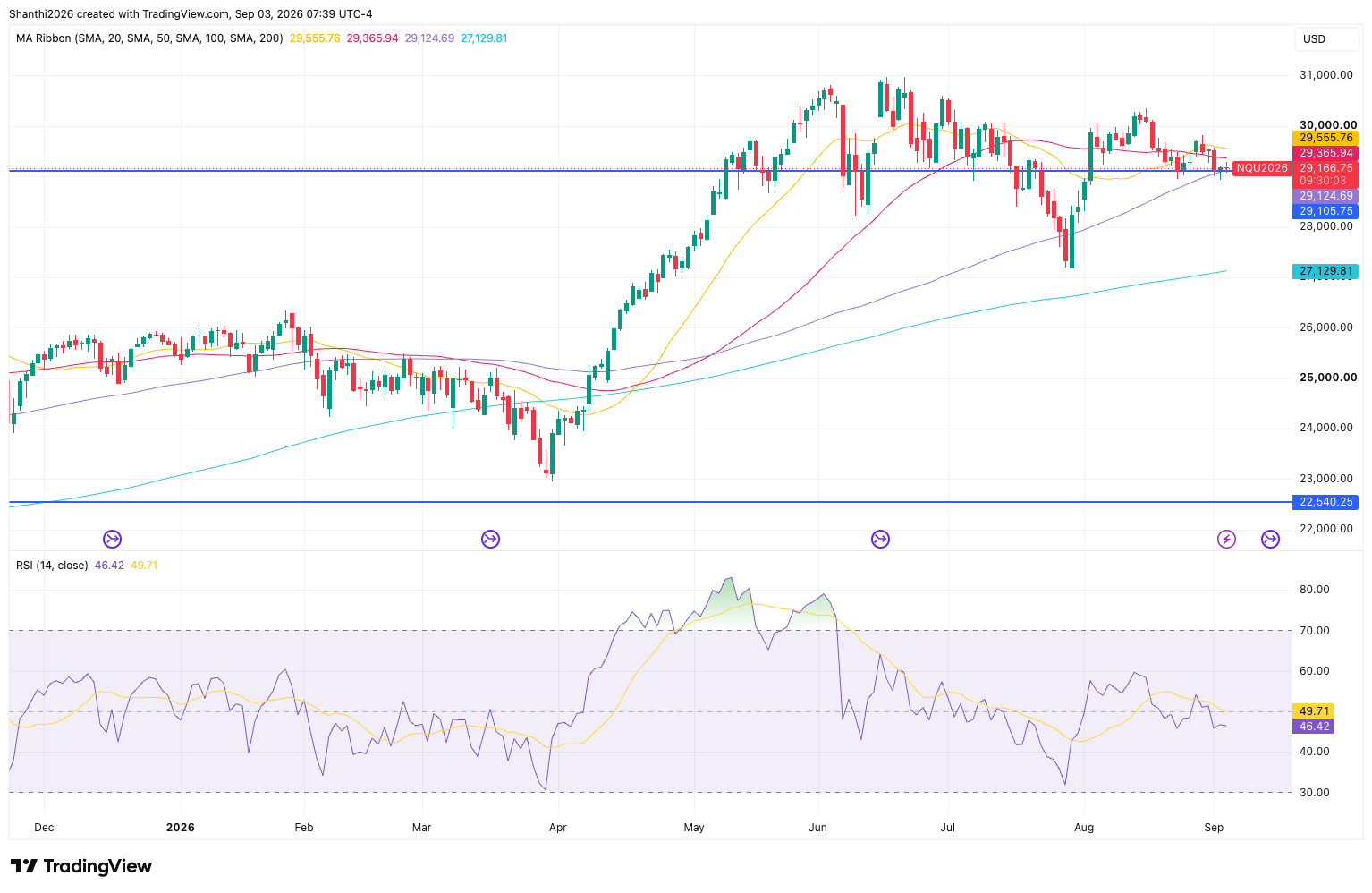
Technically, NQ futures are sitting at a critical inflection point. Price has slipped below the 20-day SMA (29,555) and is testing the rising 100-day SMA near 29,125, which has acted as dynamic support throughout the broader uptrend. The 50-day SMA at 29,366 has rolled into resistance, creating a short-term bearish structure where rallies are likely to encounter selling pressure unless buyers can reclaim that level. The recent series of lower highs from the late-August peak near 30,000 also suggests upside momentum is fading.
Source: TradingView
Momentum indicators reinforce the cautious outlook. The RSI has retreated to 46.4 and remains below its signal line, indicating weakening buying pressure without yet reaching oversold territory. While the long-term trend remains constructive with the 200-day SMA rising steadily near 27,130, the near-term setup favors consolidation or further downside toward the 100-day SMA. A decisive break below 29,125 could expose the August swing lows around 28,700–28,800, while a recovery above the 50-day SMA would be needed to shift momentum back in favor of the bulls and reopen the path toward the 30,000 psychological level.
Trader positioning in NQ futures shows an extreme bearish divergence, with profitable traders holding just 31.5% long exposure compared with 76.9% long exposure among unprofitable traders. The gap suggests experienced traders are fading the rally, while less successful participants are chasing upside momentum. Such a divergence often reflects skepticism about the sustainability of the advance, particularly when price rises are not accompanied by improving sentiment among profitable traders.


