
Brent crude has pushed back above $100 a barrel, currently at $102.13, while WTI is trading at $97.45, putting the Brent-WTI spread at roughly $5. That may look like another war-driven oil spike, but the spread is telling a different story.
During March’s initial supply shock, the Brent premium over WTI widened dramatically as traders rushed to price the threat of losing Middle Eastern barrels and severe disruptions to international crude flows. Today, oil is again surging on geopolitical risk, but the much narrower spread suggests the market is not pricing the same degree of immediate physical dislocation.
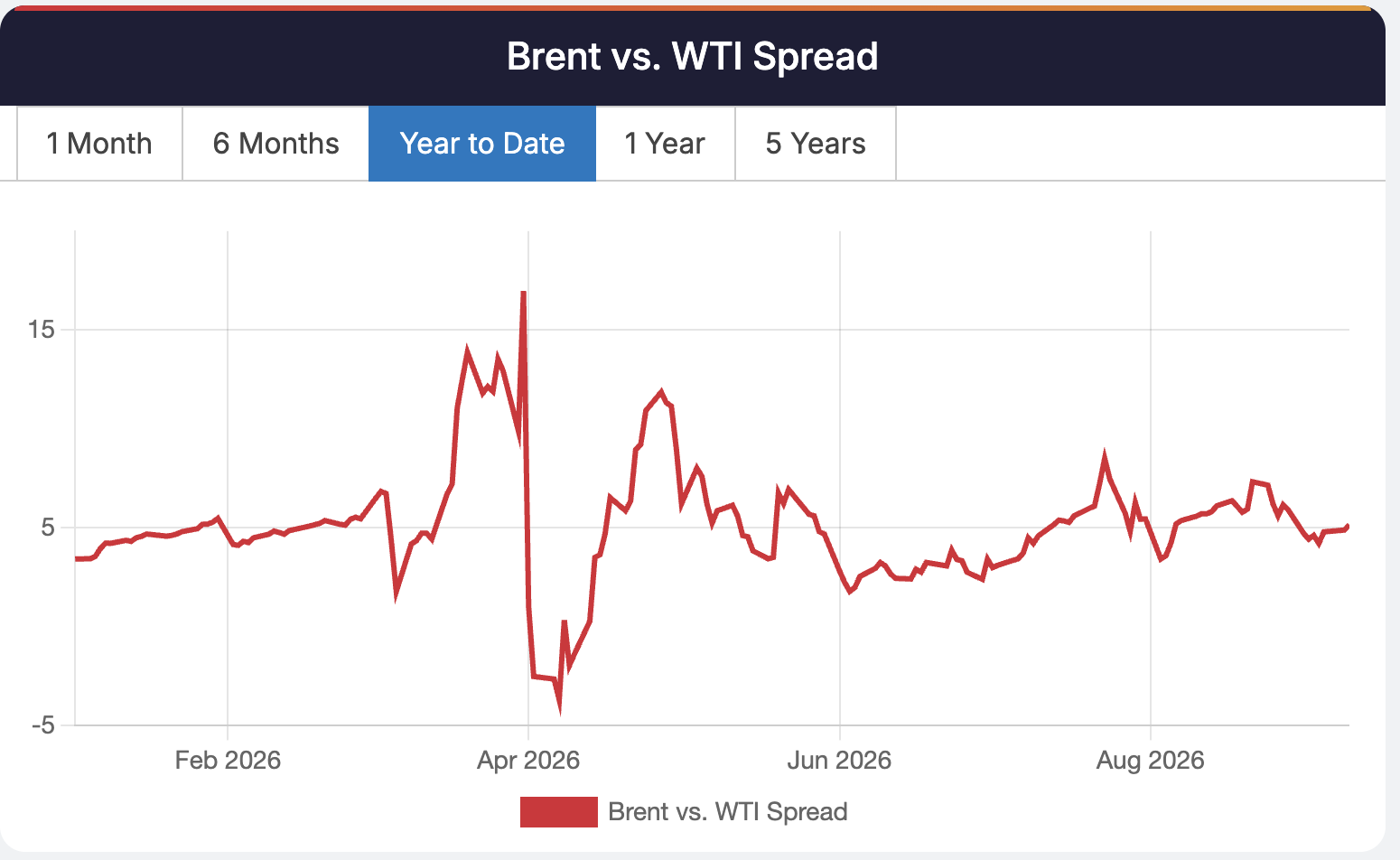
Source: RBN Energy
The distinction matters. Brent's return above $100 is a powerful headline, but the relationship between the two benchmarks offers a better read on how much of that move represents a genuine international supply shock versus a broader geopolitical risk premium.
This Rally Has More Than One Driver
The latest advance is still being fueled by Middle East supply concerns, but the market is also responding to declining inventories, disrupted shipping, tighter prompt supplies and expectations that the geopolitical situation could remain unresolved.
That combination can support crude prices without producing the extraordinary Brent-WTI divergence associated with the initial war shock.
For traders, the message is that the level of oil prices alone does not tell the entire story. Brent above $100 may look alarming, but the spread between the two major benchmarks provides another way to assess whether the market is experiencing a genuine international supply squeeze.
A Wider Spread Would Change the Signal
The Brent-WTI spread could become increasingly important if tensions escalate further.
A renewed and sustained widening of the spread would indicate that Brent is beginning to price a larger international supply premium relative to WTI. That could signal that the market is moving closer to the type of physical disruption seen in March.
Conversely, if WTI continues to catch up with Brent, it would suggest the rally is becoming broader rather than being driven exclusively by fears surrounding Middle Eastern and seaborne supplies.
That would make the current advance structurally different from the March episode even if headline crude prices continue moving higher.
The Futures Curve Offers Another Clue
Traders should therefore watch the Brent-WTI spread alongside the futures curve, rather than treating the $100 Brent threshold as the only signal.
The forward curves reinforce the message that this is not simply a repeat of March's initial war spike. Both WTI and Brent are currently in backwardation, with nearby contracts commanding substantial premiums over later deliveries, a sign that traders are placing a high value on prompt barrels and that near-term physical supply remains tight.
In WTI, for example, the October contract recently settled around $97.06, versus $93.63 for November and $89.90 for December, creating a sharply downward-sloping curve. The important distinction is that the curve is signaling current tightness rather than necessarily implying permanently higher prices. If geopolitical disruptions ease and physical flows normalize, those large prompt premiums can unwind quickly. With Brent above $102 and WTI above $97 today, the curve therefore points to a market paying up for immediate supply, while the relatively contained Brent-WTI spread suggests the stress is broader across crude markets rather than an extreme international supply dislocation.
Crude Crowd Stays Long
MarketFramework’s Top Traded Contracts tool shows that the CL client base held a “Strong Long” positioning, with 85% long versus 15% short. Retail traders are broadly long-biased during a period when oil has been rallying and yet kept losing money. With prices on the rise on fundamentals, and the “Strong Long” crowd losing money suggests poor entry timing or oversized positions, rather than being wrong on direction.
What Traders Should Watch Now
The next move in the Brent-WTI spread could help determine whether crude's latest rally is fundamentally different from March's spike.
- Brent outperforming WTI: stronger evidence of international supply stress.
- WTI catching up: broader crude repricing rather than a purely Middle East-driven move.
- Front-end backwardation intensifying: stronger evidence of a near-term physical tightness.
- Spread and backwardation both easing: potential sign that the latest geopolitical premium is beginning to unwind.
For crude traders, the question is therefore no longer simply whether Brent can stay above $100. It is whether the underlying market structure starts behaving like it did during March.