Most agricultural commodity futures have posted solid gains in the first half of the year despite an uncertain macroeconomic and geopolitical environment. Against this backdrop, Tuesday’s release of the U.S. Department of Agriculture (USDA) World Agricultural Supply and Demand Estimates (WASDE) report will be closely watched, as it could play a key role in determining whether the recent bullish momentum can be sustained.
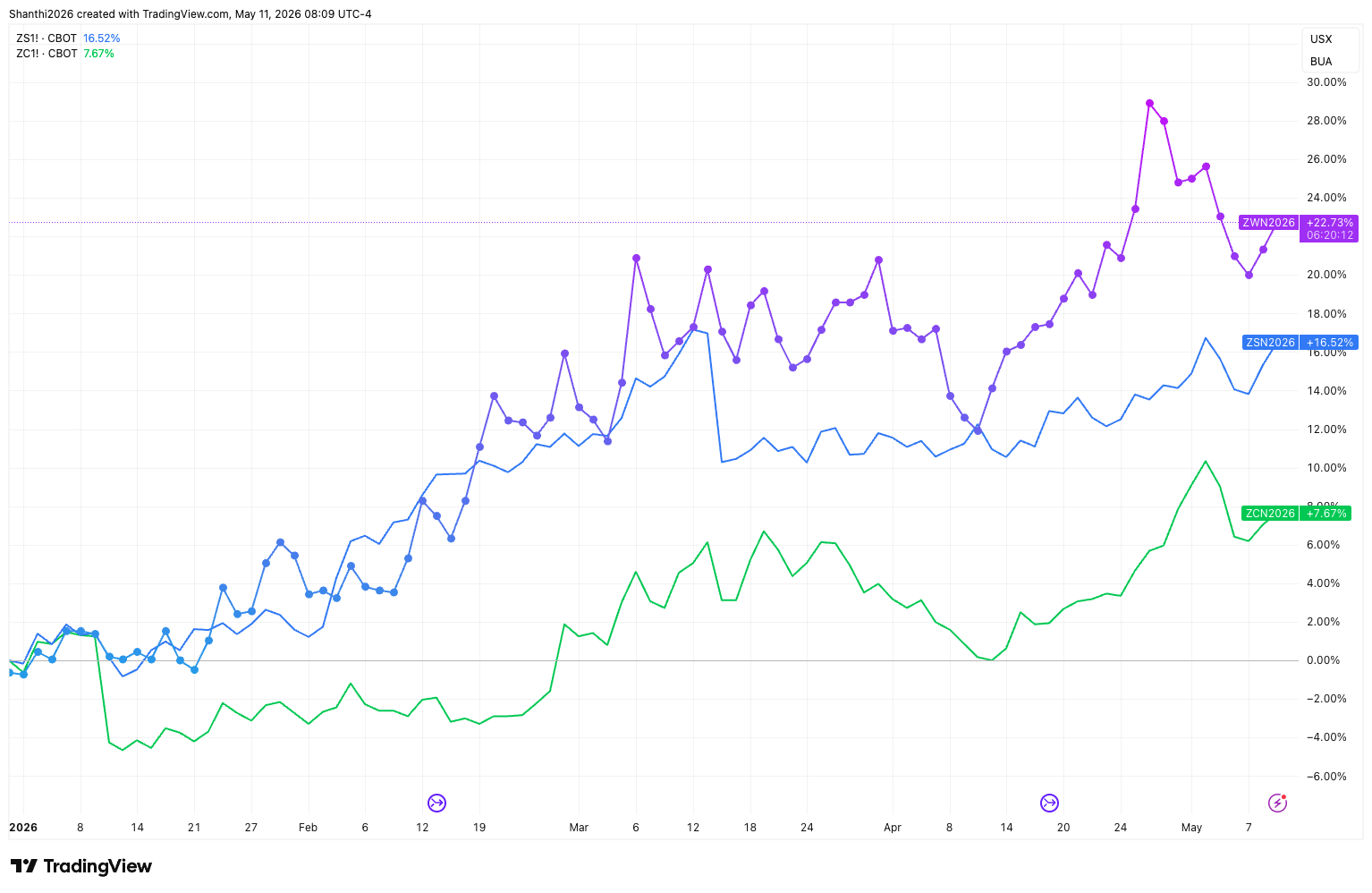
Among major agri-commodities, wheat and soybean futures have led the rally, gaining approximately 23% and 17%, respectively, on a year-to-date (YTD) basis. Corn futures have delivered comparatively modest returns, advancing around 8% over the same period.
Notably, soybean oil, a key soybean byproduct, has significantly outperformed the oilseed itself, surging more than 50% this year on the Chicago Board of Trade (CBOT).
Wheat Vs Corn Vs Soybean Futures (YTD Chart)
Source: TradingView
The strength seen this year contrasted with the performance in 2025, when wheat and corn futures fell about 8% and 4.6%, respectively. On the other hand, Soybean futures gained a modest 3.5%.
What Drove the Rally in the Big 3 Agricultural Commodities
A confluence of factors served as tailwinds for the the key agri commodity futures, and these include:
- Depressed Valuation: Wheat and corn futures came under pressure in 2025 from relatively comfortable global supply and weak speculative sentiment. The markets priced in good harvests in several producing regions, a slowdown in demand and alleviating concerns about supply shocks engendered by Russia’s invasion of Ukraine. The grain contracts, therefore, entered 2026 at relatively cheap valuation levels, rendering them vulnerable in the event of a sharp rebound when risk factors emerged.
- Weather Risk: Dry and adverse weather concerns cropped up in several major wheat-exporting regions, introducing risks to winter wheat conditions. In the U.S. Great Plains, particularly Kansas, Oklahoma, and Texas, persistent drought and above-normal temperatures have weakened crop conditions during a critical development stage. The U.S. winter wheat crop was rated at 30% “good to excellent” in late April, Argus reported, citing USDA data. This was about 19 percentage points worse than 2025 and 10 points behind the five-year average.
- Return of Geopolitical Risk Premium Returned: Black Sea wheat prices have risen sharply since the escalation of the U.S.-Iran conflict in late February. At the same time, the appreciation of the Russian ruble has reduced the competitiveness of Russian wheat exports, while the worsening Middle East conflict has increased fertilizer and diesel costs, pressuring farm-level economics globally. Heightened geopolitical tensions have also amplified logistics and shipping risks across key trade corridors. Wheat futures remain especially sensitive to developments in the Black Sea region, given the dominant export roles of Russia and Ukraine in global wheat trade.
- Short covering Rally: Many funds had built bearish or underweight positioning in grain following the weak price performance seen in 2025. As prices began to rise in early 2026, shorts got squeezed, momentum funds re-entered, accelerating the rally’s momentum.
- Biofuel Demand: Soybeans have received an additional boost from rising demand for soybean oil, a major feedstock for biodiesel and renewable diesel production. Stronger soybean oil prices have improved crush margins, providing additional support to soybean futures.
What to Watch in Tuesday’s WASDE Report
The April WASDE report is expected to provide fresh guidance on global crop balances, export demand, and ending stock levels. Traders will closely monitor revisions to
- U.S. ending stocks: Lower-than-expected ending stocks for corn, soybean and wheat would reinforce the current bullish narrative by signaling tighter domestic supply, while upward revisions could trigger profit-taking after the recent rally.
- South American Production Outlook: Any revisions to crop estimates in Brazil and Argentina will be critical, particularly for soybeans and corn. A stronger South American harvest could help offset supply concerns elsewhere and cap upside in Chicago futures.
- Black Sea Export Projections: Markets will also assess any changes to export forecasts for Russia and Ukraine, given continued geopolitical uncertainty and elevated shipping risks. Tighter Black Sea export estimates would likely remain supportive for wheat prices.
- Demand Revisions: Demand-side changes could be equally market-moving, especially Chinese soybean imports, corn feed demand and U.S. ethanol and biodiesel assumptions. Given soybean oil’s strong rally, traders will pay particular attention to any revisions tied to biofuel demand assumptions.
Can the Rally Continue?
While agricultural futures have benefited from weather risks, geopolitics, and positioning-driven buying, the market is increasingly vulnerable to disappointment after strong year-to-date gains. A bullish WASDE surprise, particularly tighter stocks or lower production estimates, could extend the rally in wheat and soybeans.
However, a neutral or bearish report featuring higher inventories, improved crop outlook and/or softer demand revisions could prompt a round of profit-taking, especially as speculative positioning has become less bearish.


