
The U.S. trade deficit widened in March, although elevated energy prices helped cushion the gap by lifting export values as the country remained a net exporter of energy products, Census Bureau data released Wednesday showed.
Breaking Down the Deficit
The trade deficit for March was at $60.3 billion, wider than the upwardly revised $57.8 billion (from $57.30 billion) gap in the previous month. Economists had expected a wider deficit of $61 billion for the month.
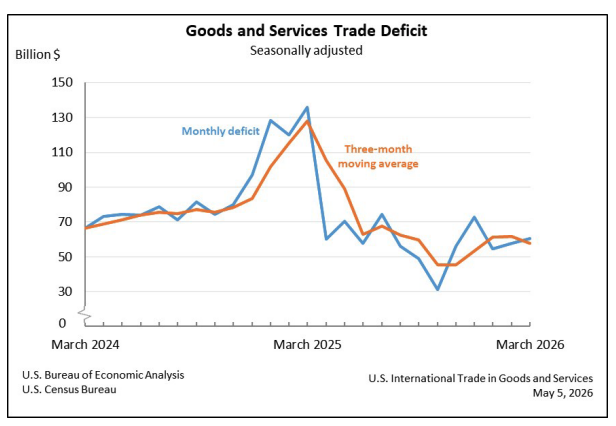
Source: Census Bureau
Although the deficit widened, the three-month average showed a dip, and March’s deficit was moderate when compared to the $130 billion+ deficit America raked up in early 2025.
Goods deficit increased by $4.1 billion to $88.7 billion, while the services surplus climbed $1.6 billion to $28.4 billion.
Exports increased nearly 2% month over month (MoM) to a fresh record of $320.86 billion in March from $314.67 billion in February. At the same time, imports increased a steeper 2.34 % to $381.17 billion from the previous month’s $372.45 billion.
How Broader Categories fared Vs Month Ago:
Foods, feeds and beverages:
- Exports: $14.99 billion ($13.92 billion)
- Imports: $17.49 billion ($16.93 billion)
Industrial Supplies and Materials
- Exports: $86.78 billion ($81.78 billion)
- Imports: $54.64 billion ($52.57 billion)
Capital goods, except automotive
- Exports: $66.75 billion ($66.19 billion)
- Imports: $120.69 billion ($118.56 billion)
Automotive Vehicles, parts and engines
- Exports: $13.54 billion ($12.91 billion)
- Imports: $36.00 billion ($32.37 billion)
Consumer Goods
- Exports: $21.26 billion ($22.97 billion)
- Imports: $57.77 billion ($55.32 billion)
Other Goods
- Exports: $9.18 billion ($8.50 billion)
- Imports: $13.36 billion ($14.04 billion)
US’ Net Energy Exporter Status Keeps Deficit in Check
U.S.’s export growth was led by the industrial supplies and materials category, which rose about $5 billion. Within this, energy product exports (crude oil, fuel oil, other petroleum products, natural gas and totaled $29.66 billion in March, while imports of this category (crude oil, fuel oil, liquified petroleum gases, other petroleum products and natural gas) were at $19.24 billion.
Crude oil exports climbed $2.79 billion in value terms, while imports rose $0.66 billion.
U.S. export growth was led by industrial supplies and materials, which rose about $5 billion. Within this category, energy exports, including crude oil, fuel oil, other petroleum products and natural gas, totaled $29.66 billion in March, compared with imports of $19.24 billion.
Crude oil exports climbed $2.79 billion in value terms, while imports rose a more modest $0.66 billion.
The higher dollar value of both energy exports and imports reflects the sharp spike in oil prices following the intensification of the U.S.-Iran conflict in late February. Since then, crude prices have rallied more than 60% amid disruptions linked to the closure of the Strait of Hormuz, a critical global oil transit route.
Elevated energy prices have provided a relative cushion to the U.S. trade balance by boosting the value of American energy exports, partially offsetting deficits in consumer goods, autos and capital equipment. However, persistently high oil prices also pose upside risks to inflation and could complicate expectations for Federal Reserve rate cuts.
Canada Swings to Trade Surplus
Separately, data released by Statistics Canada showed that exports rose a strong 6.5% MoM, while imports fell 1.6%, taking the country’s trade balance to a surplus of C$1.8 billion from a deficit of C$5.1 billion. This marked the first surplus since September 2025. Higher exports of crude and gold were primarily responsible for the swing.
Read Next: RBA Delivers Third Straight Hike of the Year as Iran War Stokes Inflation


