The Institute of Supply Management’s (ISM) July Manufacturing purchasing managers’ index (PMI) jumped to the highest reading since May 2022, with production and employment both surging. That's a notably stronger picture than S&P Global's final July PMI painted. The two surveys, released the same morning, now tell meaningfully different stories about the sector's trajectory.
The headline gap
ISM's Manufacturing PMI registered 55.6 in July, 2.3 percentage points above June and the highest reading since May 2022. The reading also exceeded the consensus estimate of 54.
That stands in contrast to S&P Global's final read, where the headline PMI held at 53.9, unchanged from June, with output growth slowing sharply and new orders easing for a third straight month.
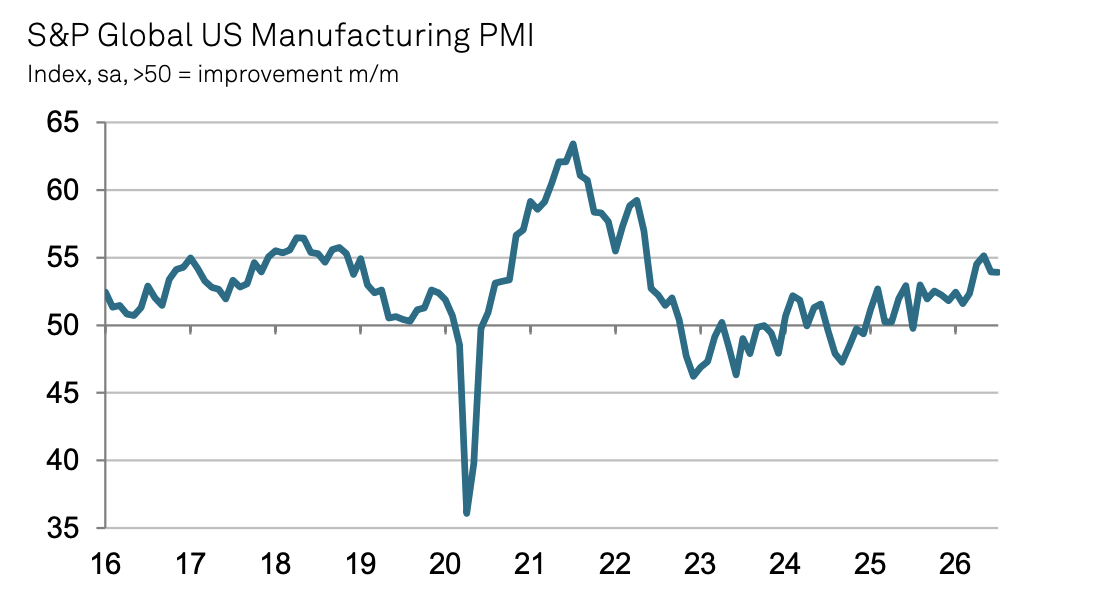
Source: S&P Global
Both surveys measure the same sector in the same month, and therefore the divergence is the story.
What's driving ISM's jump
Production surged to 58.5, up 6.3 points from June's 52.2 and the highest reading since November 2021, while the Employment Index jumped 3.1 points to 52.8, entering expansion territory for the first time in 33 months. New Orders rose to 56.7, Backlog of Orders climbed to 55.0 from 50.5, and New Export Orders snapped back into expansion at 53.0 after contracting in June.
ISM Chair Susan Spence called it a broad-based acceleration: of the five subindexes making up the headline PMI, four grew faster than the previous month, with only Inventories dipping slightly. Sixty percent of surveyed panelists reported their companies are actively hiring.
Where the two surveys agree
Despite the divergent headlines, both point to the same underlying pressure points. ISM's Prices Index eased to 71.1 from 73.0, a third straight monthly decline, but panelists still cited pricing volatility in 57% of negative comments, with the Iran war cited in 43% and tariffs in 18%. That echoes S&P Global's finding that inflationary pressures remained elevated thanks principally to high energy prices and tariffs, even as input cost inflation moderated to a four-month low.
Supply chains are visibly strained in both reports. ISM's Supplier Deliveries Index rose to 58.9, its eighth straight month of slowing performance, while Customers' Inventories fell further into "too low" territory at 40.7. S&P Global similarly flagged one of the sharpest deteriorations in vendor performance in four years, tied directly to the Middle East conflict disrupting deliveries and material availability.
Respondents made the geopolitical link explicit: one Transportation Equipment panelist noted competition for scarce electronics and critical minerals is "expected to get worse," while a Chemical Products respondent said pricing "was moving downward until the Iran war started again."
The bright spot: AI and defense demand
Several ISM respondents pointed to a specific demand driver behind the strength. A Computer & Electronic Products panelist cited continued growth in semiconductor, AI, advanced packaging, and high-performance computing markets, while a Machinery respondent said data-center buildout activity is now at "full procurement and manufacturing ramp-up," with defense orders also at an all-time high.
Of the six largest manufacturing industries, four — Transportation Equipment, Machinery, Computer & Electronic Products, and Food, Beverage & Tobacco Products — expanded in July.
Reconciling the two reports
The divergence likely comes down to methodology and timing rather than contradictory realities. S&P Global's survey period ran July 9-28 and weights new orders and output momentum, while emphasizing forward-looking confidence, which fell to a nine-month low in its release. ISM's report captures a broader hard-data snapshot across production, employment, and export orders, all of which posted their strongest readings in years this month.
Put together: production and hiring are clearly accelerating in July's hard numbers, even as forward sentiment, captured more directly in S&P Global's confidence gauge — continues to soften, under the weight of tariffs, pricing volatility, and Middle East-linked supply disruption.


