
The most interesting signal in August's manufacturing activity data isn't that U.S. factories are expanding. It is where the strength is showing up.
The S&P Global U.S. manufacturing purchasing managers’ index (PMI) remained firmly in expansion territory at 53.9 in August, but output growth slowed to its weakest pace since February and new-order growth also eased. Manufacturers continued to report material shortages, higher prices and supply delays, with the Middle East conflict and tariff uncertainty repeatedly cited as sources of disruption.
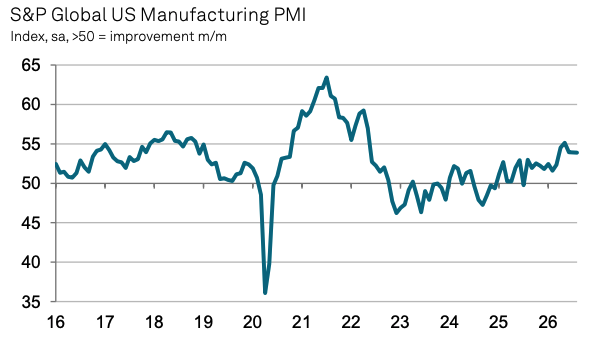
Source: S&P Global
Yet employment moved in the opposite direction.
Manufacturers increased staffing at the fastest pace so far in 2026, according to S&P Global, while business confidence climbed to a three-month high. That creates a striking divergence: companies are becoming more willing to hire even as the underlying pace of production and orders softens.
That could be an important clue for Friday's nonfarm payrolls report.
The S&P survey found firms continuing to build inventories of inputs and finished goods as protection against higher prices and delivery delays. Finished-goods inventories increased at the fastest rate since May, while supplier lead times lengthened sharply.
That matters because not all production growth is necessarily being driven by final demand.
Some companies are effectively building buffers before costs rise further or supplies become harder to obtain. The result is an economy where manufacturing activity can remain strong even while the underlying demand impulse begins to moderate.
ISM Confirms Expansion, But the Details Matter
The ISM Manufacturing PMI added another layer to the picture, registering 54.6 in August, marking an eighth consecutive month of manufacturing expansion. The index, however, slowed from the previous month’s 55.6 and trailed the expected reading of 55.2.
The headline confirms that the factory sector is not contracting. But the broader August data suggest manufacturers are navigating a more complicated environment than the headline PMI implies.
The New Orders Index fell three points to 53.7, the Backlog of Orders Index dropped 3.2 points to 51.8, and imports declined 3.2 points to 52.5.
Production remained strong at 58.3, extending its expansion streak to 10 months, but it slipped marginally from July. The combination of production holding up while orders and backlogs losing momentum reinforces the signal from S&P Global that manufacturers are still producing at a solid pace even as the forward-looking demand picture becomes less convincing.
The labor component also moved in the wrong direction. The ISM Employment Index fell to 51.2 from 52.8, remaining in expansion but showing slower employment growth. That contrasts with S&P Global's report, which found manufacturing employment increasing at its fastest pace of 2026.
The supply side remains the bigger complication. ISM's Prices Index stayed elevated at 71.1, while the Supplier Deliveries Index rose to 59.3, indicating slower deliveries. ISM said pricing volatility appeared in 57% of negative comments, while the Iran war was cited in 30%, increasing lead times in 46% and tariffs in 29%.
The survey comments illustrate how geopolitical and AI-related demand are colliding with constrained supply. One computer and electronics manufacturer described supply-chain conditions as entering another crisis, citing AI infrastructure, Middle East disruptions and uncertainty over trade rules. Machinery producers similarly reported strong demand for semiconductors, photonics and high-speed connectors, but said domestic and global supply chains were becoming increasingly difficult, with costs and lead times rising.
That leaves the manufacturing sector in an unusual position: demand has not disappeared, but the pipeline is cooling while production remains elevated and input costs stay high. For Friday's NFP, the divergence between S&P Global's stronger manufacturing hiring signal and ISM's softer employment index becomes particularly important.
July JOLTS Shows Why NFP Matters
The latest Job Openings Labor Turnover (JOLTS) report, covering July, showed job openings remaining steady at 7.27 million, undershooting the consensus estimate of 7.330 million, while hires edged down to 5.054 million. Total separations also moved down to 5.072 million in July from 5.337 million in the previous month. Quits remained subdued at around 3.2 million.
That is not an August reading, but it is the latest available snapshot of labor demand and worker turnover ahead of Friday's payroll report.
The distinction is important. There are still millions of available jobs, but the labor market is not displaying the same degree of movement that the headline openings figure might suggest.
July's employment report had already raised the warning flag: nonfarm payrolls fell by 23,000, while the unemployment rate was 4.1%.
The question now is whether August manufacturing hiring represents an early stabilization in employment or whether the broader cooling trend remains intact.
The NFP Test: Is Manufacturing Hiring a Leading Signal?
This is where Friday's report becomes more than another monthly payroll release.
If August non-farm payrolls (NFP) show a meaningful improvement in job creation, the manufacturing surveys will look increasingly prescient. The combination of stronger factory hiring, improving business confidence and continued expansion would suggest that the labor market may be finding a floor.
But if payroll growth remains weak despite the manufacturing hiring pickup, the interpretation changes.
It would suggest that manufacturing is becoming a relative bright spot rather than a signal of a broad labor-market rebound.
That distinction matters because manufacturing is a relatively small part of total U.S. employment. A pickup in factory hiring cannot by itself offset weakness across services, information, professional and business services, or other large employment categories.
There Is Also an Inflation Complication
The hiring signal is not occurring in a clean disinflationary environment.
S&P Global reported that manufacturing input-cost inflation eased to a five-month low, but remained well above its historical average. Companies continued to cite tariffs and Middle East-related disruptions as sources of higher input prices.
At the same time, manufacturers raised selling prices at their slowest pace since February.
That creates a potentially favorable combination for the Fed: cooling price pressures without an outright collapse in activity but the supply-side risks remain.
For markets, that means the NFP report cannot be viewed in isolation. A soft payroll number could strengthen expectations for easier Fed policy, but a renewed inflation impulse from tariffs or geopolitical disruptions could limit how far Treasury yields fall.
What It Means for NQ
For NQ, the most constructive NFP outcome would be a middle-ground report.
A modest improvement in payroll growth, contained wage pressures and a stable unemployment rate would support the idea of a labor-market cooling rather than a labor-market breakdown.
That would potentially push Treasury yields lower without triggering major recession fears—the combination that tends to be most favorable for long-duration technology stocks.
Bullish NQ Scenario
Moderate payroll growth + softer wage pressure + stable unemployment
This would reinforce a soft-landing narrative. Manufacturing remains in expansion, labor demand is cooling but not collapsing, and the Fed has room to ease if necessary.
Lower yields would provide an additional tailwind for NQ.
Bearish NQ Scenario
Strong payroll growth + firm wages
This would validate the stronger side of the August economic data. If markets conclude that the economy remains too strong for meaningful Fed easing, Treasury yields could rise.
For NQ, that creates the classic “good economic news is bad news for duration” setup.
Growth-Scare Scenario
Very weak payrolls + rising unemployment + negative revisions
Initially, NQ could benefit from falling Treasury yields. But if the weakness is severe enough to raise recession concerns, lower yields would no longer be sufficient to support technology stocks.
The bigger risk for markets is that the two sides of the data converge in the wrong direction. If hiring weakens while supply-driven price pressures remain elevated, the Fed could face less room to cushion a slowing economy. Conversely, a softer labor report with easing price pressures would give policymakers greater flexibility and could pull Treasury yields lower. That makes Friday’s NFP less about whether payrolls beat or miss estimates and more about whether the report restores confidence in a soft-landing path—or exposes a policy bind for the Fed.


