
The UK Producer Price Inflation data released on Wednesday morning presents a deceptive picture when looking at the headline consumer data print.
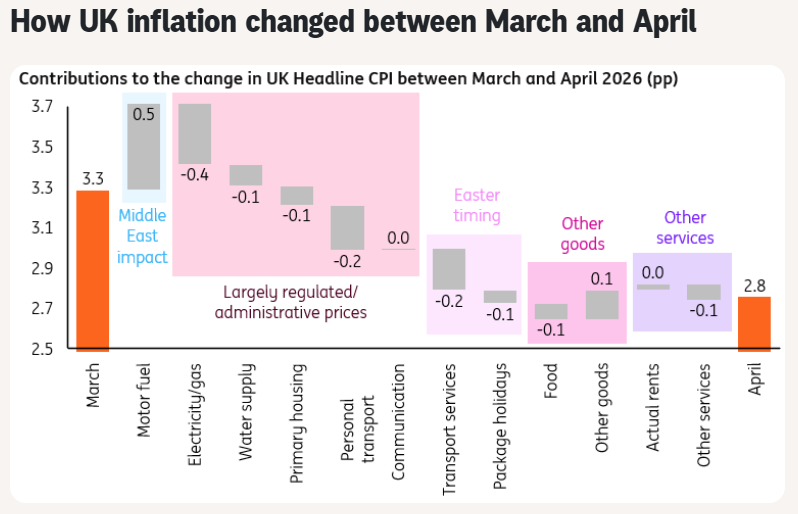
At first glance, the broader economic news seemed positive: headline Consumer Price Index (CPI) inflation slowed to 2.8% in April, beating market expectations. An offshoot of the tamer inflation numbers is that the market no longer fully priced in two Bank of England (BoE) rate hikes in 2026.
Source: ING
However, the PPI release acts as a major warning sign. It reveals that a massive inflationary wave is building up in the supply chain, creating a major headache for both markets and the Bank of England (BoE).
The "Pipeline" Inflation Surge (Input PPI)
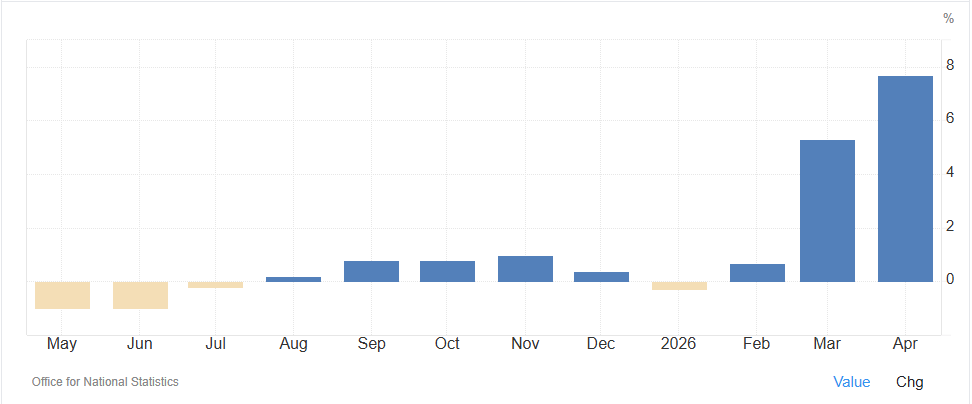
While consumers are seeing temporary relief, UK manufacturers are getting slammed. The numbers show that producer input prices (the cost of raw materials and energy purchased by manufacturers) surged to 7.7% year-on-year in April, up sharply from a revised 5.3% in March. This is the sharpest increase in input prices since March 2023.
Source: ONS, TradingEconomics
Why does this matter? Well, Input PPI is a leading indicator. The costs manufacturers absorb today almost always dictate the prices consumers pay at the register tomorrow. A 7.7% surge means consumer inflation is highly likely to reverse its downward trend very soon.
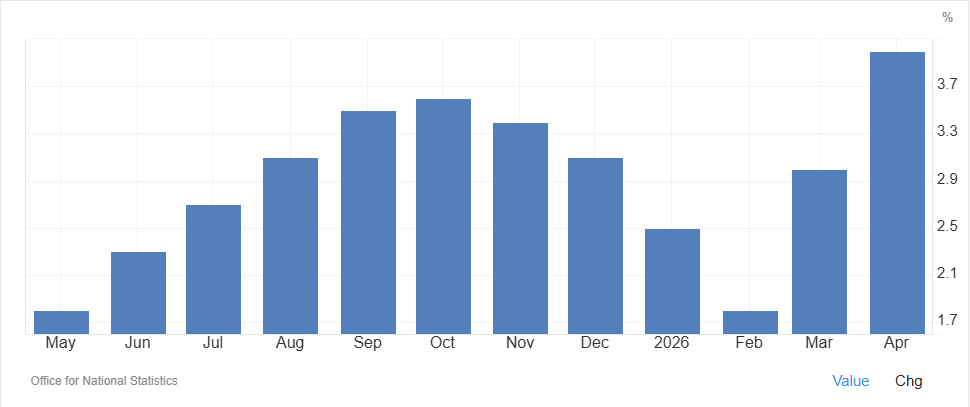
Manufacturers are already beginning to pass these higher costs down the chain. Producer output prices (factory gate prices) jumped 4.0% year-on-year, easily beating market expectations of 2.8% and accelerating from 3.0% in March. This indicates that the inflation is not being quietly absorbed by corporate profit margins; it is actively being pushed into the economy.
Source: ONS, TradingEconomics
Now it is certainly obvious that the primary driver for this current surge is the global commodity disruption, specifically tied to the conflict involving Iran and ongoing hostilities in the Middle East, which have driven crude oil prices up by 75.4% compared to April last year.
The Bank of England (BoE) policymakers have a lot to ponder. Concerns around the geopolitical risk were touched upon by BoE policymaker Sarah Breeden, who stated “if it does look like we are moving to a prolonged Middle East conflict with pronounced 2nd round effects, we will need to move quickly and possibly forcefully.” A sign that concerns do certainly linger.
This leaves the BoE in a tough position. A slowing economy amid rising prices is never a good sign. If they cut interest rates to help rising unemployment, they risk making inflation worse but if they keep interest rates high to control prices, they risk dragging the economy into a deeper downturn.
How Might Markets React?
Markets hate uncertainty. Now beyond that how will this affect markets and consumers moving forward? Markets are still pricing in just shy of two rate hikes from the BoE, meaning borrowing costs for businesses and consumers will stay painfully high and potentially increase.
With higher borrowing costs and if consumer demand continues to soften, companies will no longer be able to pass 100% of their input costs onto buyers. This threatens corporate profit margins, which is why equity markets may react defensively.
Another area to watch is the bond market where volatility may continue to surge. Historically, this is the case when an economy experiences stagnant economic growth concurrently with sticky, supply-shock-driven inflation.
Technical Outlook - GBP/USD Futures
From a technical standpoint it is still important to understand how today's data might affect the GBP moving forward. As discussed above the PPI release proves that the UK's inflation battle is far from over.
It exposes the current dip in consumer inflation as a temporary illusion, leaving the BoE with very little room to maneuver and markets bracing for a volatile summer.
This could mean markets pricing more aggressive rate hikes later in the year and this could add fuel to the GBP through the summer months.
GBP/USD Four-Hour Chart, May 20, 2026
Source: TradingView
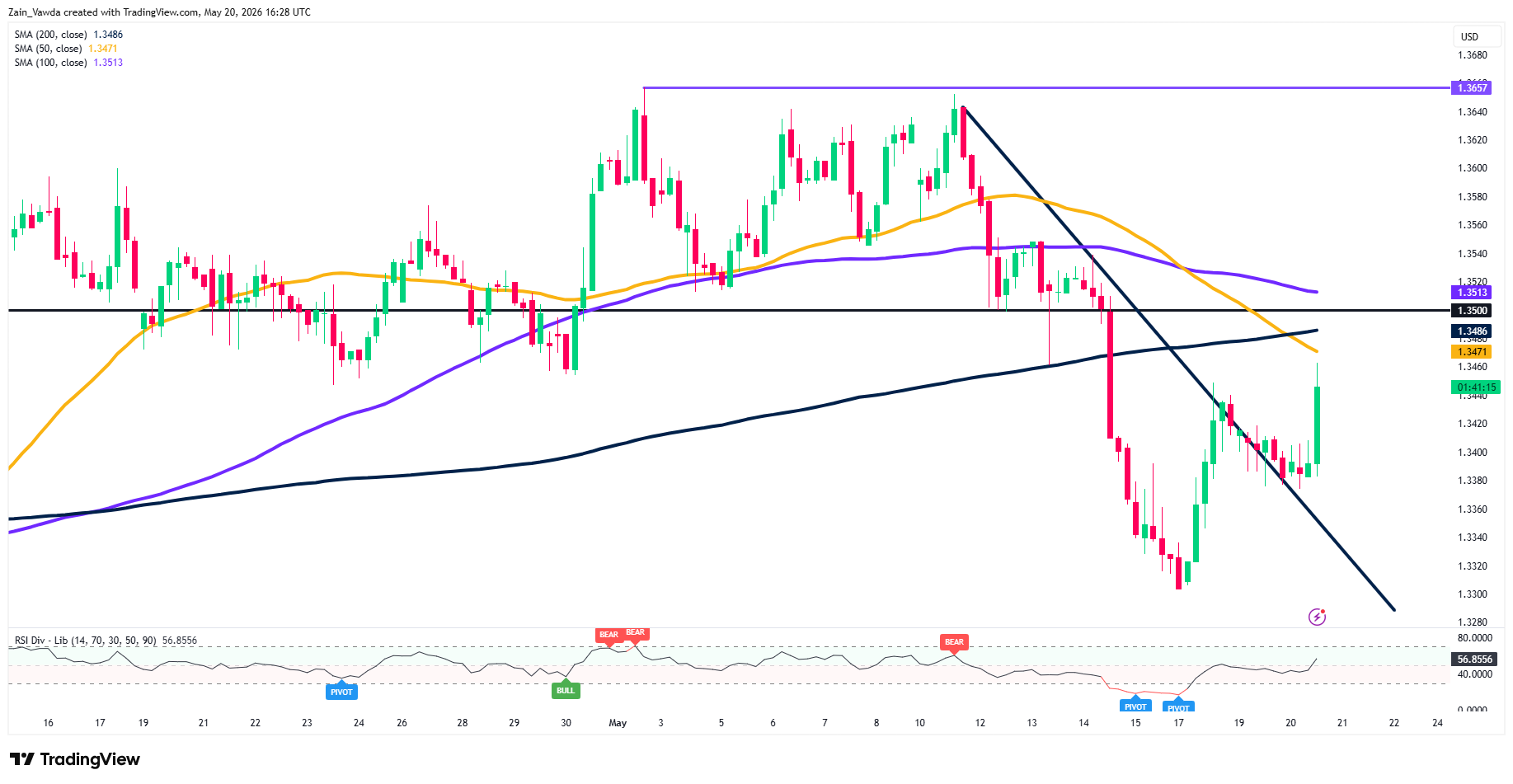
The H4 chart above shows a transition from a prolonged consolidation period into a sharp bearish breakdown, followed by a recent aggressive relief rally.
Throughout late April and early May, price action established a major resistance ceiling around the 1.3657 level, forming a double-top-like structure.
This bearish momentum easily breached the psychologically significant 1.3500 handle, which had previously served as a reliable pivot zone.
Following the 1.3300 lows, the market has initiated a sharp V-shaped recovery, breaking above a steep descending trendline drawn from the mid-May local peak.
This bullish breakout is characterized by a strong, full-bodied green H4 candle, signaling a rapid influx of buyers defending the longer-term bullish trend.
The immediate technical challenge for bulls is the dense overhead resistance cluster between 1.3471 and 1.3513, where the 50 MA, 100 MA, 200 MA and horizontal pivot line converge.
A clean close above this 1.3500/1.3513 zone is required to validate the reversal and reopen a path toward 1.3600 and the 1.3657 structural high.
Conversely, if the relief rally stalls here, a rejection could trigger a retest of the 1.3300 lows, leaving the 200 SMA as the final line of defense against a broader bearish trend reversal.
Read Next: Dollar Holds Firm as Traders Brace for FOMC Minutes to Reveal Depth of Fed's Hawkish Fracture


