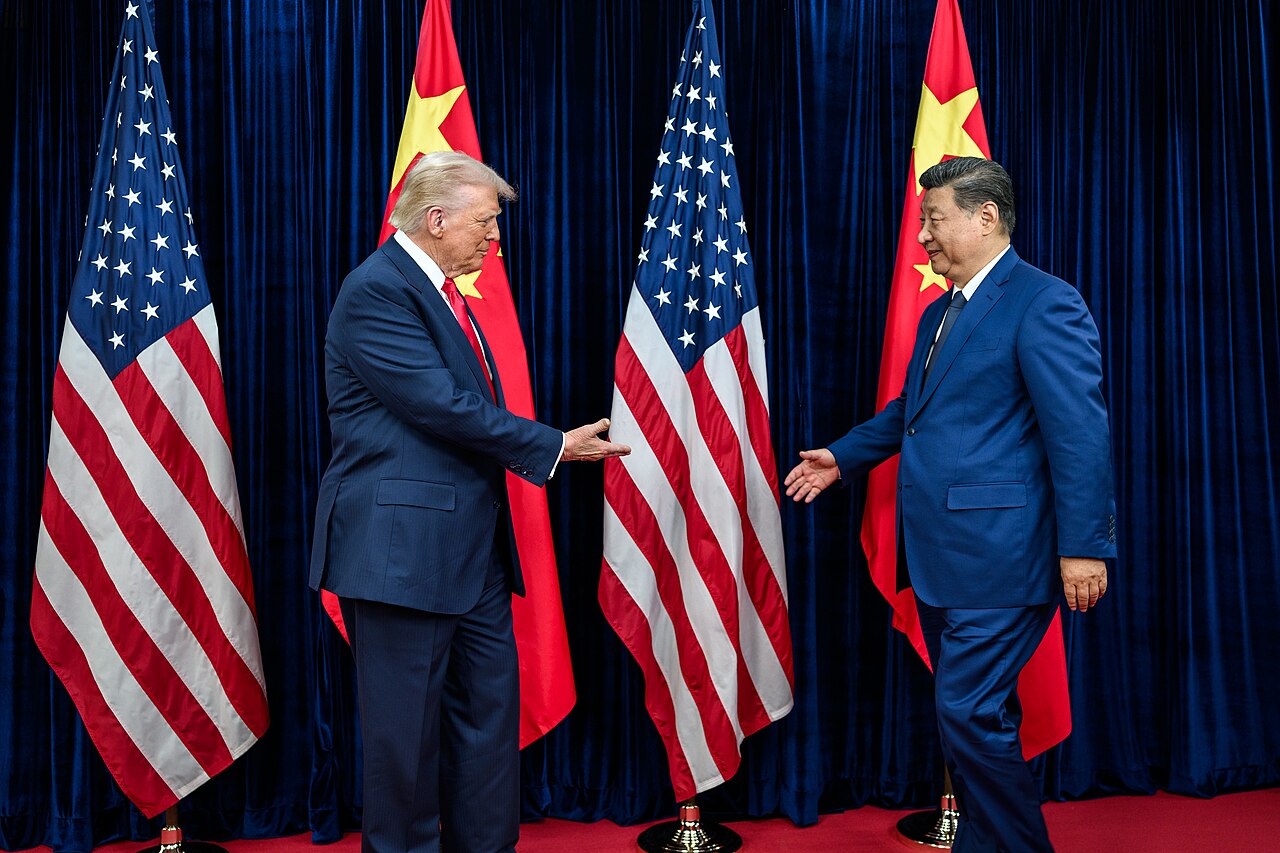
Donald Trump arrived in Beijing on Wednesday for a three-day state visit, his first trip to China since 2017, with significant attention on how bilateral talks with his Chinese counterpart, Xi Jinping, will unfold. The high-level meetings come at a time of heightened global economic and geopolitical uncertainty, with rising inflationary pressures fueled by the ongoing U.S.-Iran conflict in the Middle East adding to market concerns.
The visit has drawn additional attention due to the high-profile corporate executives accompanying the president. Among those in attendance are Tim Cook of Apple, Elon Musk of Tesla, and Jensen Huang of Nvidia adding a strong technology and business dimension to the state visit.
The Trade Agenda Emerges Primary Market Catalyst
Trade negotiations are expected to dominate discussions, with markets closely watching for signs of progress on tariffs, technology restrictions and supply-chain cooperation between the world’s two largest economies. Investors are particularly focused on whether the meetings with Xi could pave the way for easing trade tensions that have weighed on global manufacturing activity and business sentiment in recent years.
Any indication of renewed trade cooperation or sector-specific agreements could boost risk appetite across global equities, especially in technology, semiconductors and industrial stocks. Market participants are also monitoring discussions around export controls, artificial intelligence (AI), electric vehicles (EVs) and access to critical minerals.
It is widely expected that China will press for easing restrictions on advanced semiconductor exports and doing away with measures that keep critical chip-making technology from the Asian nation’s grasp. A positive outcome could help the heavily weighted U.S. AI chip names such as Nvidia and in turn the broader market. On the other hand, the absence of concrete outcomes or signs of renewed friction could add to volatility in financial markets.
The Iran Wildcard: Oil & Energy Markets
Oil futures and energy stocks remain highly sensitive to developments surrounding the Strait of Hormuz, with any signs of de-escalation likely to trigger a pullback in crude prices. A potential Chinese commitment to mediate between the U.S. and Iran could therefore pose downside risk for oil futures by easing concerns over prolonged supply disruptions.
China has strong incentives to support diplomatic efforts, given its heavy reliance on Iranian crude imports and broader dependence on energy flows through Hormuz.
However, market participants also remain cautious about the broader geopolitical implications of any Chinese mediation role. Some investors worry Beijing could attempt to leverage its diplomatic influence in the Iran conflict to extract concessions from Washington on other strategic issues, particularly Taiwan, adding another layer of uncertainty to already fragile global markets.
Any softening on Taiwan would rattle defense stocks and roil Asian equity markets, especially Taiwan, which is home to the world’s largest chip foundry, TSMC.
Investors will be watching not only for concrete policy announcements, but also for the broader tone of engagement between Washington and Beijing. Any signs of cooperation could help stabilize risk sentiment across equities, commodities and currencies, while renewed tensions or strategic disagreements may deepen volatility already fueled by inflation concerns, energy market disruptions and geopolitical uncertainty.
Read Next: IEA Cuts Oil Demand Forecast Further Amid Hormuz Disruption, Warns of Oil Deficit Until Q4


