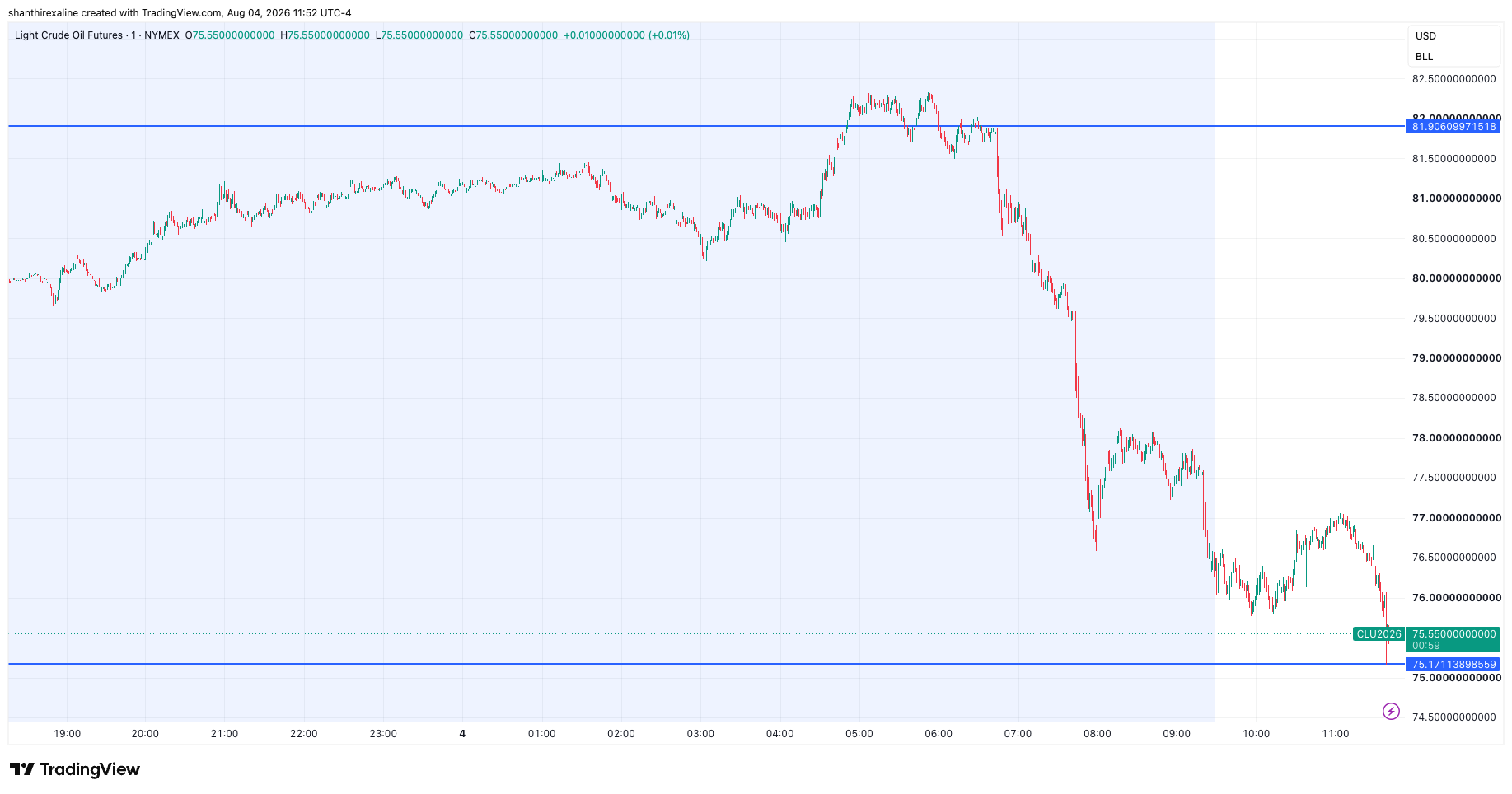
WTI crude oil futures dropped more than 4% Tuesday to roughly $76.60 after having been up as much as 2.5% earlier in the session. Brent, the more internationally-weighted benchmark, fell a more modest 4%, to about $80.50. What flipped the tape wasn't a chart level. It was a named official putting a clock on a deal.
The Move, Mechanically
Treasury Secretary Scott Bessent told CNBC's Squawk Box that the U.S. is in talks with Iran, adding there's a chance a deal to reopen the Strait could come as soon as today or tomorrow. That's a specific claim made by a named cabinet official, on the record, with a same-day-or-next-day timeline and a description of what the deal would contain.
The problem: less than 24 hours earlier, Iran's foreign ministry had gone out of its way to deny almost the identical claim. Spokesperson Esmail Baqaei told reporters Monday that Iran currently has no negotiations with the U.S., and that Tehran's only active talks are with Oman, over a shipping corridor through the strait, and not a U.S.-Iran deal at all.
So the trade Tuesday morning was, in effect, a bet on which government's account was closer to true:
- Washington's version (Bessent): active U.S.-Iran talks, deal possibly within 24–48 hours, freedom of movement for shipping.
- Tehran's version (Baqaei, one day prior): no U.S. talks — only a separate, narrower Oman negotiation over a temporary corridor.
An Al Jazeera report stated that Iran had disagreements with Oman over issues surrounding the reopening of the Hormuz Strait, namely the former’s opposition to having several corridors, and also regarding mine clearance operations and levying maritime service fees.
Oil priced Washington's version. A $6.5 intraday swing in WTI is what that repricing looked like in practice — not technicians' Fibonacci levels doing their work, but a single quote compressing the risk premium the market had built in.
Why the Contradiction Is the Trade, Not the Noise Around It
This conflict has produced a steady drumbeat of "deal is close" claims that didn't hold up. Trump said talks would start Monday; Iran denied it within hours. What's different about Tuesday's move is the specificity of Bessent's claim, which makes it a much easier position to be proven wrong on, fast. Reuters separately reported Tuesday that Iran's version of a deal — the one being negotiated with Oman, not the US — would have Iran retaining control over inbound strait traffic, a materially different arrangement than the "freedom of movement" Bessent described.
That's the actual analytical point for anyone positioning off this: even if both officials are being straight about their own conversations, they may not be describing the same deal. The market just priced in Bessent's version of the outcome. If Tehran contradicts him again, or if Wednesday comes and goes without an announcement, the repricing that happened Tuesday has a short shelf life, and the reversal could be just as fast as the move itself.
The Other Two Threads Still in Play
Two other storylines were also live in this news cycle, and while they didn't drive Tuesday's move, they're the reason any bounce here stays fragile:
A vessel was hit in the Strait of Hormuz near Oman, according to maritime security firm Vanguard, with one crew member reported missing. Vessels on the Oman-hugging corridor traders have treated as the "safe" route have come under attack multiple times since the war began; each incident forces the same reassessment.
Iran escalated its rhetoric toward U.S. forces directly: a top Iranian military adviser warned that U.S. "vessels and forces will face serious risks and casualties" if Washington's naval blockade continues, raising the possibility of a direct US-Iran military exchange.
Technical Levels to Watch for the 'Counter-Move'
Because the steep drop is built on headline confidence rather than physically cleared shipping lanes, technical traders track three key zones to see if the move holds or violently mean-reverts:
- The Breakout Origin Point ($81-$82): The exact level where crude was trading before Bessent's interview aired on CNBC. If crude reclaims this origin zone, it signals that the market views the "24–48 hour deal" claim as invalid, opening the door for a complete retracement back to early-session highs.
- Session Low / Liquidity Target (~$75.60–$76.20): The knee-jerk bottom hit right after the interview. A clean daily close below this zone confirms the geopolitical risk premium is genuinely deflating. A failure to hold below it creates a Bullish Divergence on momentum oscillators (RSI / MACD).
Source: TradingView
The retail crowd split for the past seven days shows 69% of winners lean long, with only 58% of losers being on the long side, according to MarketFramework's Top Traded Contract tool. That means the majority-long crowd is not where most of the losses are concentrated, and the short lean is running counter to broader crowd positioning. This looks like a losing week on a heavily short-biased crude oil position, with performance diverging from where the majority of the crowd is positioned (long). Worth a gut-check on whether the short thesis still holds or if it's time to reassess given the drawdown.
What to Watch Next
- Insurance and war-risk premiums for Hormuz transits — these tend to move ahead of headline diplomacy.
- Actual vessel transit counts vs. stated corridor plans.
- Whether Wednesday actually produces an announcement — if it slips, that's informative on its own.
- Whether Iran's foreign ministry responds directly to Bessent's comments, rather than repeating the "Oman-only" line.


