The first day of the summit between U.S. President Donald Trump and his Chinese counterpart Xi Jinping ended on a cordial note, although areas of friction remained, chief among them the U.S. stance on Taiwan’s independence.
While Xi showed willingness to open up China’s door wider for U.S. businesses, he warned of potential “collision or even clashes” if the U.S. pressed ahead with calls for Taiwan’s independence. While Taiwan claims to be an independent country, China considers the island to be part of its territory under the “One China” principle. In his New Year address earlier this year, Chinese President Xi Jinping reiterated that reunification with Taiwan could not be stopped.
Will China’s increasingly hardline stance on Taiwan, coupled with widening strategic differences with the U.S. over the island, emerge as a major risk for global financial markets?
Taiwan’s Chip Grip
China’s stance comes even as Taiwan, dubbed the “Silicon Island” remains critical to global supply chains, especially in semiconductors. The country’s chip industry, led by foundry Taiwan Semiconductor Manufacturing Company (TSMC), makes up roughly 60%-70% of the global contract foundry market. The country also commands a fair share (about 60%) of the packaging and testing sectors and it has the second largest integrated circuit (IC) design sector, accounting for about 20% of the global market.

Source: Taiwan Ministry of Finance
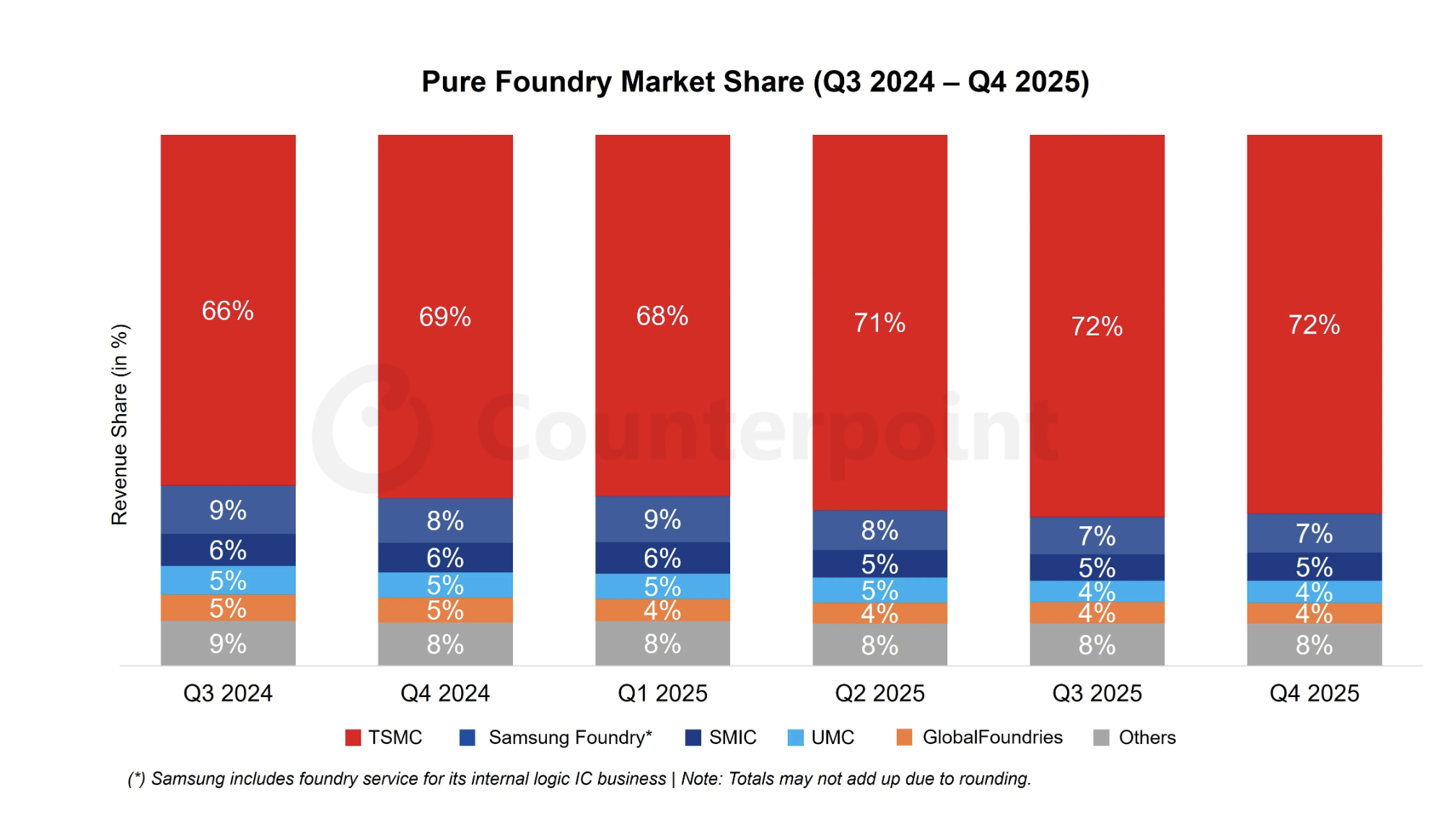
Major economies depend on Taiwan for critical inputs for the tech industry. Advanced semiconductor wafer fabs in Taiwan such as TSMC produce the cutting-edge chips powering global electronics. TSMC’s share was 72% of the total foundry market by the end of 2025, dwarfing competitors like Samsung (about 7%), according to Counterpoint Research. This means roughly 7 out of 10 contract chips (by revenue) are built in Taiwan.
Source: Counterpoint Research
The U.S. alone imported $201.423 billion worth of goods from Taiwan in 2025, according to Census Bureau data. This was primarily responsible for Taiwan’s $146.76 billion trade surplus with the U.S.
Taiwan holds a near-total monopoly on the manufacturing of sub-5 nanometer (nm) semiconductor nodes, producing nearly 100% of the capacity essential for advanced generative AI and machine learning technologies. Over 30% of U.S. semiconductor imports (by value) originate in Taiwan , and sectors like defense, telecoms and computing have virtually no immediate alternate source for the highest-end chips.
Taiwan Supply — a Threat to AI-Driven Market Rally
Any shock to the output from Taiwan is likely to immediately tighten supply, pushing prices sharply higher. Taiwanese chipmakers predominantly run just-in-time production for most customers, leaving them with very little inventory.
In a worst-case scenario, when supply is disrupted, server CPUs to auto microcontrollers will all see rapid price hikes, potentially culminating into a grave fundamental challenge for tech companies.
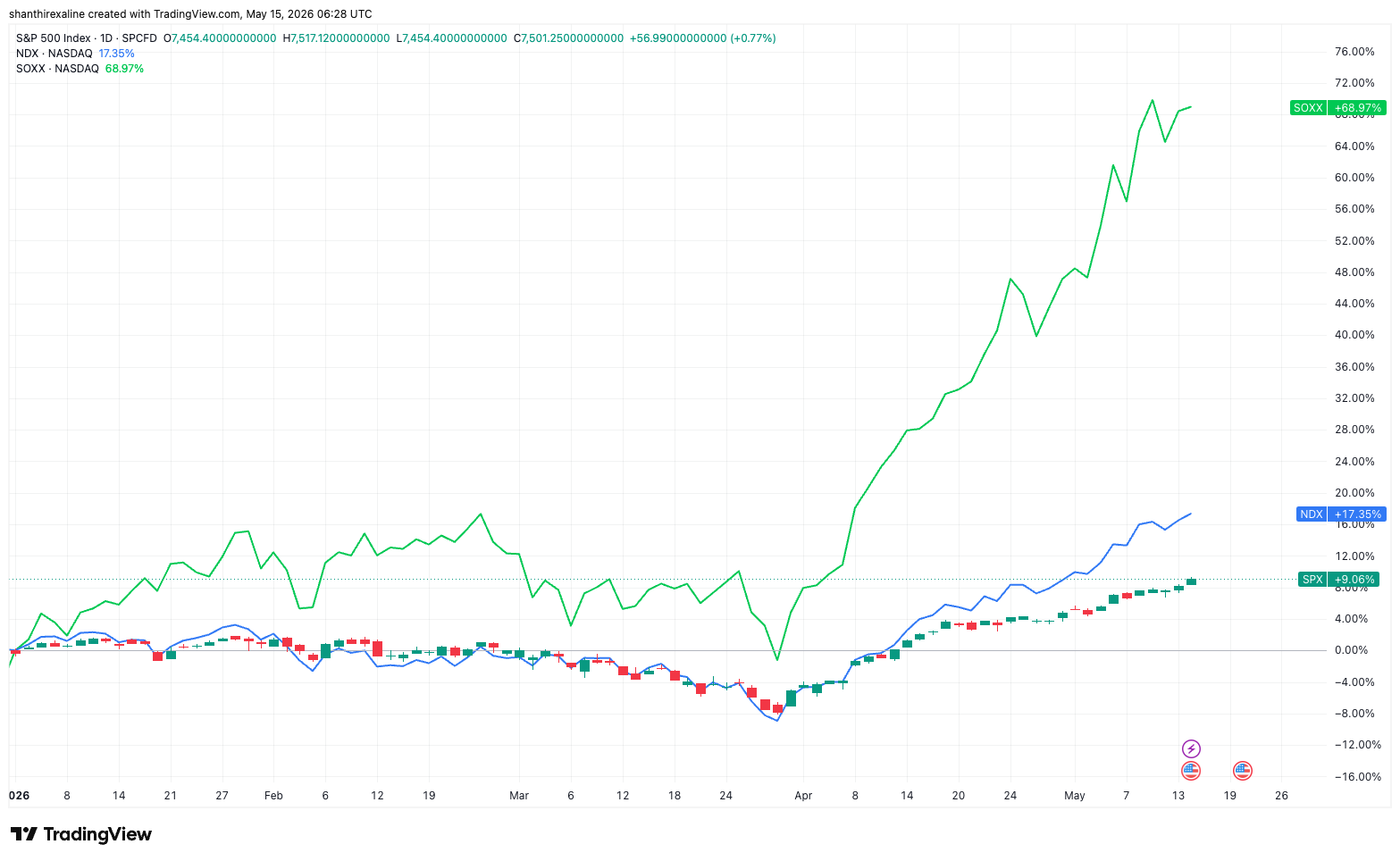
The record rally across markets such as the U.S., Taiwan, and South Korea has been largely driven by the AI boom. The S&P 500, a measure of broader U.S. stock market performance, ended at a fresh high of 7,501.24 on Thursday, with both Nasdaq Composite and Nasdaq 100 indices also setting fresh peaks.
Semiconductor stocks contributed roughly 70% of the S&P 500’s $5.1 trillion market-cap increase in 2026, according to Reuters analysis.
S&P 500 Vs. Nasdaq 100 Vs Philadelphia Semiconductor Index (YTD Performance)
Source: TradingView
The Taiwanese bourse is now the world’s sixth largest by market capitalization , thanks to the country’s tech dominance — a commendable feat for a country with roughly 36,000 square kilometers, placing it around 137th in the world by area.
Chip Price Shock Could Add to Global Inflation Risks
Higher semiconductor prices, critical to sustaining the AI revolution, are also seen weakening broader macroeconomic fundamentals. Advanced chips are now essential for everything from AI data centers and cloud computing to consumer electronics and defense systems, making semiconductors increasingly central to the global economy.
At a time when the world is already grappling with the inflationary impact of elevated energy prices stemming from geopolitical tensions in the Middle East, any sharp increase in chip prices could add another layer of cost pressure. Rising semiconductor costs would likely feed into higher prices for electronics, automobiles, industrial equipment, and AI infrastructure, potentially worsening existing inflation risks and complicating the path for central banks seeking to ease monetary policy.
With AI-driven semiconductor stocks accounting for an outsized share of recent global equity gains, any escalation in tensions over Taiwan could quickly evolve from a geopolitical flashpoint into a major market risk. For investors, the issue is no longer merely political as it sits at the heart of the global technology supply chain and the sustainability of the AI-fueled market rally.
Read Next: South Korea’s Export Surge Extends in April as AI Chip Boom Powers Trade Growth Despite Energy Risks


