Crude oil is falling. Diesel isn't following. That gap, not the crude price itself, is the real story in energy markets this week, and it is being driven by a rare convergence of tight refining capacity, a looming Russian export deadline, and a hurricane season that's arriving right as the system has zero spare room to absorb a shock.
Crude oil traded in the New York session on Tuesday at sub-$80-a-barrel level, down more than 4%. MarketFramework's Top Traded Contracts tool showed retail traders remained broadly neutral on WTI crude futures (CL) over the past seven days, indicating neither bulls nor bears held a decisive edge in positioning. The neutral positioning suggests retail traders are waiting for fresh catalysts such as inventory data, geopolitical developments or macroeconomic news, before taking a stronger directional view.
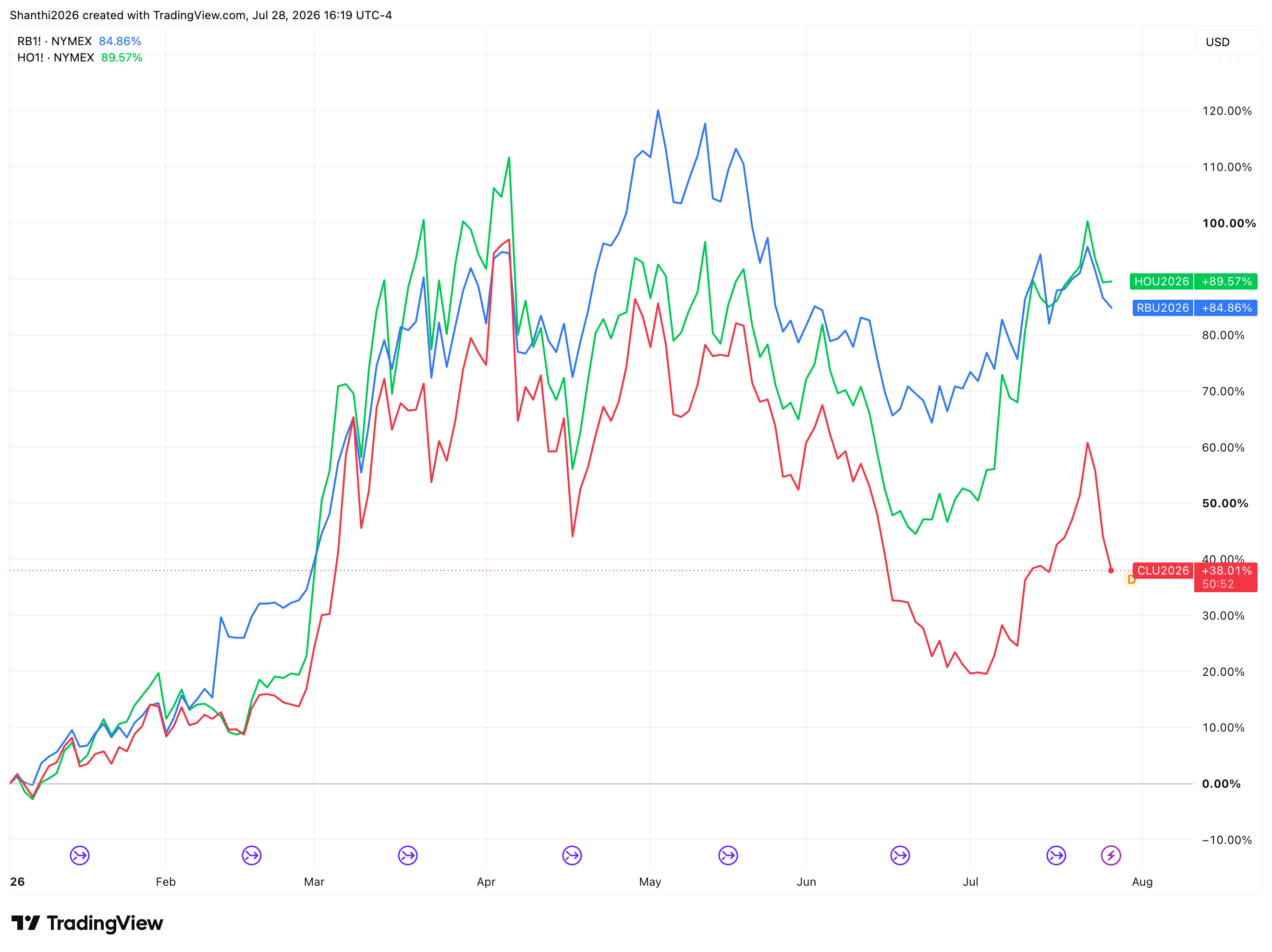
The chart shows that gasoline (RB, +84.9%) and ULSD/diesel (HO, +89.6%) have significantly outperformed WTI crude (CL, +38.0%) year-to-date. This divergence suggests refining margins remain robust, with demand for refined products and tighter supply supporting gasoline and diesel prices even as crude oil has lagged.
Source: TradingView
The Diesel-Crude Disconnect, By the Numbers
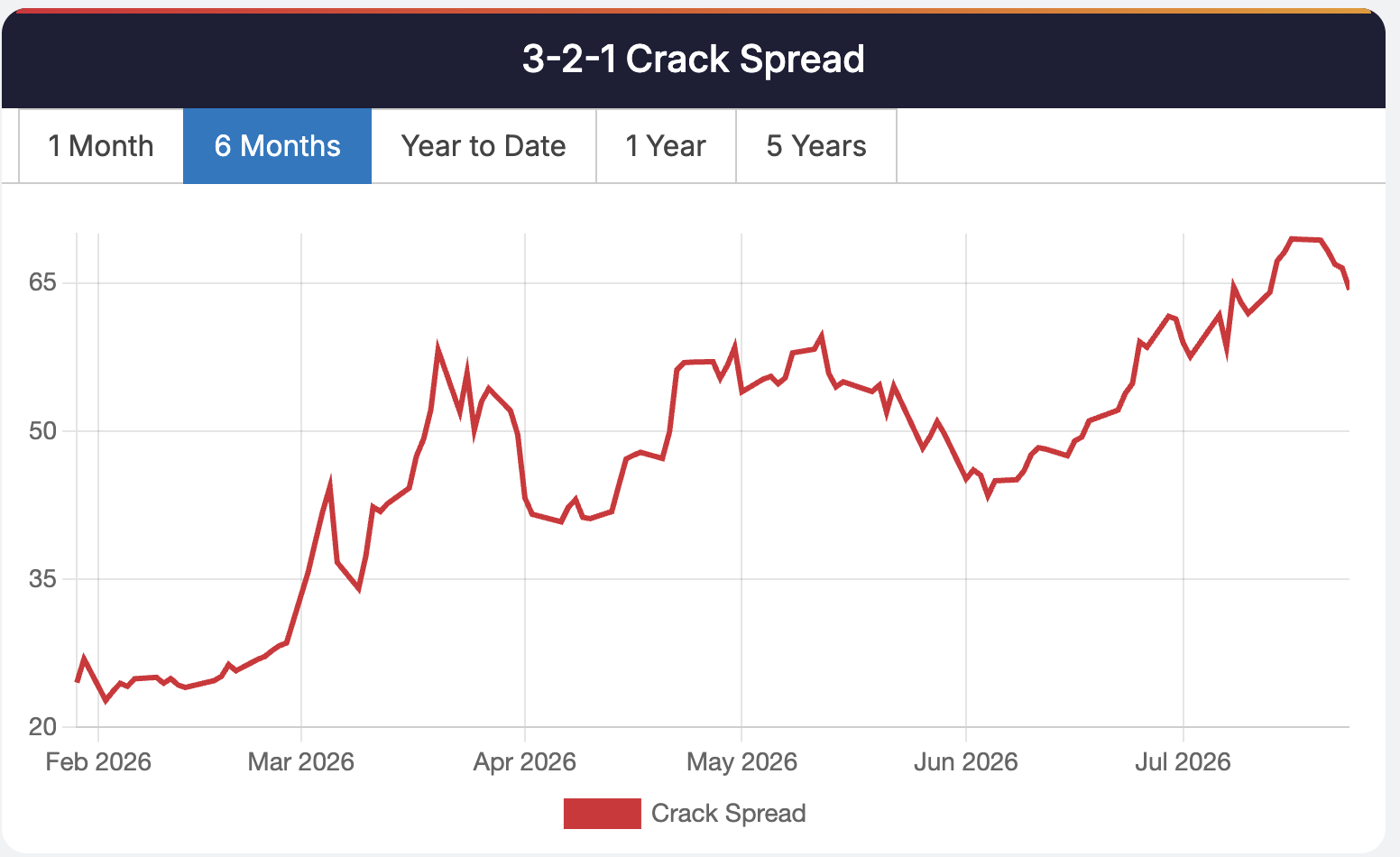
The scale of the divergence is stark. Product cracks, especially diesel, have been rallying much faster than flat crude, pointing to tight refinery output rather than a shortage of crude barrels. The 3:2:1 crack spread, the standard measure of refining profitability, tells the story clearly. It has been running at about 70% of the value of a barrel of crude in recent days, up from about 45% at the start of June and just 27% when 2026 began.
Source: RBN Energy
Put simply, refiners are pocketing a far larger share of every barrel processed than they were seven months ago, and that's happening even as crude prices have fallen in recent weeks while diesel and gasoline prices have not.
Why Refineries Can't Just Make More Diesel
The obvious question is why refiners aren't simply ramping output to capture the wider margin. The answer is that they largely can't; capacity is already maxed out.
Refiners nationwide have been running at or above 95% utilization, widely regarded as full capacity, for almost two months. According to the latest weekly Petroleum Status report, plants ran at 96.1% utilization in the week ending July 17, producing roughly 5.3 million barrels per day of distillate fuel.
Running at these rates isn't sustainable indefinitely. Churning along at maximum output increases wear and tear on the units that heat, pressurize, and crack crude oil into finished fuel — and it means there's essentially no buffer capacity left if something goes wrong.
Friday's Russia Deadline Adds a Supply Wildcard
Compounding the tightness is a geopolitical deadline landing this week: Russia's temporary export restrictions on diesel are set to lapse Friday. The ban had been one of the factors keeping a lid on global diesel supply even as crude itself softened. Its expiration is a genuine two-way risk. A return of Russian barrels to the export market could ease some of the tightness, while any delay, reversal, or disruption to that flow would tighten the market further at the worst possible time, given how little slack refiners currently have to compensate.
Hurricane Season Arrives With No Room for Error
The timing compounds the risk. The Gulf Coast accounts for the majority of U.S. refining capacity, and a hurricane or major outage there can force fuel production to a halt just as the Atlantic season enters its most active stretch. The most severe hurricanes typically form in August and early September — meaning the riskiest weeks of the season are essentially starting now.
History shows what that risk looks like in practice: when Hurricane Beryl struck the Texas coast in July 2024, Gulf Coast refiners were forced to cut crude processing by more than half a million barrels a day, with regional fuelmaking declining for four consecutive weeks. Two months later, Hurricane Francine knocked out production for another four weeks.
The difference this year is that refiners have no cushion. A storm hitting a system already running near 100% doesn't just slow output. It removes capacity the market is already straining without.
What This Means Going Forward
Three dynamics are now stacked on top of each other: a refining system with essentially no spare capacity, a Russian supply deadline that could move either direction, and a hurricane season entering its most dangerous window. Each on its own would be worth watching. Together, they explain why diesel has stayed elevated even as crude has fallen — and why the crack spread, already at multi-decade highs, has more room to widen than to normalize in the near term.
What to watch next: Friday's Russia export deadline for signs of returning supply; weekly EIA refinery utilization and distillate inventory data for signs of stress; and NOAA/NHC storm tracking for any Gulf Coast formation through the peak of hurricane season in August and September.