
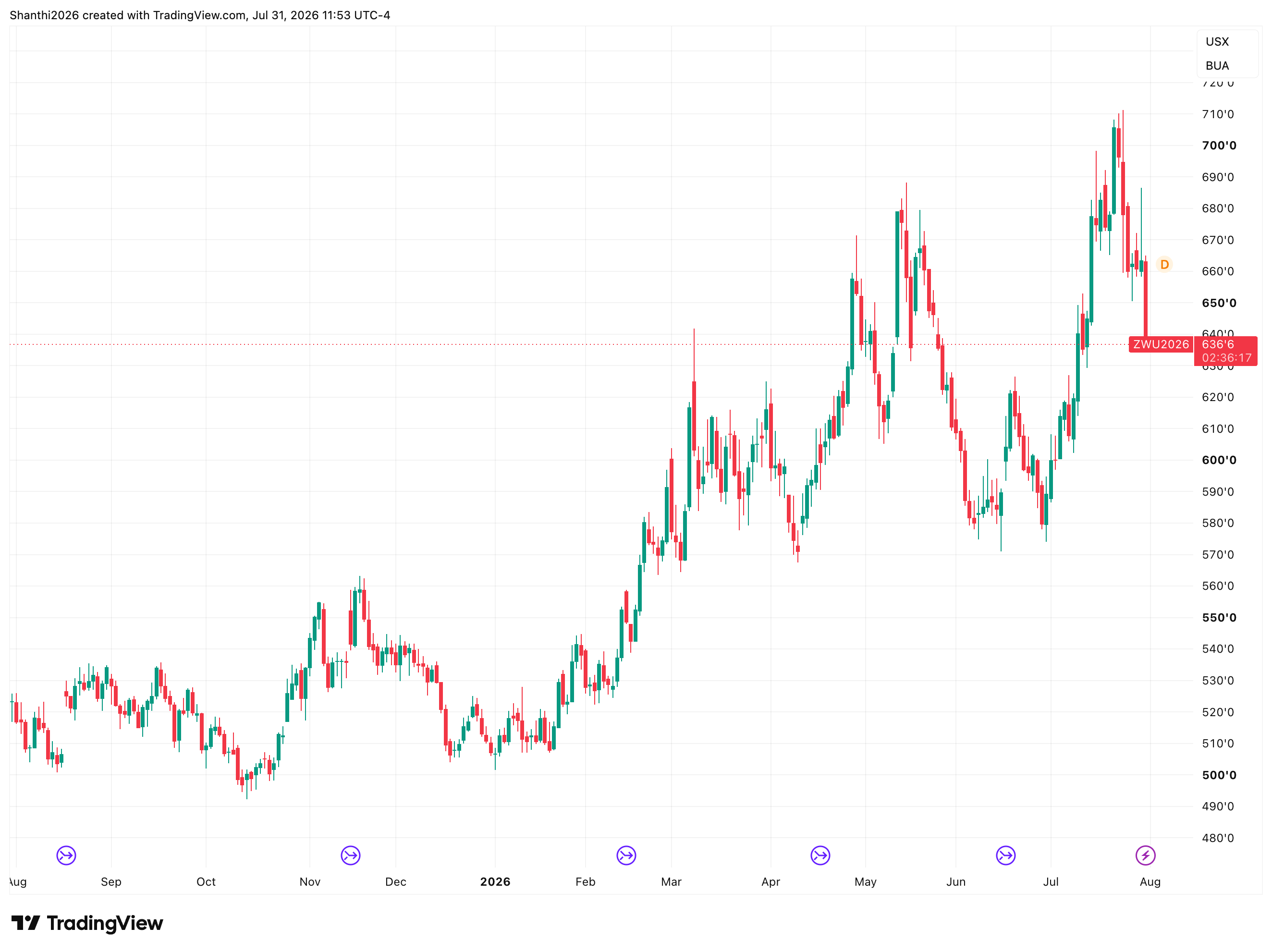
Wheat futures sold off sharply Friday morning, with the August CBOT contract falling about 4%, to 636.50 cents. The drop marks a sharp reversal from the war-driven rally that carried wheat past the $7 a bushel earlier this month, and it came alongside broader weakness across the grain complex, with corn, soybean meal, soybean oil, and canola all trading lower in the same session.
From Rally to Retreat
Wheat's run-up over the past several weeks has been almost entirely a Black Sea story. Escalating attacks between Russia and Ukraine on ports, terminals, and vessels have repeatedly disrupted shipping through the Sea of Azov and the Kerch Strait, prompting consultancy firm SovEcon to trim its outlook for Russian wheat exports and Rusagrotrans to lower its estimate for July shipments. That steady drumbeat of supply-disruption headlines pushed CBOT wheat to its highest level in more than two years.
Source: TradingView
Friday's pullback doesn't reflect any resolution to that conflict — shipping through both the Ukrainian and Russian sides of the Black Sea remains severely constrained. Instead, it looks like a classic unwind: after weeks of geopolitical risk being priced into the market at an accelerating pace, traders are booking profits and paring back the premium, even without a clear catalyst pointing to de-escalation.
A Broad Grain Complex Pullback, Not Just Wheat
Friday's session wasn't isolated to wheat. Corn fell more than a percent, and soybean meal and soybean oil both declined. Only oats and soybeans traded higher, and soybeans were essentially flat. That pattern — a broad, same-direction move across unrelated grains and oilseeds — points to macro and cross-commodity positioning playing a role alongside any wheat-specific news.
Notably, this pullback is happening even as crude oil stays elevated, up more than 20% on the month on Middle East supply-disruption fears. That decoupling is itself informative: it suggests today's grain weakness isn't being pulled down by a broader commodities sell-off, but instead reflects profit-taking and position-squaring specific to the war-premium that had built up in wheat and its correlated grains, alongside routine cross-commodity fund flows that don't always move energy and agriculture in lockstep.
The Underlying Black Sea Risk Hasn't Gone Away
Despite Friday's drop, the structural disruption to Black Sea grain flows remains fully in place. Shipowners have largely paused calls at Ukrainian ports since late July after a wave of missile and drone strikes on commercial vessels, and Russia's own Azov Sea export channel, which normally carries roughly a quarter of the country's grain exports, has been closed since earlier in the month following Ukrainian drone attacks. Diplomatic efforts have so far produced statements without concrete results: an emergency United Nations Security Council session called by Kyiv this week ended without any binding action, and Russia signaled its operations would continue.
That combination — a real, unresolved supply shock sitting underneath a price that's proven capable of swinging several percent in a single session — is the core dynamic defining this market. Friday's pullback pares back some of the risk premium built into wheat prices, but it doesn't remove the underlying vulnerability that could send prices sharply higher again on the next escalation headline.
Seasonal Pressure Adds to the Pullback
Timing is also working against wheat bulls right now. Northern Hemisphere wheat prices historically bottom in June and July, when harvest activity peaks and physical supply is at its most abundant point in the calendar. That seasonal dynamic runs counter to the war-risk premium that's been propping prices up, and it may be amplifying Friday's decline as harvest-driven selling adds to the broader unwind.
The Bottom Line for Traders
Friday's 4% drop reflects a market recalibrating an aggressive risk premium rather than responding to any actual improvement in Black Sea shipping conditions. The core supply disruption stemming from closed export channels on both sides of the conflict, no diplomatic resolution in sight, and a UN response so far limited to statements remains intact. Wheat's next major move will likely hinge on whether the Black Sea conflict escalates further or genuinely shows signs of stabilizing. Either of which could reverse today's pullback just as quickly as it arrived.