Iran has asked Yemen's Houthi movement to stand ready to close the Bab el-Mandeb strait if the United States strikes Iranian power infrastructure, Reuters reported Thursday, citing two senior Iranian sources and a regional source.
The request was conveyed to the group only recently and had not been previously reported. Oil's response, so far, is a shrug: WTI is trading just around $79, down 1.4% on the session.
That calm deserves scrutiny, because this is not another round of rhetoric. It is a targeting decision aimed at the one thing still holding the oil market together.
Why This Threat Is Different
The operational detail in the Reuters reporting is what elevates it.
A source close to the Houthis said preparations are complete, missiles and drones are deployed near the strait in the highlands overlooking Hodeidah and the Gulf of Aden, and the group is awaiting the order to begin. Critically, IRGC representatives already inside Yemen will control the timing.
This is a loaded weapon with Tehran's finger on the trigger, conditioned on a specific U.S. action: strikes on Iran's power plants and civilian infrastructure, which President Trump has repeatedly threatened.
The escalation ladder around it is climbing fast. Iran struck U.S. bases in Kuwait, Bahrain and Jordan in retaliation for earlier American strikes. The Houthis fired missiles at Saudi airports after accusing Riyadh of bombing Sanaa's airport — breaking a truce that had held for four years.
Tehran's emergency command warned that infrastructure attacks would trigger devastating region-wide retaliation.
The Yanbu Problem
Here is the piece the $80 tape appears to be ignoring. With Hormuz transits running at less than half their pre-war pace, the market's functional workaround has been Saudi Arabia's East-West pipeline: roughly 7 million barrels per day flowing to the Red Sea port of Yanbu, per Kpler data — capacity Riyadh restored to pre-war levels only days ago after the line itself was hit by suspected Iranian missiles and drones.
Every one of those barrels exits through the Red Sea and the Bab el-Mandeb.
Close the second strait, and the two main export routes out of the Middle East are disrupted simultaneously. Verisk Maplecroft's Torbjorn Solvedt put the exposure plainly: fighting spilling into Red Sea export infrastructure would threaten "the only major alternative route" for the region's oil.
A Houthi political bureau figure went further, warning that a joint closure of both straits would send prices toward $200. Analyst tail-risk estimates need not go that far to matter: MST Marquee already flagged a $100 retest if current hostilities persist, before the Red Sea variable was on the table and the strategic-reserve cushion that absorbed the March–April shock has been substantially depleted.
Why Crude Isn't Moving — Yet
Three explanations for the disconnect, in rising order of comfort.
First, conditionality: the trigger is a US infrastructure strike that has not happened, and the market has learned this cycle that Trump-era escalations can reverse inside 48 hours — the 20% Hormuz toll lasted barely two days.
Second, diplomacy: Trump said Wednesday that Tehran has signalled willingness to negotiate.
Third, fatigue: after five months of headlines, the marginal threat buys less premium each time. The first two are rational. The third is how markets get caught.
Scenario Matrix — Catalyst: US Infrastructure-Strike Decision / IRGC Order, Next 48–72 Hours
| Scenario | Trigger - Next 48-72 Hours | Oil Reaction |
|---|---|---|
| Bull | US strikes Iranian power infrastructure; IRGC gives the order; first Houthi attack on Red Sea shipping or Yanbu-bound tankers | Both export arteries disrupted at once — the scenario analysts tie to a violent repricing; $100 retest fast, gap risk beyond on confirmed strikes |
| Base | Threat stays rhetorical; strikes remain confined to Iran proper; Houthi order withheld while back-channel talks resume | Oil holds the $76–82 consolidation; geopolitical premium builds slowly via the curve rather than spot; fade rallies only while triggers stay unconfirmed |
| Bear | Iran's negotiation signal converts into scheduled talks; blockade posture eases; Saudi–Houthi truce restored | Premium unwinds toward pre-escalation levels; $76 support tests first, June's low-$70s zone opens on a formal de-escalation framework |
Technical Outlook - Oil Prices
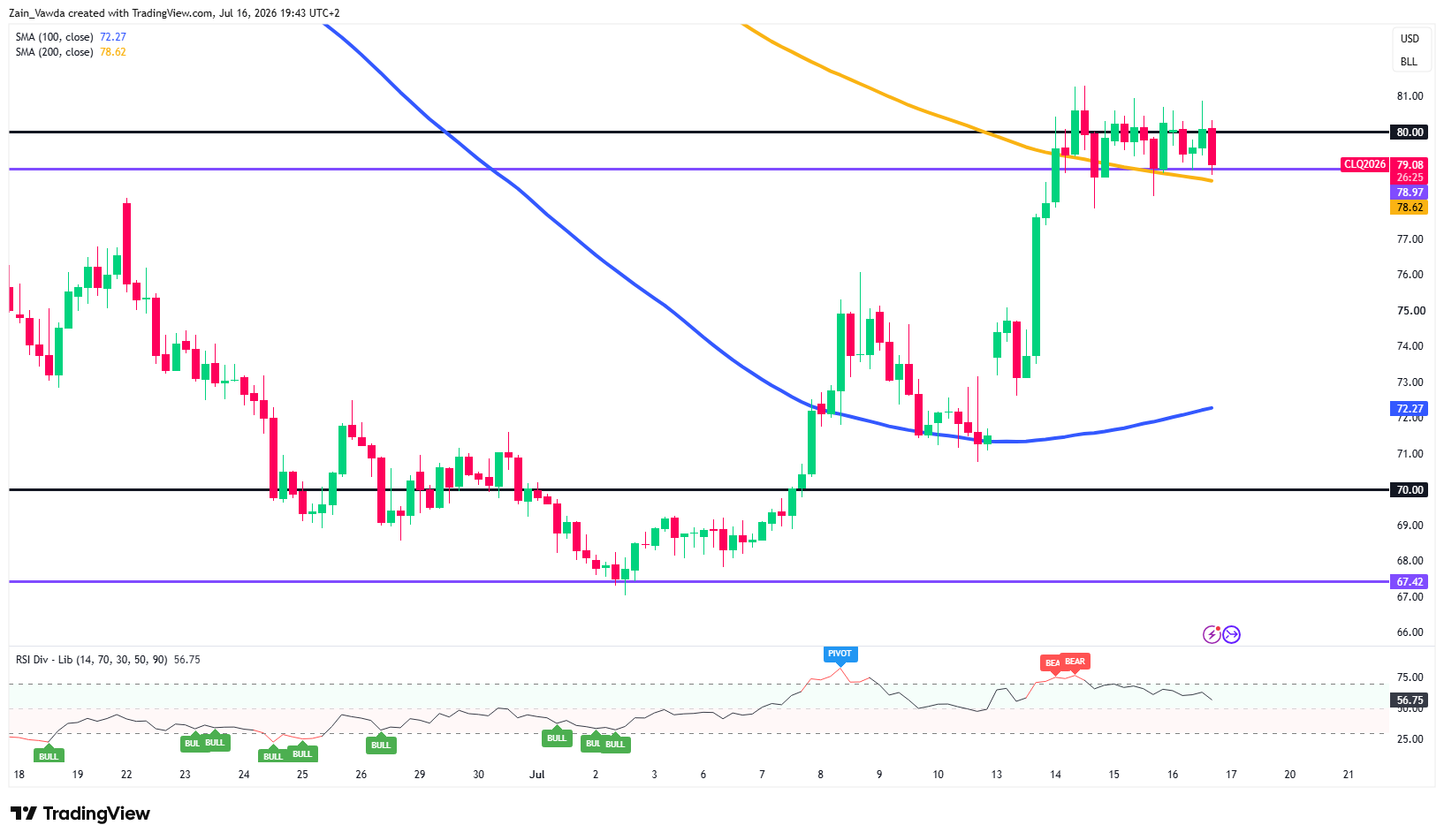
Oil trades at 79.08 after a powerful rally off the July 2 base near 67.42, reclaiming both the 100-MA (72.27) and 200-MA (78.62) along the way.
Oil Futures Four-Hour Chart, July 16, 2026
Source: TradingView
Price has spent the past three sessions consolidating between the psychological $80.00 ceiling and support at $78.97, with the flattening 200-SMA now acting as a dynamic floor.
RSI at 56.75 has cooled from overbought after printing bearish divergence at the highs — momentum is fading even as price holds elevated. A 4H close above 80.00 targets 81.00 and fresh extension; rejection here risks a pullback toward 78.62, then 77.00. Bias stays constructively bullish above the 200-SMA, but the divergence warrants tighter risk.
Stop second-guessing your setups. Use the Trade Validator to confirm your signals, look at retail trader positioning, filter out low-quality trades, and optimize your entries before you risk capital.
The Bottom Line
Crude at $80 with both of the Middle East's export arteries under credible threat is either a market correctly discounting a bluff or the most underpriced tail on the board. The honest answer is that nobody — including Tehran — knows which yet, because the trigger sits in Washington.
What traders can know is where the asymmetry lies, and it is not in fading this.


