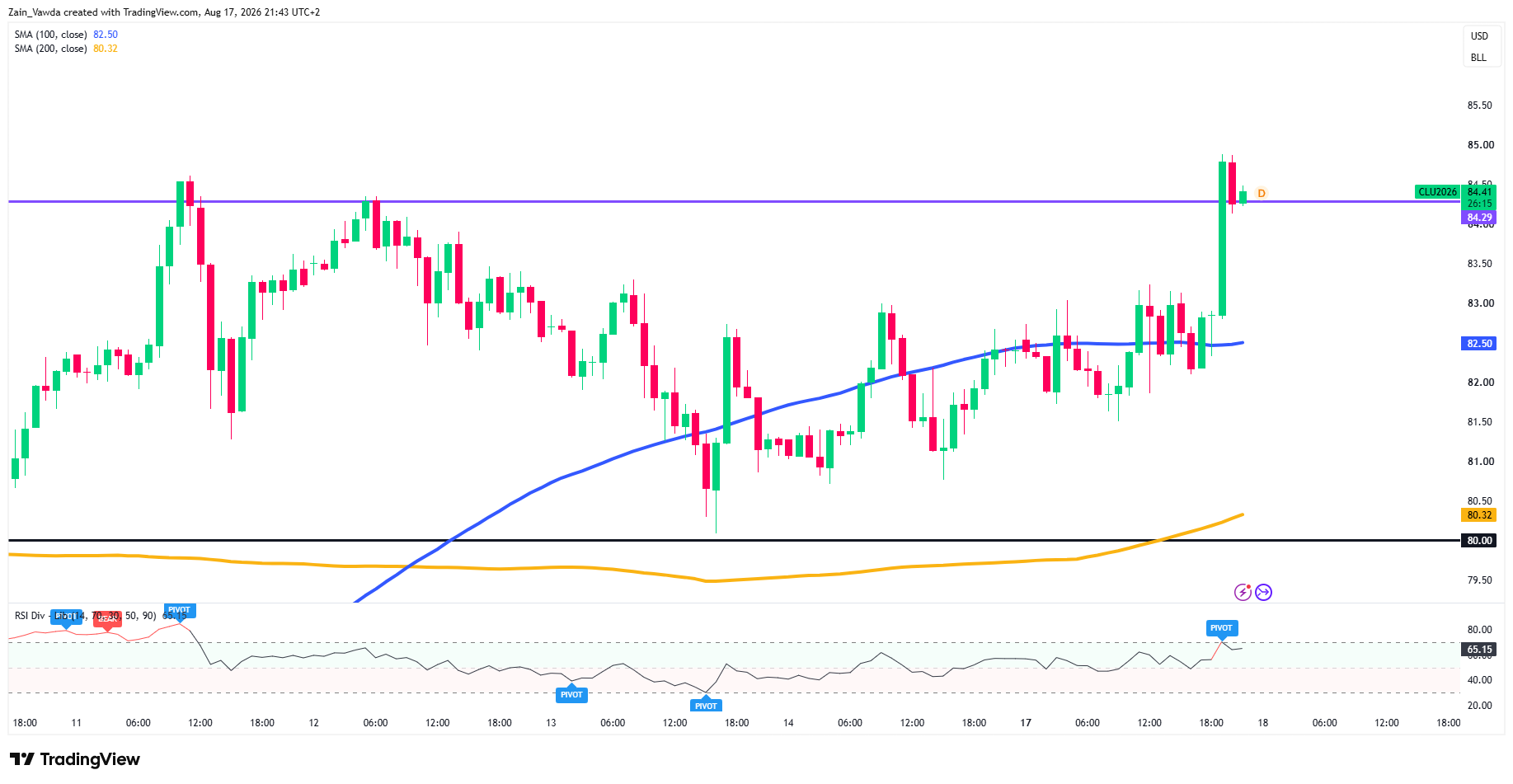
Oil (CL) trades around $84 both gained more than 5% last week. The move isn’t about demand, it is about the strait and that is exactly what makes crude the Federal Reserve’s problem heading into an intriguing Wednesday.
Oil (CL) One-Hour Chart, August 17, 2026
Source: TradingView
Why Crude is the Fed’s Problem
The chain is simple, and every futures trader should hold it in their head this week. Energy feeds straight into headline inflation. Higher fuel costs lift the public’s inflation expectations.
Those expectations are a big reason the long end of the bond market will not rally: the 30-year Treasury yield sits near its highest level since 2007 even as the market has cut the odds of a September rate hike to about 30%, down from roughly 65% just two weeks ago.
In short, the hike debate has lost momentum and rising oil is the one thing that can bring it back. A committee that already saw three officials vote for a hike in July does not want crude breaking higher into the Jackson Hole meeting. This is why it is a macro story, not a chart.
The Floor: Geopolitics
The bid under oil is political. Speaking on Friday in New York, President Trump said that once Iran is defeated he will declare the Strait of Hormuz a territory of the United States, and suggested the U.S. naval blockade already makes it one.
The June memorandum meant to reopen the strait expired on Sunday with no extension sought, and Iran says it will keep enforcing its side until Washington lifts its blockade of Iranian ports.
Traffic has slowed to a trickle, five vessels crossed on Saturday and none on Sunday, against 31 the weekend before. And the American cushion is thinning fast: Strategic Petroleum Reserve stocks fell again last week to about 293.4 million barrels, the lowest since 1982.
The Other Side: The Overhang
It is not one-way traffic. The bearish case is just as real. The EIA’s latest outlook sees Brent easing toward $78 by the fourth quarter and $69 in 2027 as the strait slowly normalises and shut-in barrels restart.
U.S. commercial crude stockpiles posted a surprise build of about 17.4 million barrels in early August, the largest since January 2023. OPEC+ has been unwinding its cuts, and extra Middle Eastern barrels are being routed toward the United States. So the supply-and-demand picture pulls hard against the war premium. That tension is the entire trade.
Wednesday Could be the Pivot This Week
Wednesday stacks both catalysts into one afternoon. EIA inventories land at 10:30 a.m.ET.
Watch whether commercial crude builds again, a bearish tell, even as the SPR keeps draining. Then the Fed minutes hit at 2:00 p.m. If crude is firm and the minutes sound worried about inflation, that is the combination that revives the hike.
If inventories build and crude softens, the pressure comes off. Two prints, one afternoon.
Scenario Matrix — Into Wednesday (EIA 10:30 + Fed Minutes 2:00)
| Scenario | Trigger | Oil (CL) Path & Fed Read-Through |
|---|---|---|
| Bull | Fresh Hormuz escalation or tanker damage, plus minutes that read hawkish on inflation. | CL pushes toward $88–90+ (banks flag $120 if the blockade drags on). The September hike is back on the table. |
| Base | No new shock; inventories mixed; minutes add nothing new. | CL chops in the ~$80–85 zone; hike odds stay near 30% and the pause consensus holds. |
| Bear | A de-escalation headline, or a large commercial build, plus soft-sounding minutes. | CL slips toward the high-$70s and the EIA’s path; the inflation-tail fear fades and the pause case firms. |
Trader Positioning
On a two-catalyst day the losing pattern is taking a directional crude position before 10:30 and holding it blind through 2:00.
Profitable traders treat Wednesday as two separate events: they let the inventory number print, size down into the minutes, and trade the reaction with a defined stop rather than carrying a full position across both.
In a headline-driven tape, the gap is the account-killer. Trade the reaction, not the forecast.


